


The higher education news didn’t exactly focus on open inquiry this week. A shocking and hotly contested allegation of sexual assault at Cornell, a $3 billion gift to Carnegie Mellon, and Senate passage of a college sports overhaul were all in the headlines. On more academic matters, it was a week of questions about dialogue, diversity, and the disciplines.
Check out the top stories we’re following this week at HxA.
Is the Civil Discourse Movement a Right-Wing Plot?
If its job ads are to be believed, the storied American Association of University Professors now aims to “transform… into an organized, fighting union.” That’s consistent with its recent political endorsement and this summer’s leaked recording of Prof. Isaac Kamola, director of the AAUP’s Center for the Defense of Academic Freedom, planning to target university civics centers with “a robust research project on these right-wing centers and individuals—like, naming and shaming and discrediting and undermining the legitimacy…. I would love to strategically map who these f---ers are, and figure out what the weaknesses are, and design a research agenda that just goes through them and tries to knock them out.”
The Uncivil Collective, a group of scholars whose leadership includes Kamola and other prominent AAUP members, seems to be taking a similar approach. This week, the group published a dubious dossier about a long list of groups promoting dialogue and pluralism on campus — a movement Uncivil says is driven by a conservative, pro-Israel agenda. This time around, Heterodox Academy was among the “f---ers” in question, although the Uncivil folks were, ironically, more polite in their choice of words.
Inside Higher Ed published a roundup of responses, including Arthur Vining Davis Foundations president Michael Murray pointing out Uncivil’s flawed methods. Disagree Wisely co-founder (and HxA fellow) Simon Cullen says that “Uncivil uses many of the habits of argument that Disagree Wisely helps students learn to avoid: guilt by association, circumstantial ad hominem, and unsupported insinuations about people’s motives.”
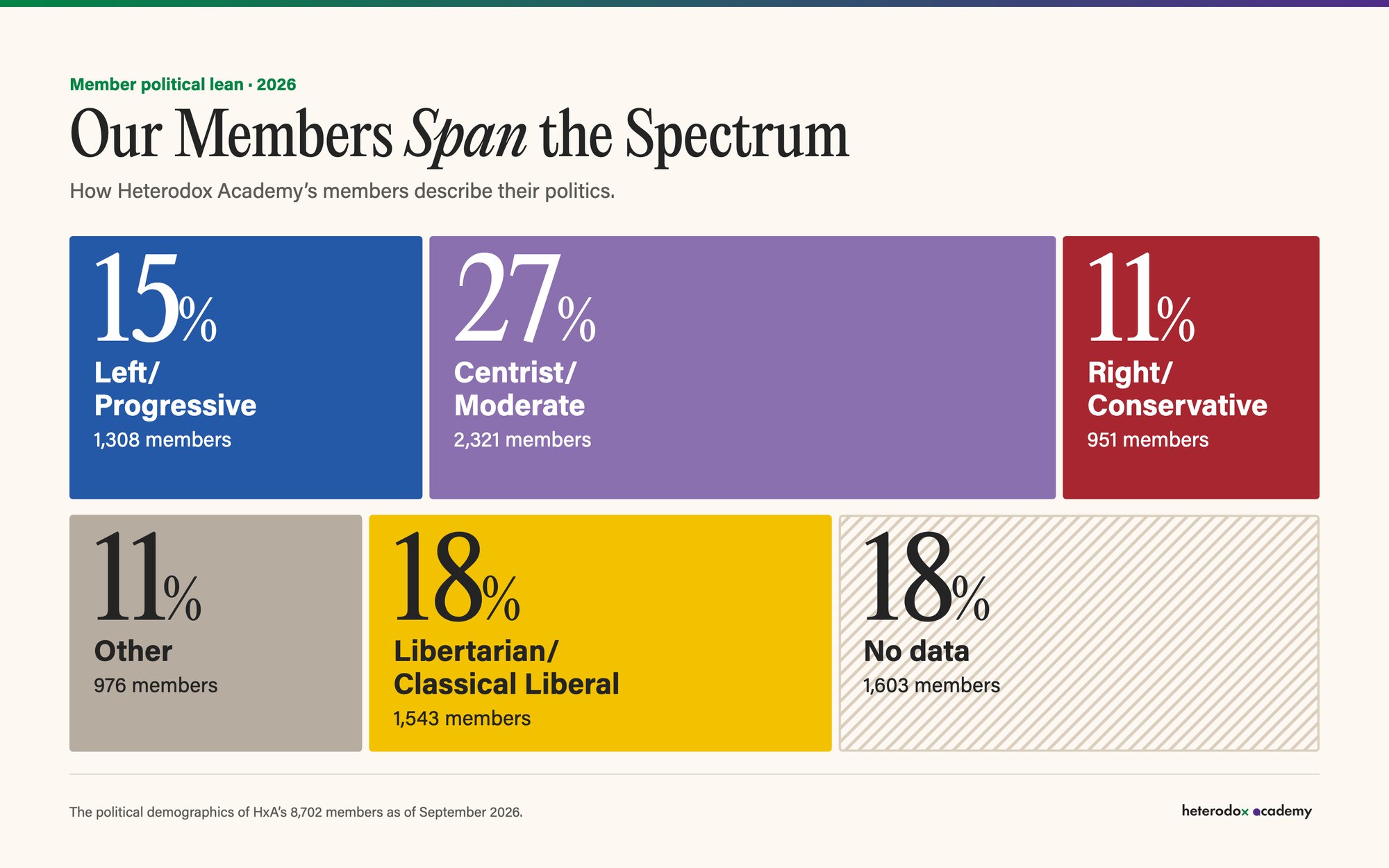
As for HxA, John Tomasi clarified that our members are a politically diverse bunch, and a plurality are self-described moderates or centrists (see the chart). Compared to the professoriate, it’s true, our members are on average more conservative or libertarian. Compared to the American public, they are less likely to call themselves conservative or progressive.
On issues of Israel and Palestine, longtime members know HxA has done research and analysis; hosted discussions, panels, workshops, and podcasts; opposed academic boycotts; opposed physical violence and antisemitism; and regularly spoken up for pro-Palestinian expression and academic freedom.
We think that approach is principled, not partisan. But if it makes us part of a pluralistic conspiracy with the likes of FIRE and BridgeUSA, we are proud to conspire.
Uncivil does make one good point: pluralistic rhetoric can be misused to stifle discussion if we aren’t careful. As I have argued, if the toughest issues are taken off the table by well-meaning moderators, dialogue programs will fail to prepare students for real democracy. And as Tomasi argued last year, dialogue is no substitute for a real variety of viewpoints on campus in the first place
Structural Explanations for Thee, Not Me
Speaking of viewpoint diversity, sociologist John M. Kainer has a terrific essay with an interesting observation about his field:
If you want to send a group of sociologists into an uproar, tell them a group disparity is the result of individual choice. Take your pick of groups and issues. Try telling a room full of sociologists that women are underrepresented in STEM because they prefer people to ideas, or that intergenerational poverty persists because the poor make bad decisions with money.
But when conservatives are outnumbered 27:1 in their field, Kainer says, sociologists claim it’s because the conservatives lacked merit or just chose differently. No structural forces to see here, folks. Move along.
Those of us who see political monocultures as a problem for social research might chuckle at such inconsistencies. But that’s too easy. Inconsistency is everywhere, and if we can fault the “other side” for violating our principles or their own principles, we will never be wrong. Meanwhile, they will find chuckles of their own.
Are We the Identitarians?
For instance, isn’t it equally odd for critics of the excesses of DEI to turn around and advocate for a different type of diversity and inclusion? What is this, people ask HxA, the new affirmative action?
Those who say that usually support affirmative action, but it doesn’t matter. To get beyond finger-pointing and make any progress, we have to get into specific proposals.
HxA has never advocated for quotas or hiring preferences based on political identity. We want to strengthen research and build a university the world has never seen, using the lessons of past diversity efforts to enhance knowledge production while preserving the universalism and individualism at the heart of science and scholarship.
We think universities can pursue excellence and protect academic freedom while diversifying the ideas they teach, the questions they ask, and the explanations they test. For starters, institutions can take the steps listed in our Open Inquiry U reform agenda: broadening narrow curricula, job postings, and research agendas; removing ideological litmus tests, both formal and informal; and adding incentives for pluralistic approaches.
Interpreting the Interpretive Fields
Even that is not specific enough, though. Close studies of individual academic disciplines can help spot the places where promising ideas have been ignored and talented scholars have been wrongly excluded.
Such reviews must acknowledge the good news where they find it, too, and uncover the potential where it still exists. In the latest insightful take on the interpretive disciplines, historian Steven Mintz gives his account of the value of history, anthropology, sociology, and literary studies. Balancing appreciation with concern, he suggests a simple standard for accountability:
A field cannot live indefinitely by interrogating other people’s explanations. Eventually it must offer explanations of its own. A useful test would be simple: ask any discipline to name three findings from the past generation that an intelligent outsider would be surprised to learn, explain why those findings matter, and show why the discipline’s methods were necessary to uncover them.
A field that can do that has a strong claim on students, resources, and public respect. A field that cannot has a problem deeper than politicization.
The supply of students and public respect is still looking shaky this week, with only 31% of Americans calling a college education “very important,” an all-time low in the Gallup poll. College doesn’t have to be for everyone, but what students learn there is certainly “very important.” It’s worth arguing about, and worth fighting for.
Disclosure: Heterodox Academy receives financial support from the Arthur Vining Davis Foundations and has partnered with Disagree Wisely on grant-funded projects.