



The festive season is upon us! We trust everyone’s holiday table will be overflowing with nothing but the most charitable conversations and engagements. Enjoy a few morsels of data before the real feast begins.
A growing divide in curricular emphasis
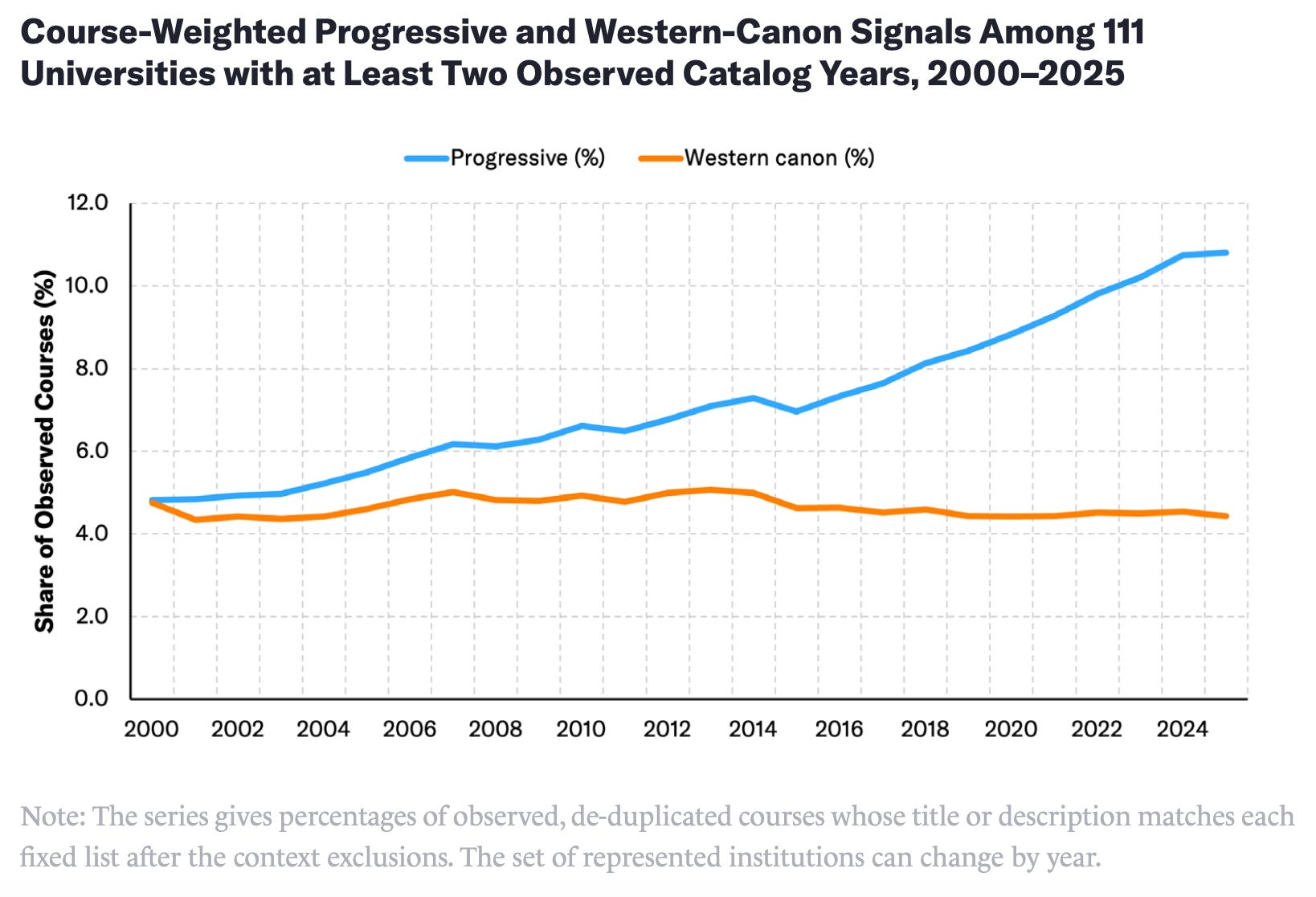
In a new Manhattan Institute report, Iván Marinovic of Stanford University analyzes how curricular language has evolved over the last 25 years of American higher education. All together, the analysis spans 111 universities and 7.3 million course-year records. The headline finding: progressive language occupies an ever-growing share of course content, but references to the Western canon seem to be stagnating.
For this analysis, course descriptions were classified as covering progressive topics, the Western canon, or both, depending on the presence of keywords from pre-defined lists. Terms like “settler colonialism” and “privilege” triggered a “progressive” classification, while terms like “ancient Greece” and “John Stuart Mill” triggered a “Western canon” classification. While the share of courses with progressive language more than doubled between 2000 and 2025, there has been no such increase for courses referencing the Western canon. (Figures like Fanon and Foucault were grouped with the Western canon. They are about as postmodern as it gets, so if “progressive” and “Western canon” are intended to be mutually exclusive categories, in our view the faint Western canon signal may, if anything, be an overestimate.) One might conjecture that while the share of courses with progressive topics is rising, their reach may be limited in practice if they’re mostly small seminars. But data from Stanford, which provides both course catalog and enrollment records, suggests that more of the student body is enrolling in these courses over time, too.
Although the prevalence of progressive language has increased overall, the timing and degree of this change varies across universities. Vanderbilt, WashU, Penn, and Duke all saw sharp rises around 2020, whereas the increase at MIT, Northwestern, Princeton, and NYU was not as pronounced in this period. At Columbia, 2020 does not even register as an inflection point because the trajectory had been in place since at least 2015. Although the author does not note this, there also seems to be an uptick after 2023 at Harvard, perhaps indicating a response to the October 7th attacks and the pro-Gaza protests of the following year.
The author does note a few limitations of this method. For one, counting the occurrence of keywords in course descriptions only indicates what is covered, not how it is covered. Course descriptions can also be low on detail, so the author suggests that his results are a relatively conservative estimate of curricular politicization. Finally, the sample is skewed toward selective, private institutions (and those that post historical catalogs). But given that these universities train a disproportionate share of influential members in our society, we think it’s valuable to know what ideas their undergraduates are exposed to.
Neutrality policies are associated with less student intolerance
A new working paper from Bitzan, Saravia, Marroquín is among the first of its kind to explore the relationship between institutional neutrality policies and student intolerance. Using the American College Student Freedom, Progress, and Flourishing Survey (2021-2025), the researchers looked at student intolerance as indicated by their endorsement of five different actions: withdrawing a controversial speaker’s invitation, dropping a required reading that makes students uncomfortable, stopping a class discussion that makes students uncomfortable, reporting a professor who says something offensive, and reporting a fellow student who says something offensive. Across 7,240 responses, the average student endorsed 2.3 of the 5 actions.
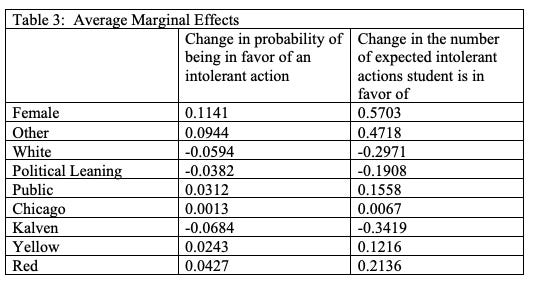
Across all responses, students endorsed an average of 2.3 intolerant actions, out of 5 possible actions. Students who attended a university with a neutrality policy adopted at least a year before they were surveyed endorsed 0.34 fewer actions, on average, compared to peers at institutions without neutrality policies, after accounting for demographics, political leaning, and campus speech codes. Interestingly, neutrality policies were associated with lower endorsement of all intolerance measures (though willingness to report a professor did not pass the significance threshold). In a variation on the same gendered theme that others have noted (as have we in a previous roundup), female and gender-nonconforming students were much more likely to endorse any of the intolerant actions.
The researchers also explored how student intolerance related to university adoptions of The Chicago Principles and each campus’s FIRE Speech Code rating. Statements of academic freedom didn’t seem to have a unique association with intolerance over and above the effect of neutrality statements, but the relationship with the speech codes moved as you might expect: students at campuses rated yellow and red endorsed more intolerant actions than those at green-rated campuses.
Many questions remain about the role of institutional neutrality in either drawing students to an institution or causally impacting student tolerance, but we’re happy to see this worthwhile subject receive overdue study. And only 5.5% of the students in the dataset attended a university with a neutrality policy. We’d love to see the sample grow (for more than just methodological reasons).
Do people underestimate receptivity to different political opinions?
A paper published by a research group based in Sweden and Portugal finds that a common reason why people may be reluctant to engage in dialogue with others who hold different political views is that they (wrongfully) assume others aren’t interested in listening to them. This misperception was found consistently across four studies with over 1,300 participants total. People rated themselves as moderately receptive, as measured by the Receptiveness to Contrary Opinions scale, with self-ratings landing above 4 on a 1-7 scale, but rated their political opponents significantly lower (about 3 on the same scale). This negative perception of political opponents coincided with an expectation that talking with them about politics would be a negative experience.
One study involved an experiment in which researchers showed participants vignettes of characters who voted for the participant’s least liked political party. These characters varied in receptivity to having cross-partisan discussions.
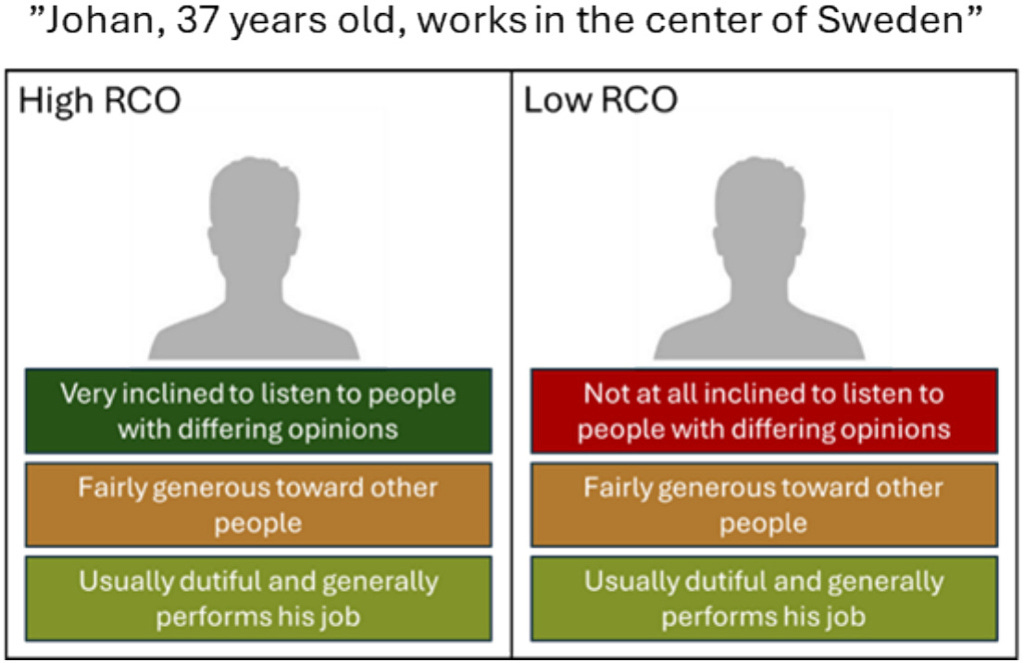
Participants who read about the highly open and receptive character (high RCO) expected political discussions to be more pleasant, even though the fictional character belonged to the participant’s least-liked political party. Participants also rated the characters as better potential co-workers.
This paper adds to a growing literature on political “meta-perceptions,” meaning research on what people think about how others think. Other studies on political “perception gaps” show that Democrats and Republicans typically underestimate the extent to which they all endorse commonly held values and attitudes. Some research has found that correcting those misperceptions by showing people the actual views and attitudes that others have can lead to depolarization.
“Ipso facto” liberally educated? Testing gen ed’s civic promise on 200,000 transcripts
What does it mean to educate for democratic citizenship? At most American universities the implicit answer is built into degree requirements: sample widely across the liberal arts, then go deep in a major. Alexander Astin, founding director of UCLA’s Higher Education Research Institute, took a jab at the idea in 1999, when he said “take such and such an array of [general education] courses in these fields, pass them, and ipso facto you’ve been ‘liberally educated.’” A new working paper from a Michigan-led team puts it to the test. The authors use transcripts and career histories for more than 200,000 graduates of Michigan, Indiana, UC Irvine, Houston, CUNY, Georgia College, and Truman State, plus a 2021 survey of about 2,750 members of the class of 2009–10, to understand how curricular depth and breadth tracked with civic engagement. The results give Astin’s dismissive remark some support, but the overall picture is mixed.
The authors measured curricular breadth as “the number of distinct subjects students take in the humanities, social sciences, and natural sciences” and depth as “the maximum number of upper-division courses a student takes within the same focal area.” They found that for most measures of civic engagement, such as voting, volunteering, contacting officials, and following the news, neither curricular breadth nor depth showed a detectable link, and described the association as “underwhelming and inconsistent.”
In contrast, students who took a broader spread of liberal arts subjects were somewhat more likely to work in public service 10 years following graduation and to report spending time with people from different backgrounds. The public service link is driven mostly by natural science coursework, and it shrinks once major is held constant. (Public service here means working for a nonprofit, government, or educational employer, which would include hospitals, so some of it may be the pre-health track.)
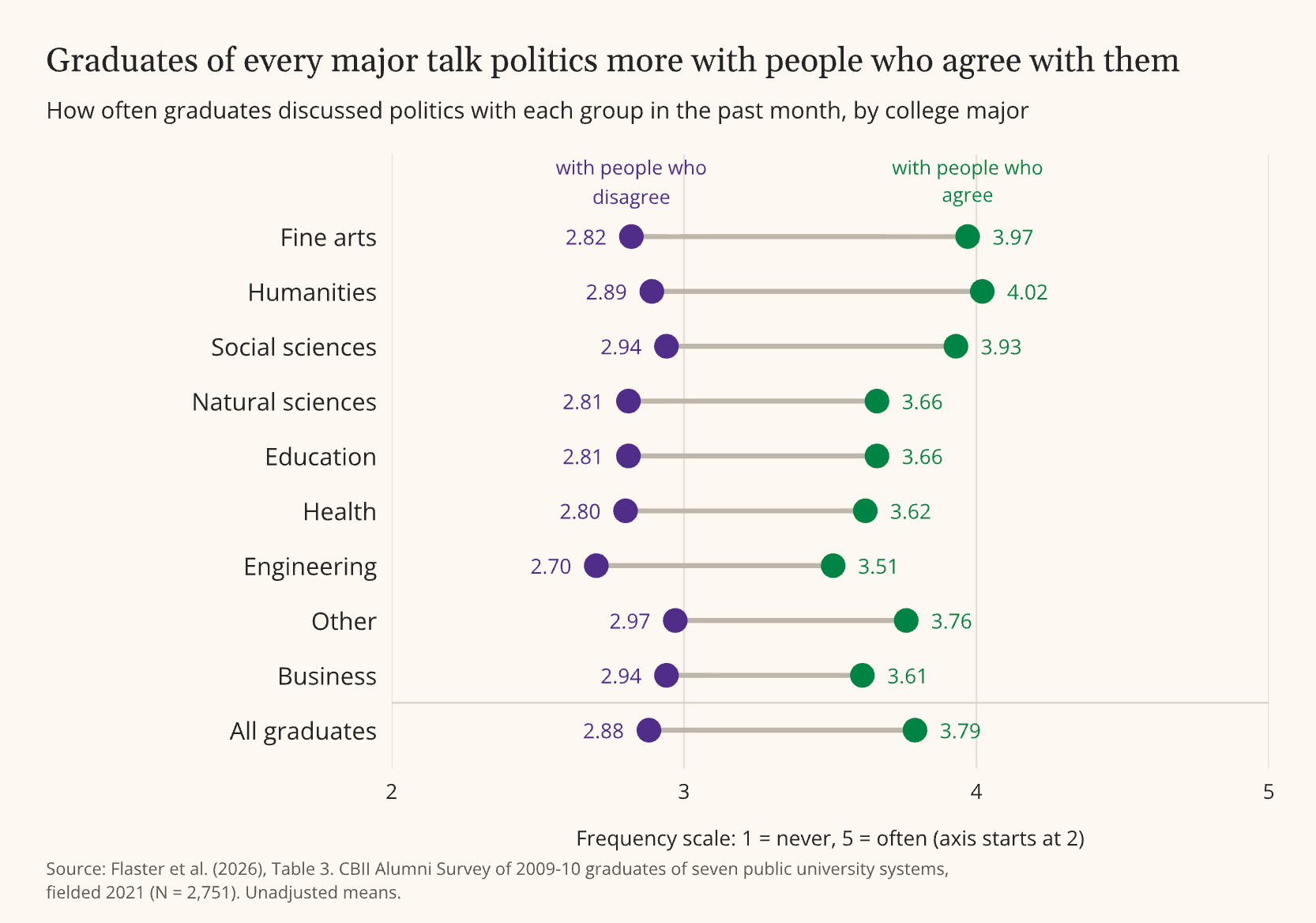
Major was the stronger predictor on several outcomes. Students pick their majors, though, so the paper can’t say whether the field shaped the graduate or the graduate chose the field. Humanities and social science graduates scored higher on staying informed and talked politics more often than business, engineering, and health graduates. But look at who they talked to (see chart). On discussing politics with people who disagree with you, no major differed significantly from humanities majors. And graduates as a whole reported talking politics with the like-minded more often than across disagreement (3.79 against 2.88 on a five-point frequency scale).
The authors conclude that “if liberal education at public colleges and universities is uniquely able to develop engaged and thoughtful citizens, it operates through mechanisms other than taking a breadth of courses across the liberal arts and many advanced courses in a focal area.”
If checking off distribution requirements doesn’t form citizens, what does? Earlier studies have linked civic outcomes to teaching quality, high-impact educational practices, diversity experiences, and service and student government. The authors also float a common core built around citizenship; Stanford’s first-year Civic, Liberal, and Global Education (COLLEGE) requirement is one version of that idea. While this paper tests none of those, it does leave anyone redesigning general education with a sharper question: what would a curriculum built for viewpoint diversity and constructive disagreement in a free society look like?
We hope you enjoyed gobbling up this month’s Research Roundup! Send any corrections, comments, hot research previews, or strong feelings about giblet gravy to research@heterodoxacademy.org. See you next time!


