



It’s a new month and a new Research Roundup! Take a breather from the back-to-school chaos to catch up on the latest from the heterodox research frontier.
The (demographic) diversity hypothesis might not be all it’s cracked up to be.
The diversity hypothesis, long touted by DEI advocates, claims that diverse teams produce more innovative science. But is this true? And “diversity” according to whose definition, anyway? A recent paper from Beck, Patterson, and Wilson illuminates counter-narrative findings about the diversity hypothesis and takes a closer look at what researchers really mean by “diversity.”
The authors conducted a rapid scoping review of scholarly works on the diversity hypothesis to take stock of the field and synthesize results from different studies. In total, the authors identified 104 scholarly works that assessed the relationship between diversity and research output (typically in the form of the number of publications) or impact (generally indicated by citations and h-index). Many studies included more than one aspect of diversity or considered more than one measure of productivity or impact, yielding 200 unique “results” for analysis.
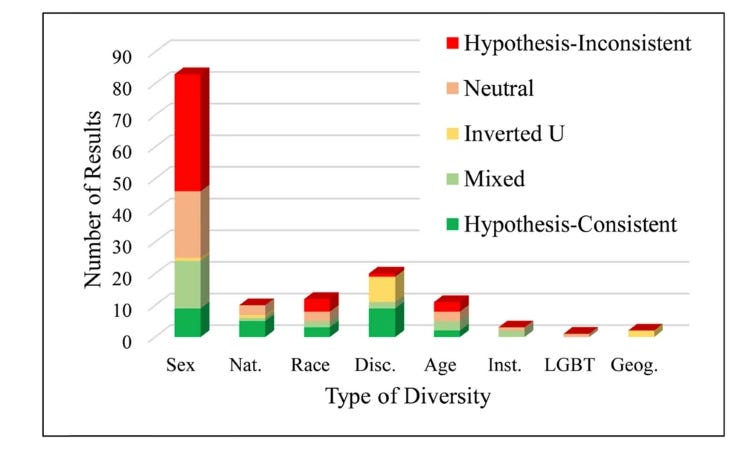
The authors focused on 142 results from studies that were population-adjusted (i.e., compared to a reference population). What they found does not bode well for the diversity hypothesis: only 15% of results were fully consistent with the diversity hypothesis, and when allowing for a more generous interpretation of “consistent” (including results that were either mixed or exhibited an inverted-U shape in which some amount of diversity improved outcomes, but a large amount worsened them) only 28% of results were aligned with the hypothesis.
But what counts as a “diverse” team anyway? Turns out, most conceptualizations of “diversity” in these studies boiled down to demographic diversity — sex in particular, and by a wide margin. About 80 results examined “sex” as a component of diversity. Conceptualizations of diversity outside of demographic considerations, such as disciplinary diversity, were relatively rare (though disciplinary diversity showed a greater share of potentially hypothesis-consistent results). As the authors noted, there was “markedly less attention given to viewpoint diversity” — a gap in the literature if we ever saw one!
FIRE’s 2027 College Free Speech Rankings reveal a national student body walking on eggshells
The Foundation for Individual Rights and Expression (FIRE) just released its 2027 College Free Speech Rankings, and some notable trends stand out.
First, the University of Chicago and Claremont McKenna continue to top the list, and Harvard resumed its climb up from dead last in 2024 and 2025 to a ranking of 71 (driven in part by improvements in student expression surveys, according to FIRE’s Sean Stevens). NYU now ranks last, mostly over its handling of several Israel-Palestine-related events in the last few years. Rutgers, also placing in the bottom 5, lost points for an incident where student activists disrupted a talk by a former IDF soldier, as well as for rescinding a commencement speaker’s invitation over complaints about his pro-Palestinian social media posts. These incidents highlight a broader pattern in which Israel and Palestine continue to be among the most difficult topics across campuses. The other bottom-ranked schools similarly ranked low partly due to their handling of speech controversies. Two Texas universities — Texas State and Texas A&M — saw their rankings fall, likely reflecting evolving state restrictions on the teaching of DEI-related topics and administrative confusion over compliance.
Rankings reflect a combination of each school’s speech climate (as perceived by students), the school’s speech policies and commitment to institutional neutrality, and its handling of recent speech incidents on campus. Related to this last component, the assassination of Charlie Kirk on Utah Valley University’s campus in September 2025 continues to make itself felt in UVU’s speech climate. Although students reported more administrative support for speech, they felt less comfortable expressing their views on controversial topics and reported increased self-censorship. Not helping the situation, UVU rescinded a commencement speech invitation to author Sharon McMahon following backlash from conservative campus groups, politicians, and members of the public over her criticism of Kirk on social media.
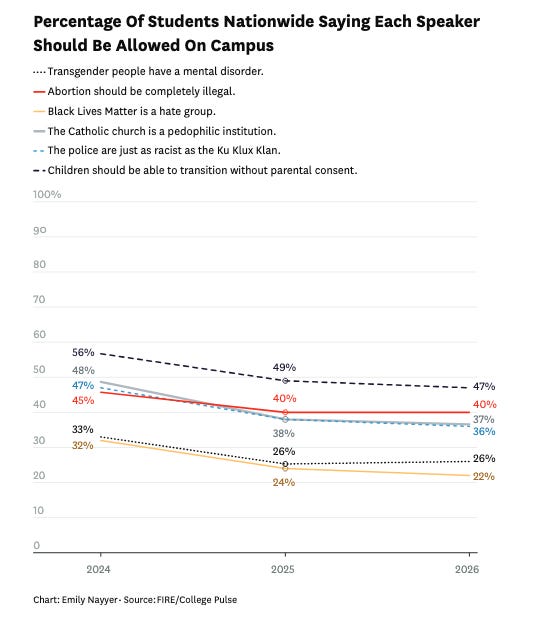
Finally, students’ tolerance for offensive speech continues its year-by-year decline. To assess this, FIRE asks students whether each of six controversial speakers — representing a mix of views offensive to liberals and conservatives — should be allowed on campus. Strikingly, a majority of students oppose each speaker’s presence on campus, with opposition so widespread in some cases that it can’t be explained only by students who would predictably be offended by the speech. Although the report doesn’t break down these results by students’ political leaning, our own internal analysis of FIRE’s publicly available data indicates that solid majorities of all political groups opposed speakers promoting views like “Black Lives Matter is a hate group” (opposed by 86% of liberals and 59% of conservatives) and “The police are just as racist as the Ku Klux Klan” (opposed by 58% of liberals and 72% of conservatives). (Consistent with Chapin Lenthall-Cleary’s analysis of last year’s data, men in the sample were substantially more tolerant than women, even within the same political groups, and even toward speech supporting their “own” side.) With tragic events like Kirk’s assassination, on top of other speech controversies that have shown no sign of slowing, perhaps students feel it’s better to avoid controversy altogether.
Words cannot hurt you: new evidence shows that “harmful language” guides are targeting a problem that doesn’t really exist.
“Safetyism” is often cited as a concern by HxA members, especially with regard to the policing of language. Some universities (e.g., Stanford) as well as academic societies (e.g., American Psychological Association) have even taken steps to reduce or eliminate the use of what they deem “harmful” words. Such efforts go well beyond popular consensus on what is harmful language (e.g., racial slurs) and instead target words and phrases that most people (including those in minority groups) perceive to be innocuous (e.g., “guru,” “blacklist,” and “pipeline”) along with a set of alternative words that they deem less harmful (e.g., “expert,” “denylist,” and “pathway”).
A new paper published in the Journal of Open Inquiry in the Behavioral Sciences tests whether such words actually cause harm to those reading or hearing them. In one study, the authors presented participants with “harmful” words as identified by Stanford’s Elimination of Harmful Language Initiative (EHLI) and asked participants to rate how acceptable those words were on a 0-100 scale, from unacceptable to acceptable. While a handful of pejorative slurs were rated low (as in, actually perceived to be harmful), most words on the harmful language lists were rated highly and perceived to be more acceptable (for example, the word “pipeline” was rated 89 out of 100). Not only that, there were some words for which participants rated them as more acceptable than the alternative words! For example, participants showed a preference for “blacklist” over “denylist,” “Hispanic” over “Latinx,” and “breastfeeding” over “chestfeeding.”
In a second study, the researchers randomly assigned a group of participants to read a passage with either the harmful words or the alternatives. The researchers then measured participants’ discomfort in a variety of ways, including anxiety, neuroticism, feeling of inclusion, and ingroup preference. They found no statistically significant differences between participants in the two conditions. Whichever set of words they read did not make any difference in terms of how they felt. Then the authors tested whether the participants in a marginalized group (e.g., transgender or non-white) would respond differently, and once again the authors did not find any statistical differences in how upset they felt after reading the supposedly harmful words.
The authors found an interesting trend: those participants who perceived themselves as moral elitists and who felt a need to be recognized by others were more likely to feel upset after seeing the words on the harmful list. As the authors put it, “Moral elitists hold the view that they have ‘immaculate morality’ while other people are immoral (Gabay et al., 2020). People with a higher need for recognition feel an increased desire for their own perceived victimhood to be acknowledged and empathized with. When exposed to harmful language, people with higher levels of these traits may be more negatively impacted through perceived moral violations and an absence of recognition. Thus, as seemingly benign language (e.g., pipeline) is promoted as being harmful, people with certain personality traits may experience more negative outcomes.” These results add to a growing body of research showing that some people may be too eager to police others’ language in the name of protecting vulnerable groups from harm.
From one institution to another, professors bring some of their courses’ politics with them
When professors change universities, how much do their courses change? In a working paper, Stanford economics researchers Jacob Light, Gideon Moore, and Samuel Thau score millions of course descriptions from 964 U.S. universities on two scales: how much a course engages topics from the 2016 Democratic and Republican party platforms (political content) and which platform it sounds more like (slant). Compare, for instance, the introductory language instruction course “Elementary Spanish Conversation,” which barely registers on either scale, versus “Race and Ethnic Relations” and “Faith, Reason, and Culture,” which are both politically inflected but slant about equally far in opposite directions.
Overall, the researchers offer a creative way to investigate the underlying processes that shape the political content of college courses. The analytical sample, based on an impressive panel of course catalogs and schedules collected by one of the authors, includes data from nearly 45,000 instructors who moved from one college to another. Fascinating insights emerge when comparing their courses before and after the switch.
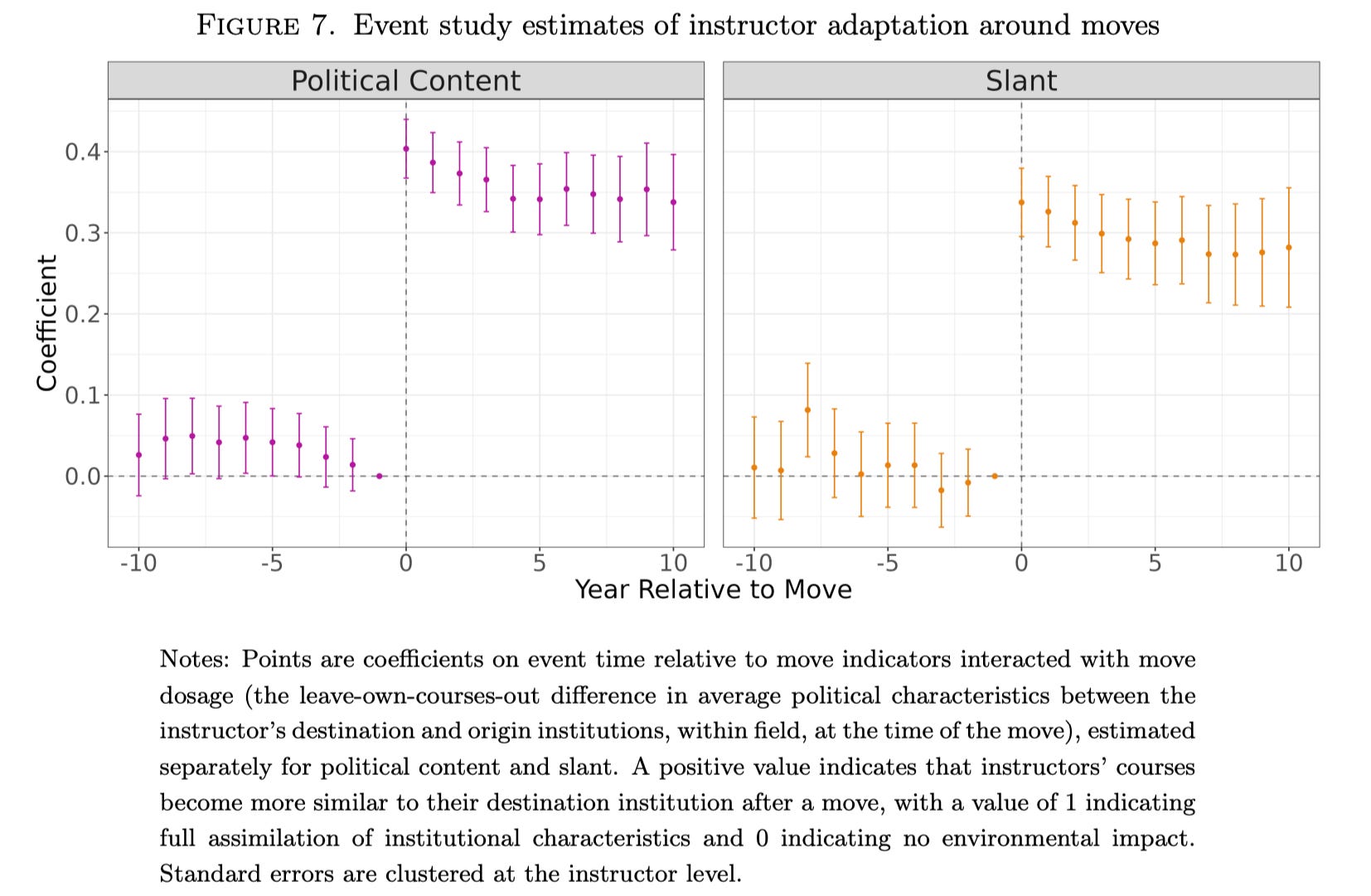
Upon arrival, instructors’ courses were pulled 41 percent of the way toward their new department’s level of political content and 34 percent of the way on slant, according to the researchers’ measures. The other 59 to 66 percent stayed with the instructor, a share the authors say may reflect portable expertise as well as personal views. Moreover, the courses didn’t change before the move, and most of the shifts remained for years afterward. The pull was weakest at elite schools: for moves between highly selective institutions, courses moved only about 19 percent of the way on political content versus 46 percent between the least selective. Some of the pull came from handing existing courses to new hires; on courses they wrote themselves, instructors seemed to adapt less to their new environment. For universities hoping to improve the ideological balance of what gets taught, especially selective ones, hiring may matter as much as catalog reform.
The paper also found that over the 25 years of course description data, the average course became only modestly more political (0.15 SD) and more liberal (0.13 SD). The typical course’s slant barely changed. The movement came at the edges, where strongly liberal courses became about a quarter more common between the late 2000s and today, while strongly conservative ones became about an eighth less common. Additionally, students’ enrollment choices showed no tilt toward liberal courses from 2005 to the mid-2010s. But that began to shift, and the preference for liberal courses peaked in 2020 (“a course one standard deviation more liberal would see 5.5 percent more demand — almost doubling relative to the baseline”) and has partly reversed since.
That’s all for this month’s Research Roundup! As always, shoot any hot research news our way at research@heterodoxacademy.org.


