


It’s now widely (though not universally) conceded that improving viewpoint diversity on campus would improve university teaching and research. Faculty on American campuses are overwhelmingly cut from the same ideological cloth, and this homogeneity has harmful effects on all aspects of the professoriate, including teaching, research, and service. The research mission, in particular, is under threat as faculty political and religious homogeneity distort our knowledge of everything from gender and immigration to secularism and terrorism.
But suppose you had the opportunity to fix this. You could wave a magic wand and improve viewpoint diversity in any part of campus. Where should you work your magic? Where does viewpoint diversity matter the most?
The topical answer says that you should focus your efforts on the humanities and the social sciences. This is a common answer. Back in 2016, Gerard Alexander noted that it was no “coincidence that intolerance is radiating across universities from those subfields of the humanities and social sciences in which viewpoint diversity is most absent and rigorous scrutiny is most anemic.” More recently, Michael W. Clune argued that professors in the humanities and social sciences are unable to articulate and respond to objections to controversial positions in their field, and so most likely to benefit from viewpoint diversity. And just last year, Jonathan Haidt and John Tomasi, both of Heterodox Academy, wrote that viewpoint diversity is especially important “in the social sciences, humanities and some of the professional schools.”
This topical answer is plausible. The humanities and social sciences exhibit the least amount of political diversity and yet feature the most enduring controversial questions in politics, religion, and philosophy. Yet it’s also incomplete. The topical answer doesn’t offer a deeper explanation for why some disciplines are problematic in a way that others are not. It also misses some pretty important exceptions in the natural and life sciences like climate change, vaccines, or transgender health. The research in all of those fields would be improved with viewpoint diversity.
Tyler VanderWeele of Harvard offers a different kind of answer. Instead of a topical boundary, he offers a principle: “Universities should…hire faculty who hold disfavored or controversial views when those views are held by a large portion of the population, have not been clearly refuted, and influence culture and policy.” Anytime a viewpoint is popular, influential at the level of culture or policy, and unsettled by the discipline, we should ensure that we have viewpoint diversity in the faculty teaching and researching those topics.
Like the topical answer, this answer is plausible. It links cultural/social influence with discipline-specific standards. It also correctly identifies the wide concatenation of topics often cited as in need of viewpoint diversity, such as medical treatment for transgender youth, climate change policy, government-subsidized healthcare, etc.
But the principle-based answer also fails to offer a deeper explanation for why viewpoint diversity is more important under these particular conditions. What is it about the combination of popularity, social influence, and absence of academic refutation that mandates viewpoint diversity on some topics but not others?
While granting that both answers are appropriate, I want to offer a different answer to the question. This account explains what’s correct about these other answers while providing the deeper explanation they lack. Where does viewpoint diversity matter the most? Anywhere our identities are at stake.
At a very general level, each of us faces all sorts of non-epistemic pressures to believe in certain ways. That’s precisely why peer-reviewed journals often require authors to disclose funding for research and other potential conflicts of interest. And it’s why judges are required to recuse themselves from cases where they have personal interests at stake. In cases like these, the non-epistemic pressure to draw a conclusion a certain way impedes our ability to evaluate the evidence impartially.
It’s not that in these cases we see the evidence and choose to ignore it. Rather, the problem is that in these cases, it’s difficult for us to see the evidence in the first place. As Upton Sinclair put it, “It is difficult to get a man to understand something when his salary depends upon his not understanding it.” In a case like this, the non-epistemic, financial pressure drowns out the contrary evidence.
Contemporary philosophers have been identifying these sorts of pressures and drawing out their epistemic implications for knowledge and understanding. Katia Vavova explains when irrelevant influences undermine our justification for a belief. In a Millian vein, Hrishikesh Joshi argues that anytime there’s social pressure to believe something, there’s a good chance that your evidence base is not representative. And Nathan Ballantyne defends a regulative epistemology that takes seriously our internal and external pressures to believe in ways that don’t fit the evidence.
Some of the most powerful non-epistemic pressures we face have to do with our identity. We see ourselves a certain way, and our beliefs feature prominently in our internally constructed view of ourselves. We are theists, progressives, anti-vaxxers, religious skeptics, patriots, and the like. What we believe is important to who we are. Giving up the belief that God exists or changing your mind about the effects of structural racism could be devastating for your identity.
Because of this cost, we are prone to engage in ideologically motivated reasoning that will spare us the problematic conclusion. Better to gloss over the evidence than to deal with the pain of cognitive dissonance. Given the discomfort of cognitive dissonance, it’s no surprise that a wealthy man thinks that his wealth is largely the result of personal choices and that the poor man thinks that poverty is largely the result of circumstances outside of his control. Each needs to sleep well at night.
One central facet of our identity is our membership in a group. Humans are deeply social creatures, and our identities are intertwined with belonging. In principle, this need not cause any epistemic trouble; humans might have sorted themselves into in-groups and out-groups by cultural, religious, or political symbols like dress, tattoos, etc. instead of beliefs.
But in practice, beliefs are important for defining group membership. They become even more important as our habits of dress, design, and lifestyle converge–how are you supposed to tell liberals from conservatives anymore? Beliefs help us to recognize and police those boundaries.
Not just any belief will do. Beliefs that provide reliable signals of group membership should not be obviously false or refuted (like “the sky is red”) or straightforwardly self-destructive (like “humans can fly”). Instead, good examples of group signaling beliefs are things like “It’s wrong to eat meat” and “God is real.” These beliefs are sometimes referred to as “symbolic beliefs” since they function as social markers and can perform their social function even when they are false.
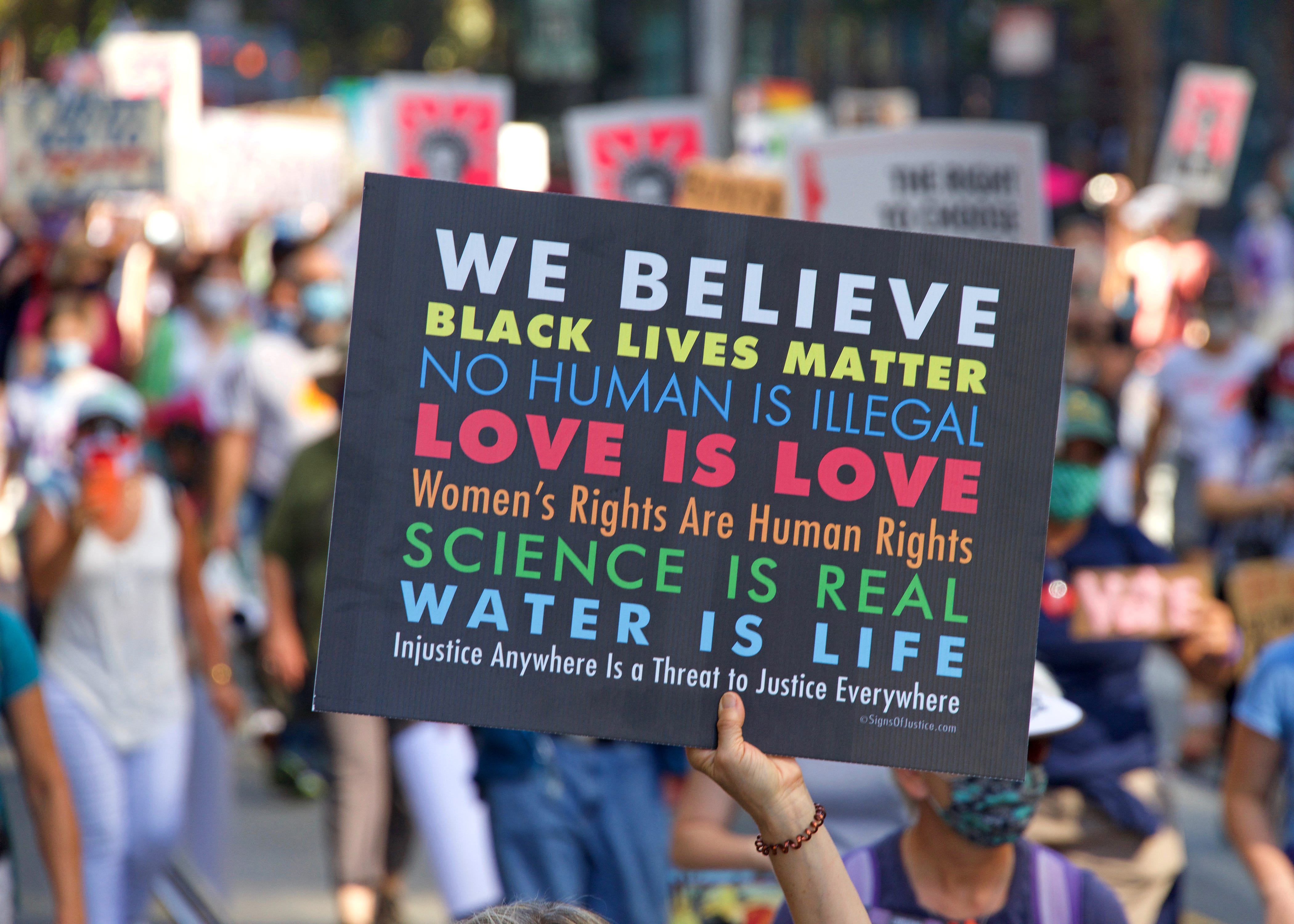
As evidence for the prominent role of symbolic beliefs as group markers, there is a strong market for bumper stickers and signs literally offering a list of things that you believe (for example, “We believe that: science is real, black lives matter, etc.”). Why would you put such a thing in your yard? The answer is purely about identity. Posting the sign is a form of group participation. You get to wave the flag of your team, signal your group loyalties to others, and perhaps to offer your own non-epistemic pressures on neighbors to agree with you.
The problem is that once a group-marking belief is under threat, we don’t think well about the evidence for or against it. Dan Kahan and others have shown that we process information about these topics in highly motivated ways in order to maintain beliefs that signify loyalty to our affinity groups. Even worse, he concludes that those of us who score the highest in cognitive reflection are the most likely to engage in ideologically motivated cognition.
Putting the pieces together: we face pressures to maintain a coherent identity, belonging to a group is a central part of that identity, groups are often defined in terms of belief, yet when a belief is a group marker, we are more likely to evaluate it in biased ways. That means anytime a topic touches on a belief, conclusion, or commitment used to demarcate socially important groups, members of those groups will face strong non-epistemic pressures to believe in certain ways regardless of the evidence.
If people are put into a position where they must choose between their identities and an idea, most will happily choose their identities. (Although “choose” is too strong–they won’t consciously choose it so much as subconsciously process the evidence in biased ways.) It would be incredibly difficult for an atheist to come to believe that there was a God. It would be incredibly difficult for a progressive to come to believe that a racial disparity is due to anything other than systemic racism. It would be incredibly difficult for a conservative to come to believe that climate change poses an existential risk. Their identities are built around believing along with their tribes.
Universities should know this and not pit faculty against their own identities. Doing so stacks the epistemic deck in a pretty obvious way. Instead, we should have ideologically diverse groups of faculty contesting these issues so that they can better sort the evidential signal from the identitarian noise.
This identity-based explanation shows why both the topical answer and principle answer we started with are correct. The topical answer that we need viewpoint diversity in the humanities and social sciences is correct because identities are more at stake in those fields than others. Hobbes, that astute observer of human nature, anticipates this distinction between the humanities and other disciplines like math:
I doubt not but if it had been a thing contrary to any man’s right of dominion, or to the interest of men that have dominion, that the three angles of a triangle should be equal to two angles of a square, that doctrine should have been, if not disputed, yet by the burning of all books of geometry, suppressed, as far as he whom it concerned was able. (Leviathan, Part 1, Chapter XI section 21)
Hobbes’ point is that our social incentives impact whether we dispute or suppress a doctrine, and we rarely have such social incentives when it comes to mathematics.
That’s because mathematical beliefs are not relevant to our identities. If they were, you can bet that we’d see the same level of controversy in math departments as we do in the humanities and social sciences. Instead, as the authors of the recent Vanderbilt-Washington University report note, even though academic mathematicians are more liberal than the general electorate, it’s no reason to think that the scholarly standards in mathematics are somehow bogus because of their politics.
Identity pressures also explain why VanderWeele’s principle-based answer is correct. Recall that his suggestion is that we need viewpoint diversity for faculty evaluating views that “are held by a large portion of the population, have not been clearly refuted, and influence culture and policy.” This is almost a perfect recipe for a symbolic belief. In the long run, views that have been refuted are too difficult for in-group members to hold in the face of overwhelming contrary evidence. Views that are powerful enough to shape culture and policy are obvious candidates for group markers as groups often form in competition over cultural issues.
In sum, anytime faculty are wrestling with questions concerning symbolic beliefs used as markers for group identity, we should ensure that we have robust viewpoint diversity in place. This includes the obvious cases of ethics, religion, history and the like but also controversial issues in the social and natural sciences. These days, we use empirical beliefs on everything from EVs and voting security to climate change and vaccination to enforce tribal boundaries–the humanities don’t have a corner on the market for identity beliefs.
One final point. The primary value of viewpoint diversity in these areas is squarely epistemic: it improves the group’s ability to sort the signal from the noise. Viewpoint-diverse groups are more likely to cancel out the non-epistemic pressures associated with identity and more likely to get to the truth. If we want our universities to research and teach on these issues well, we absolutely need to cultivate a viewpoint diverse set of scholars and teachers.
But an important knock-on effect of viewpoint diversity in these domains is an expansion of epistemic trust with those outside the university. When viewpoint diverse experts arrive at a conclusion, that signals to the non-experts that the conclusion was driven by evidence rather than identity.
Research on partisan cue-taking consistently shows that messengers matter: people are more likely to trust members of their in-group first, mixed groups second, and out-groups least. Further, normal humans exhibit biased assimilation: we are more likely to trust experts and expert knowledge when they align with our moral commitments.
In an era when trust in higher education is in freefall, universities should welcome the opportunity to restore trust with the broader public by improving viewpoint diversity in the right areas on campus.

Meaningful nuanced diagnosis and worthwhile prescription.
I'd like to add one thought on the discipline-dependent importance of view-point diversity that isn't touched on: diversity of well-supported viewpoints is most important in those areas that touch on the material being taught.
For example, the opinions of sociology and economics faculty on the societal effects of wide-spread same-sex marriage matters much more than the diversity of opinion on this amongst physics faculty.
In the latter, none of the faculty's opinions are transmitted as authoritative elements of the instruction. Any physics professor who even mentioned the effects of same-sex marriage as part of the course would likely be subject to some level of discipline simply for straying so far off topic and wasting students' precious time. A lack of faculty diversity on this issue should have no effect on students' understanding of the world.
In contrast, societal effects are a core concern of sociology and economics. The consequences of same-sex marriage rates could be central to a course's syllabus. A homogeneous faculty opinion on the issue would almost certainly direct student understanding of the world, creating areas of research and discussion that are out-of-bounds and subject to social and/or professional sanctions.
Unfortunately it is precisely in those disciplines addressing complex social issues involving inconclusive data that can support conflicting conclusions where the homogeneity is pronounced.
Very helpful piece. Thank you.