


Following up on last year’s roundup of convocation speeches and welcome addresses, we took another look at what campus leaders are saying to their communities at the start of the 2026-2027 academic year. Across a non-exhaustive set of speeches at influential universities, several themes stood out. Like last year, civil discourse and constructive disagreement appear to be top of mind for many university leaders, alongside curiosity, uncertainty, and the growing presence of artificial intelligence.
Civil discourse and constructive disagreement emerged as a dominant theme, as university presidents framed disagreement as a core feature of the university experience. President Chiang of Northwestern told incoming students that they are “supposed to sweat through disagreement, debate and dissent” in the “intellectual gym” of the university — sentiments echoed by President Mnookin of Columbia, who praised the necessity of “productive tension.” “Great universities like Columbia,” wrote Mnookin, “are places of productive tension—tension between tradition and innovation, certainty and doubt, established knowledge and new ideas, agreement and disagreement. That tension is essential to our intellectual life.”
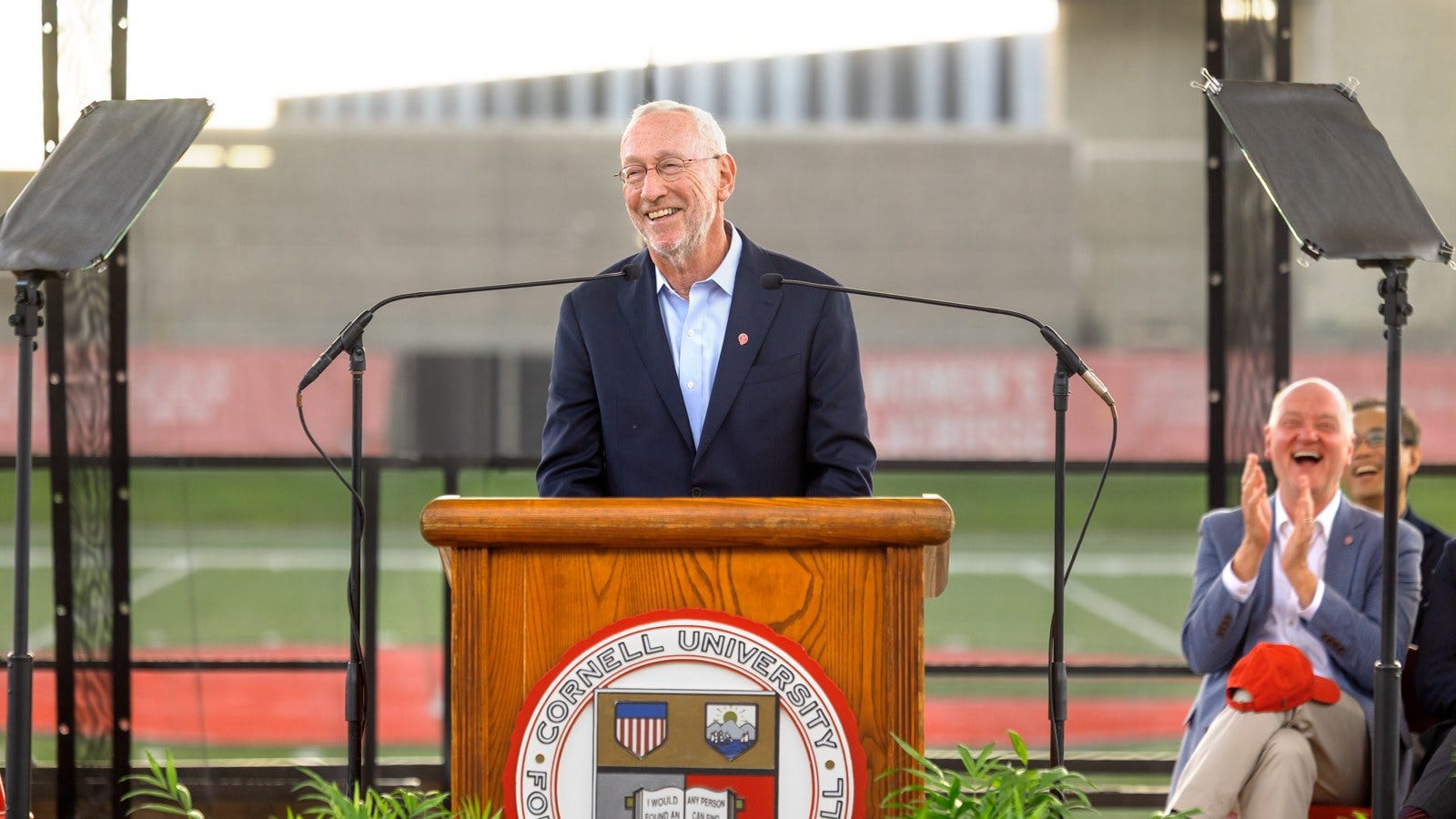
At Cornell University, President Kotlikoff emphasized to his students that they have the freedom to form their own views, but that this freedom comes with a responsibility “to protect and respect the freedom of expression and exploration for everyone around you. Even, and especially, for the people with whom you have the least in common, and the ideas with which you most disagree.”
Curiosity — a timeless intellectual virtue and critical prerequisite for open inquiry — was roundly celebrated across campuses. President McInnis of Yale encouraged students to adopt “a kind of egalitarian curiosity, one that embraces every variety of knowledge, and debates even the most agreeable assumptions.” At Johns Hopkins, President Daniels urged students to nurture an “insatiable, unquenchable, driving curiosity.” President Levin of Stanford told incoming students that Stanford aspires to “to have a culture of dignity,” best cultivated when students are “curious, not judgemental.” Similarly, leaders at Columbia, Penn, Denison, and Georgetown all named curiosity as an explicitly cherished value.
At Denison University, President Weinberg’s welcome back message linked the preconditions for curiosity to institutional neutrality: ”An essential part of being curious is keeping your mind wide open. A college campus isn’t expected to reflect or speak with one voice,” wrote President Weinberg. “The purpose of a university is to give ourselves space to explore, create, and refine ideas, thereby adding to the world’s knowledge and understanding.”
Many speeches also acknowledged the uncertainty of today’s world — not as cause for fear, but as a driver of knowledge. Uncertainty was the central theme of President McInnis’s address at Yale, where students were told “uncertainty is not something to fear. Uncertainty is something to welcome.” President Price at Duke University encouraged students to “embrace” and “nurture” their uncertainty, while President Beilock at Dartmouth described the university as a place to “learn to exercise sound judgment, navigate ethical complexity, grapple with uncertainty, and take responsibility for your decisions.”
Artificial intelligence was mentioned by leaders from Princeton, MIT, NYU, and Denison. Mentions of AI were woven throughout President Eisgruber’s remarks at Princeton, culminating in his observation that leadership and expertise depend “on finding and leveraging the human advantage, the ways of knowing that allow us not simply to consume the products of information technology but to evaluate, critique, harness, and build upon them.” Across all references to AI, the message was consistent: students should use AI thoughtfully, not as a replacement for their own judgement and cognition.
Other university leaders highlighted complementary intellectual virtues and practices. Intellectual humility and rigor were the cornerstones of Provost Jackson’s speech at the University of Pennsylvania. “During your relatively brief time here,” said Provost Jackson, “you have the chance to do something extraordinary: to experiment intellectually, to push yourself ideologically, to question your assumptions, and to learn how to engage the world with both rigor and humility.”
Last year, “viewpoint diversity” as a specific phrase was rarely mentioned. But this year, it was named directly by President Peñalver of Georgetown University. In a particularly striking speech, he told freshmen, “the air that allows the fuel of intellect to catch fire is an atmosphere that celebrates fearless inquiry and fierce but collegial debate, robust discussion, and deep disagreement. You can’t experience the spark of intellectual surprise on a campus where different perspectives or divergent points of view are smothered by censorship or censoriousness.” He went on to say that Georgetown’s “conception of diversity is and must be a broad and inclusive one. It includes diversity of identity to be sure, but it also includes diversity of life experiences and diversity of viewpoints.”
There’s reason to think that this is more than just talk. There is real, concerted effort to not just articulate these values, but to meaningfully embed them throughout campus life. From Cornell’s recent Future of the American University Report, to the Provost’s Initiative on Pluralism, Free Inquiry, and Belonging at Duke University, to the Georgetown Dialogues Initiative, these commitments are being backed up by action. Time will tell how effective these programs will be at strengthening open inquiry, but the willingness to actually support these commitments rather than just name them is promising.
Though these opening remarks may not take up permanent residency in the minds of students, the values espoused in these speeches are signals that these institutions are places of vibrant intellectual exchange. And by following up on these words with actions, campus leaders are contributing to the growing momentum and successes of the internal reform movement. The gap between aspirations and actual campus climate will wax and wane, but the values enshrined throughout the campus will endure.
