


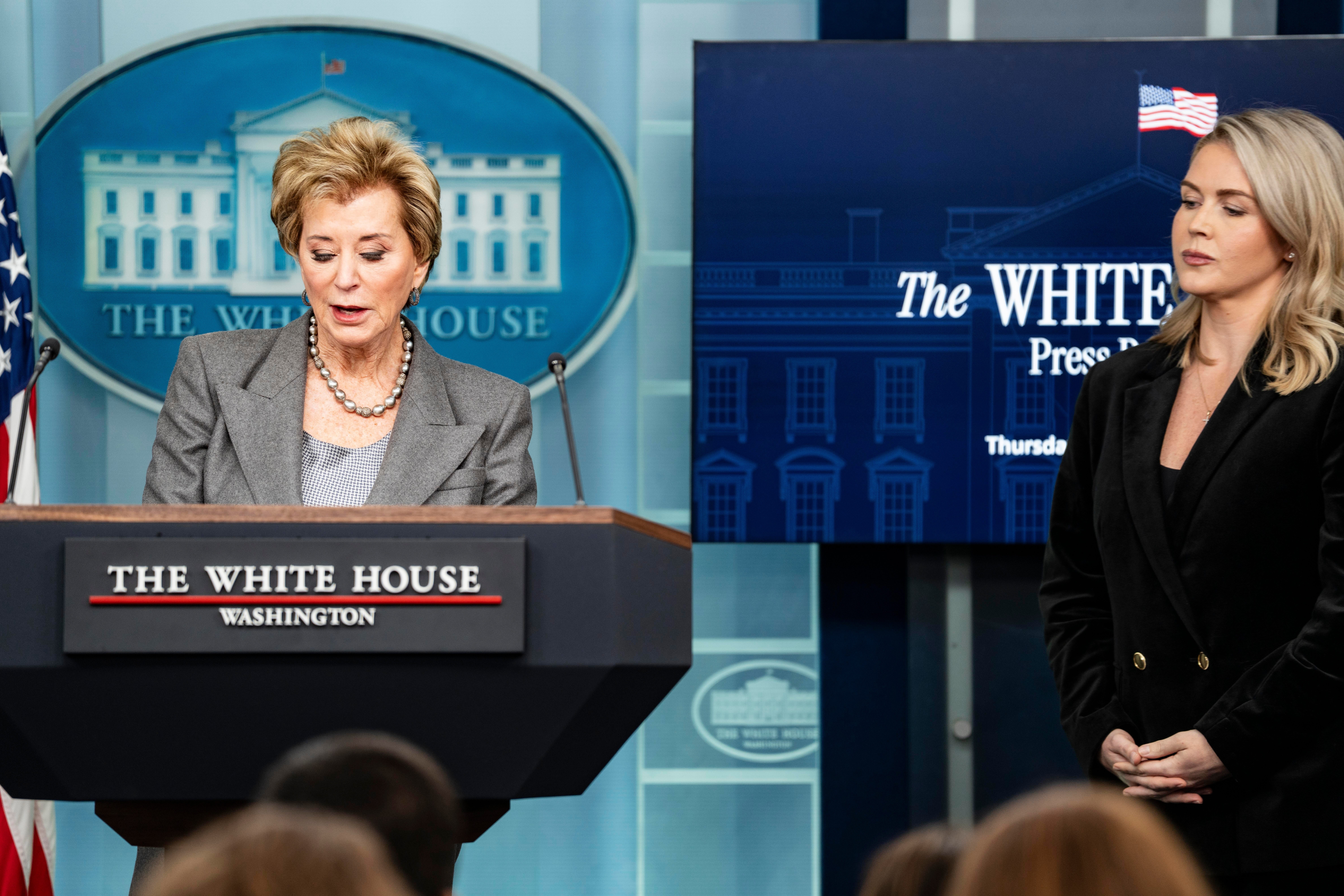
On August 3rd, Education Secretary Linda McMahon issued a letter titled “A National Call to Action to University Presidents and Governing Boards.” The letter has been called “Compact 2.0,” a reference to last year’s controversial Compact for Academic Excellence in Higher Education, which proposed conditioning access to federal student loan programs, research funding, approval of student visas, and preferential tax treatment upon universities agreeing to reforms.
The original compact was overwhelmingly rejected by universities, many of whom questioned the legality of its provisions, and ultimately dropped by the Department of Education. The new letter takes a softer approach. It contains no explicit funding conditions or enforcement mechanism. But universities will not be confused about what’s really going on: the government wants reform, and they’re willing to play nice for now, but if changes aren’t made voluntarily, their tactics are likely to change yet again until things do. Government actions are ultimately backed by its coercive power, and it’s the fear of that power that will motivate universities’ response. Yet even when a government’s methods are questionable, it doesn’t follow that the changes they are seeking are necessarily unreasonable.
In 1961, Dwight Eisenhower warned about the relationship between government and universities — a warning since eclipsed by a three-word phrase it coined: “military-industrial complex.” Eisenhower’s farewell address also described how the “free university, historically the fountainhead of free ideas and scientific discovery,” was becoming vulnerable to federal direction. With research increasingly conducted at Washington’s direction, “a government contract becomes virtually a substitute for intellectual curiosity.” The prospect of scholars being dominated by “Federal employment, project allocations, and the power of money,” he said, “is ever present and is gravely to be regarded.”
Eisenhower’s warnings have been realized. The dependence of universities on government research funding began during World War II, when universities became wartime partners in scientific research. By 2023, universities performed $108.8 billion in research and development, with almost $60 billion — 55% — supplied by the federal government. This reliance has led to an expectation among university leaders for continued funding, resulting in widespread complaints about the impact of cuts on academic freedom, and some even referring to cuts as an “erosion of democracy.”
In fact, the cuts to future research funding were an example of democracy in action. In 2024, U.S. adults’ confidence in higher education had reached a historic low. The Trump administration was brought into power on a platform that included bringing widely desired change to universities. And although universities may have become accustomed to receiving billions in federal funding, it doesn’t follow from this fact that they are therefore permanently entitled to it. The government has an obligation to spend taxpayer funds in line with the taxpayer’s will. A failure to fund research of any particular nature is not the same as banning such research, and confusing this for an attack on academic freedom is a conceptual error.
However, strictly on the issue of academic freedom, the initial Compact still overstepped, as it included government dictates over what ideas and values universities should teach. It required “transforming or abolishing institutional units” that “belittle” conservative ideas, introducing foreign students to “American and Western values,” providing them “instruction in American civics,” and screening out foreign students “who demonstrate hostility to the United States, its allies, or its values.” Had the initial compact actually been enforced, it almost certainly would have faced a strong First Amendment challenge. Additionally, the Compact dictated numerous terms to control other elements of university operations. Universities may not be entitled to government research funding, but neither is the government legally or ethically entitled to use its purchase of research as a cudgel to entirely control a private entity.
While reduced in its number of demands, this flaw remains in McMahon’s Compact 2.0, arguably masked by the lack of reference to consequences for disobedience, but present through the implicit threat of them. The letter still seeks to coerce universities against allowing “foreign actors” to provide gifts that influence “academic programming” and “researcher assignments.” McMahon’s letter insists that universities serve the “national interest” (whatever the administration takes that to mean), but the purpose of the university is not — and was not historically — subservience to a politically determined conception of the good. The federal government is not the universities’ only research client, and its attempt to monopolize the research and academic programming faculty are allowed to pursue does violate their academic freedom and the broader principle of open inquiry. And despite the federal government’s massive funding of research, at public universities students, who are paying to pursue knowledge, still remain the larger customer. This is, of course, even more true at private universities, where on average government funding in the form of appropriations, grants, and contracts (combining federal, state, and local sources) comprises only 10% of their revenue, and students and families generally pay a larger amount in tuition.
Nonetheless, while these flaws remain, the opposition to the entirety of the initial Compact from the AAUP and other progressives lacked nuance; their continued knee-jerk oppositional stance to McMahon’s toned-down letter deepens that mistake. The vast majority of the letter is focused on asking universities to do a better job following through on their stated purpose of pursuing truth and knowledge, a purpose they are widely perceived to have compromised in favor of a political agenda. Despite the letter coming from a conservative administration, there’s nothing inherently conservative about asking universities to follow through on their advertised mission to excel in truth-seeking and knowledge production.
The AAUP’s response to the letter criticizes its allegedly “racially coded” support for admissions based on “merit.” The accusation is precisely backward. Race-based affirmative action and other race-conscious DEI policies literally coded applicants based on their race. Meanwhile, merit-based, identity-neutral admissions and hiring put the most capable individuals to work in the pursuit of truth, with no regard to their race.
The AAUP’s response also objects to the letter’s purported “mischaracterization of peaceful protesters as ‘unruly and violent.’” But since there weren’t specific examples named in the letter, it’s not possible for any instances to have been mischaracterized. Conversely, we do have many documented instances of protesters “harass[ing] students or disrupt[ing] classes, research, public lectures, and campus operations” to deny that this is a real phenomenon, and one that harms the university’s mission of truth-seeking by making open inquiry impossible. The pursuit of knowledge requires the ability to ask questions and challenge popular assumptions without repercussions. These incidents, even if not representative of the average protest, have contributed to a culture of fear on some campuses that prevents this inquiry.
Most of McMahon’s other requests in the letter are equally vital to fulfilling the university’s purpose. The letter asks how institutions will “incentivize rigor,” “prioritize excellence in teaching and learning,” and “encourage intellectual pluralism.” Indeed, intellectual pluralism is vital to these other important goals. We can only establish what’s true through a process of challenging our perspectives, and students can only learn to reason by engaging with ideas contrary to their assumptions. Viewpoint diversity ensures the strongest objections to an idea are surfaced, and constructive disagreement with them enables us to discover where we might be mistaken.
We shouldn’t need a letter from McMahon for universities to take appropriate action on these issues. Unfortunately, the situation on campuses has so degraded that many Americans feel there is no other choice. But regardless of whether one thinks the ends justify the means in this case, it doesn’t change that the ends sought in McMahon’s letter are largely correct. Internal reform is essential to restoring universities, and letter or no letter, the right actions for university leaders to take remain the same.
As someone who would be considered center, center left , I see no way universities are going to reform themselves. They may do some rebranding and change a name here and there to protect the guilty , but it will remain business as usual. I graduated in 1970 and it was a completely different world , even with all the uproar that took place in the 60's. What is discouraging to me is to see institutions , disciplines , .undermine their credibility for major issues that need to be confronted.. NPR degenerating into the Fox News of the left reduces what positive impact they could have. They want to win a small battle , but lose the larger war in the process.; far too short sighted. And unfortunately , I don't see the push for this coming from the left where it is most needed.
I'm now politically homeless as the Democrats have lost credibility for me and as the song goes , "Clowns to the left of me , jokers to the right ; here I am , stuck in the middle with you".
Good piece.
As the title states, universities need reform. In fact, the case is even stronger: universities must reform, or else. Or else student applications will drop to unsustainable levels, ... And if the federal government chooses to use sticks rather than carrots to ensure reform before disaster truly strikes, good.