


Universities say they are trying to regain public trust. But how deep are they willing to take their trust-building efforts? In Inside Higher Ed’s (IHE) latest survey of college presidents, just over half of respondents said that their institution had recently launched an initiative “aimed at improving public trust,” with public university presidents being 11 percentage points more likely to indicate doing so than private university presidents. This is welcome news given the relatively low (but potentially rebounding) degree of public trust in higher education. Respondents indicate that these initiatives are often focused on perceptions of college affordability, return-on-investment, and value to the community.
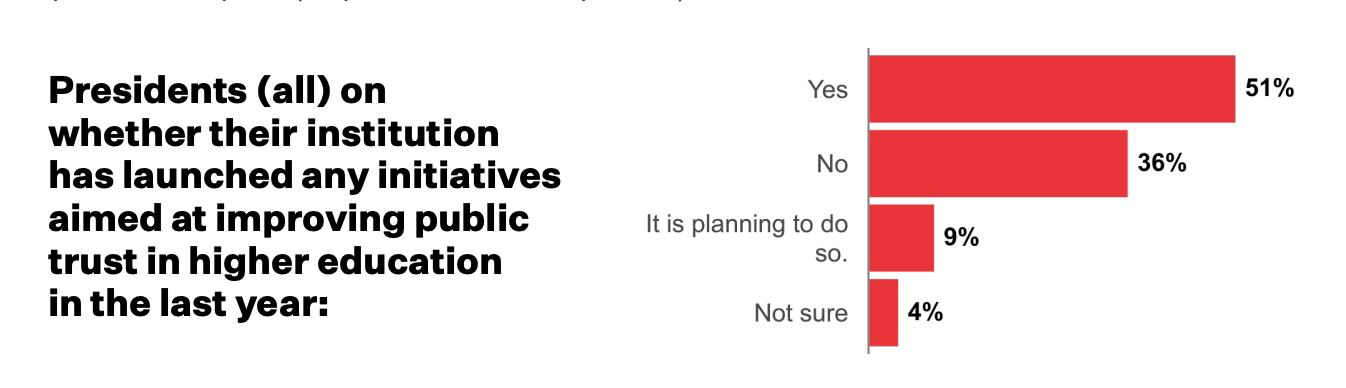
Concerns about the value of college are persistent. Nearly 80% of Americans say universities are doing only a fair or even a poor job of keeping college costs affordable. Between misunderstandings about college’s sticker price versus net price (which has actually declined in recent years), and pessimistic perceptions of college affordability (despite high college wage premiums), efforts to increase cost transparency and communicate the financial benefits of a degree are necessary and worthwhile. University leaders are right to address concerns and misconceptions about college affordability.
But presidents also recognize that the current trust-building initiatives are lacking. Only 16% of IHE respondents believe that higher education has responded effectively to declining public trust (up from 8% on last year’s survey), with just 2% saying they have been “highly effective.”
And this might be because the loss of trust in higher education is about more than just affordability. To truly rebuild trust, universities must acknowledge that public skepticism is also about the intellectual climate on campus. The two issues of cost and climate are likely intertwined: the high sticker price of an education perceived to be ideologically biased only deepens public distrust. But concerns about intellectual climate are worth addressing in and of themselves, not just as measures to overcome fiscal apprehension. Trust-building efforts that address cost concerns while skirting issues of open inquiry and the climate of free expression will not fully restore public confidence.
Surveys consistently show that concerns about political bias and intellectual climate are also major drivers of weakened trust among the public. A 2025 Lumina-Gallup survey found that those with a low degree of confidence in higher education often cited concerns about “political agendas” as well as concerns that universities are “too liberal/political.” The same survey found that across all respondents, many think that universities could bolster public support by being “less politically biased.” A 2025 Pew survey found that 45% of Americans think that colleges are doing only a fair or poor job of exposing students to a wide range of viewpoints, and a 2025 survey of over 31,000 Americans found that 77% of respondents (including 72% of Democratic voters) were concerned about liberal bias on campus.
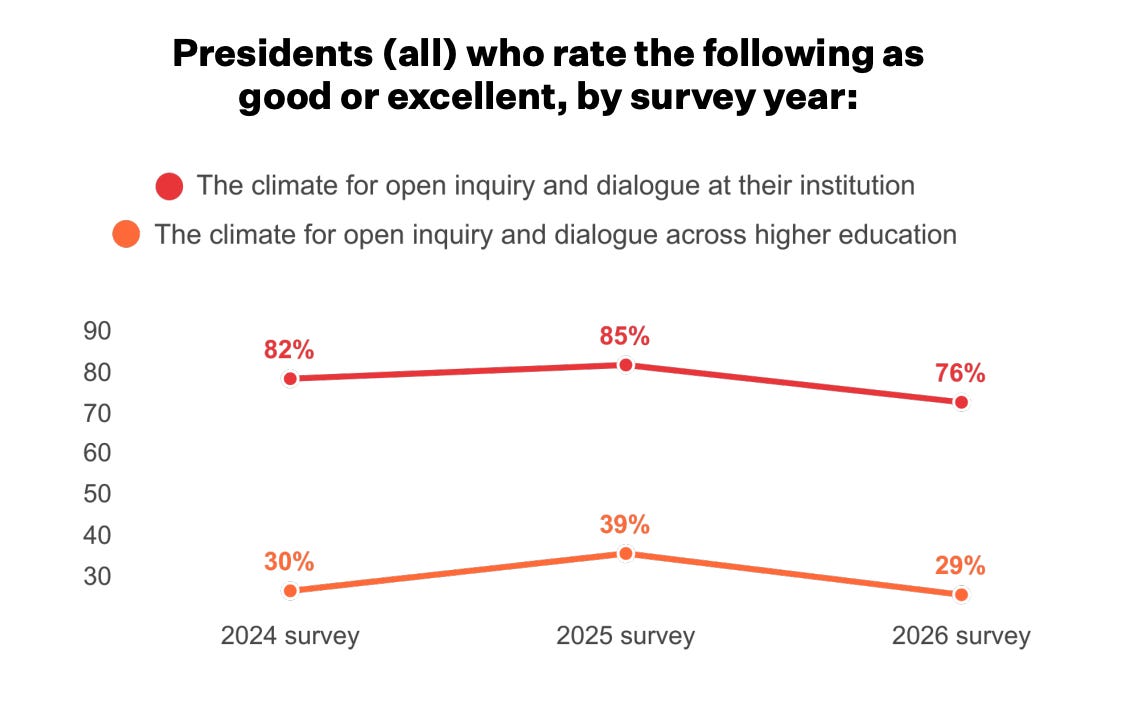
Despite growing evidence that declining trust is tied to concerns about politicization and intellectual climate, college leaders are reluctant to see similar problems on their own campuses. IHE’s survey found that only 29% of respondents rated the climate for open inquiry and dialogue across the higher education sector as “good” or “excellent,” indicating broad recognition that something is amiss. But interestingly, leaders are much more optimistic about the conditions on their own campuses.
In fact, they are more than twice as likely to rate the climate of open inquiry and dialogue at their own institution as “good” or “excellent” compared to higher education more broadly. This has remained true for three years now. (Though, there has been a nine percentage point decline in the more optimistic share of presidents, from a high of 85% in 2025 to 76% in 2026.) Unless the hundreds of participating presidents came almost exclusively from the healthiest of institutions, this gap suggests that presidents’ rosy perceptions of the climate for open inquiry on their campuses may not fully reflect the reality on the ground.
If most presidents are confident in open inquiry on their own campus, even if less sanguine about other institutions and despite widespread public doubts, what motivation is there to pursue meaningful reform? To win back public support, and to protect the truth and knowledge-seeking mission of the university, effective trust-building efforts must address concerns about bias and politicization on campus.
Some institutions appear to be attuned to this, and have pursued more comprehensive trust-building efforts that go beyond return-on-investment messaging. Yale has commissioned a faculty-led group to study trust in higher education, and some public universities in Pennsylvania have undertaken efforts to strengthen trust through community partnerships, for example. These promising efforts are hopefully indicative of broader efforts to come. But if only a minority of leaders see the need to meaningfully strengthen open inquiry and free expression at their own institutions, then collective action in defense of open inquiry will remain a long way off.
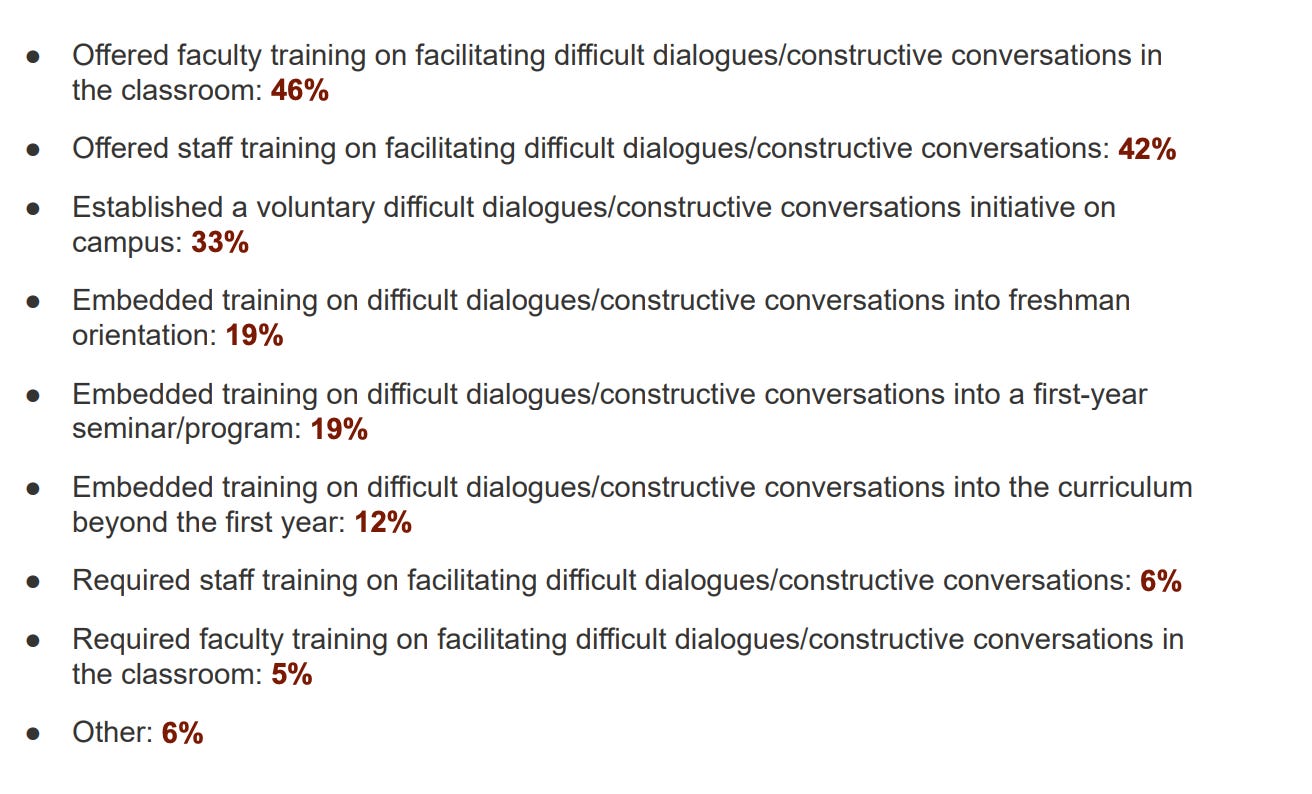
Leaders are not entirely neglecting campus initiatives aimed at bolstering intellectual climate. Seventy-five percent of IHE respondents indicated that they had undertaken specific initiatives to educate their campus community about free speech and difficult dialogues. Yet here, too, we see shortcomings. The steps taken by the largest swaths of presidents are voluntary. Embedded programming and training on these issues are seen on only a small fraction of campuses, and required trainings for faculty and staff are rare. Moreover, while dialogue initiatives and trainings may be well-intentioned,programs that draw from an ideologically narrow range of views still fall short of promoting open inquiry.
Meaningful, sustained reform of higher education is best driven by those who care most deeply about their institutions and wield powerful influence over their direction. These inside reformers such as presidents, provosts, deans, and high-level administrators must adopt a clear-eyed view of the challenges at hand — all of the challenges, including the ones in which their own campus cultures are complicit.
To meet the moment, university leaders must move beyond messaging and also pursue a full-throated embrace of open inquiry on their campuses. This means undertaking initiatives that are overdue (and also potentially uncomfortable), such as improving strategies for identifying overlooked (or prematurely sidelined) research areas; broadening the range of scholarly perspectives in curricula; educating students and faculty about the principles of free speech and academic freedom; and emphasizing intellectual virtues such as humility and curiosity.
While cost transparency initiatives are important, they are less difficult and less culturally disruptive than addressing ideological homogeneity and its downstream consequences. But strengthening open inquiry on campus is well worth the difficulty and disruption — and it is essential to restoring public trust.
I am a donor to HxA in lieu of donating to my alma mater (Brown class of 1978). After years of trying to bring the issue of their advocacy of a particular viewpoint to their attention and suggesting they needed, at a bare minimum, to do some serious introspection on this matter, I gave up. Not being a billionaire donor, I rarely got so much as an auto-reply to my concerns and suggestions. I now support HxA with the continued belief and hope that change to academia must come from within. Just as with other mono culture institutions (NPR is another egregious exemplar), it seems while swimming in their homogeneous swamp waters they are completely incapable of seeing what they are without some outside shock to the system. While I am not a fan of some/much of what the politicians are doing, it has raised awareness and in some cases has had an impact on the money. Sadly, where reason can’t prevail, financial self interest usually does. I still worry that any “changes” being made now are window dressing while they weather what I am sure they hope is a passing political storm. Perhaps HxA could take on a project of seeing how estranged alumna/alumni such as I could have an impact on supporting necessary change in once beloved and respected institutions.