



HxA has long argued that ideological conformity within the academy suppresses worthy lines of inquiry. Similar concerns have been raised by the much-discussed Vanderbilt/Washington University Report and the Yale Report, both of which identify ideological conformity as a threat to open inquiry. But identifying the specific topics, questions, and perspectives that have been stifled is a challenging task, requiring disciplinary expertise and an intimate understanding of how each field operates.
Fortunately, nearly 350 HxA members hailing from a variety of institutions, disciplines, and sub-fields recently allowed us to pick their brains on what might be called “topics non grata.” In collaboration with University of Buckingham political scientist Eric Kaufmann, and psychologist Andrew Hartz, we surveyed these members to better understand these areas of missing and neglected scholarship. The question at the heart of the survey: “Are there any topics you feel have been inappropriately neglected in your own discipline for ideological reasons?”
What did HxA members tell us? Broadly speaking, topics relating to race, sex, religion, and politics were all identified as unfairly neglected within respondents’ disciplines. These findings, though not representative of entire disciplines or comprehensive in their coverage, support the suggestion that some topics are perceived to be off-limits because they are broadly considered to be ideologically unpalatable rather than lacking in scholarly merit.
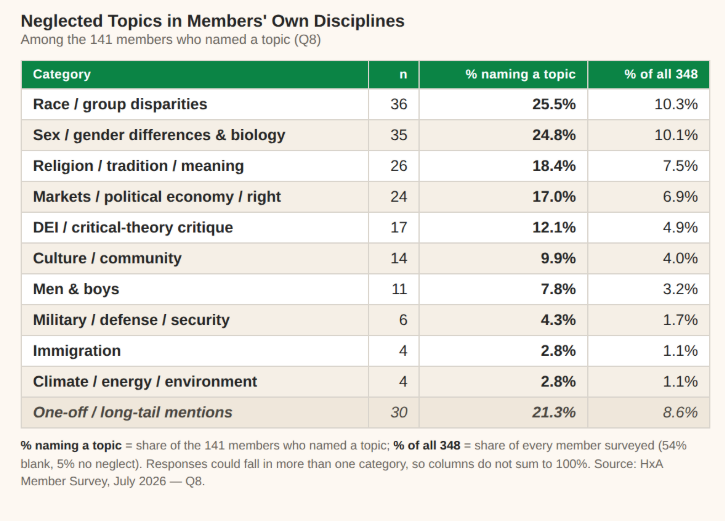
To better understand these responses, we used Claude Opus 4.8 to identify general recurring themes in the dataset, and then developed a list of search terms for each. Responses were assigned to a theme based on the terms they contained. Of the 348 member responses we received, 141 (41%) affirmatively named at least one topic in their field that they felt was neglected. About 54% of respondents left this question blank, and another five percent said that they didn’t think any topics were neglected in their field. (The share naming a topic varied significantly by discipline, with 30% of STEM faculty and 34% of arts/humanities faculty affirmatively naming a neglected topic compared to 45% of social science faculty.)
About a quarter of those who named a neglected topic mentioned issues relating to race or group disparities. Named topics in this area (loosely paraphrased) included subjects such as “differential crime rates across racial groups,” “challenges in LGB families,” and “impacts of family structure on child wellbeing.”
Some scholars do grapple with these questions, but often at a cost. For instance, research that bucked common narratives about police shootings and race created considerable backlash for Harvard University economist Roland Fryer. A study that found worse outcomes for adult children of parents who had same-sex relationships earned University of Texas sociologist Mark Regnerus considerable scorn, even resulting in an audit of the paper’s peer-review process. And a book on the importance of two-parent households on child development was opposed by a reviewer on moral rather than scientific grounds, according to the book’s author, University of Notre Dame economist Melissa Kearney.
Naming these particular topics and perspectives is not the same as endorsing them. At HxA, we are less interested in the advancement of specific academic claims than ensuring that the environment for scholarship remains intellectually rich and unencumbered by artificial restrictions on inquiry. That’s because any attempt to improve society and create conditions that allow people to flourish requires reliable knowledge, which scholars can’t produce when they feel pressure to steer clear of certain areas of inquiry.
The Fryer, Regnerus, and Kearney examples illustrate that the pursuit of ideologically unwelcome topics may not necessarily result in total academic ruin; after all, these three professors are well-known and continue to produce research in their fields. Still, even for these well-established scholars there was a price to pay, as evidenced by the varying degrees of controversy and in some cases institutional pushback that their work generated. Moreover, we don’t know how many other scholars and their ideas never made it through ideological or partisan gauntlets. And so, it’s impossible to know what the state of scholarship would look like without the immense pressure not to explore unpopular ideas.
The controversy surrounding political scientist Bruce Gilley’s “Case for Colonialism” is a good example of how the perceived hostility towards certain politically heterodox perspectives can lead to ideas and arguments being suppressed. Gilley’s article, which argued that colonialism often led to improved quality of life, was withdrawn from publication after several of the journal’s board members stepped down in protest and the journal’s editor received threats of violence.
Off-Limits
Much of the rest of the affirmative responses in the survey also dealt with topics that can easily be seen as too controversial to consider. For instance, about 25% of responses to this question mentioned topics related to sex / gender differences & biology such as “gender identity” and “gender dysphoria,” areas with no shortage of academic controversies. Likewise 18% of responses mentioned topics relating to religion, tradition, and meaning such as “the role of religion in public life” and “virtue ethics,” and about 17% of responses mentioned topics relating to markets, political economy, and the political right, such as “conservative political theory” and “the value of social cohesion.”
In a follow-up question, we asked respondents what was the main reason for academia’s neglect of topics, this time offering a list of choices as well as a free response option. The top two reasons selected were that topics were viewed as “too controversial” (29%) and that they were “overlooked due to the intellectual focus of faculty” (29%), followed by being “viewed as old-fashioned/no longer relevant” (11%). Nearly a third of respondents (31%) wrote in answers such as “all of the above,” that the themes are seen as “un-progressive” (or, in the words of one respondent, “gross”), or that academia incentivizes conformity over intellectual risk-taking.
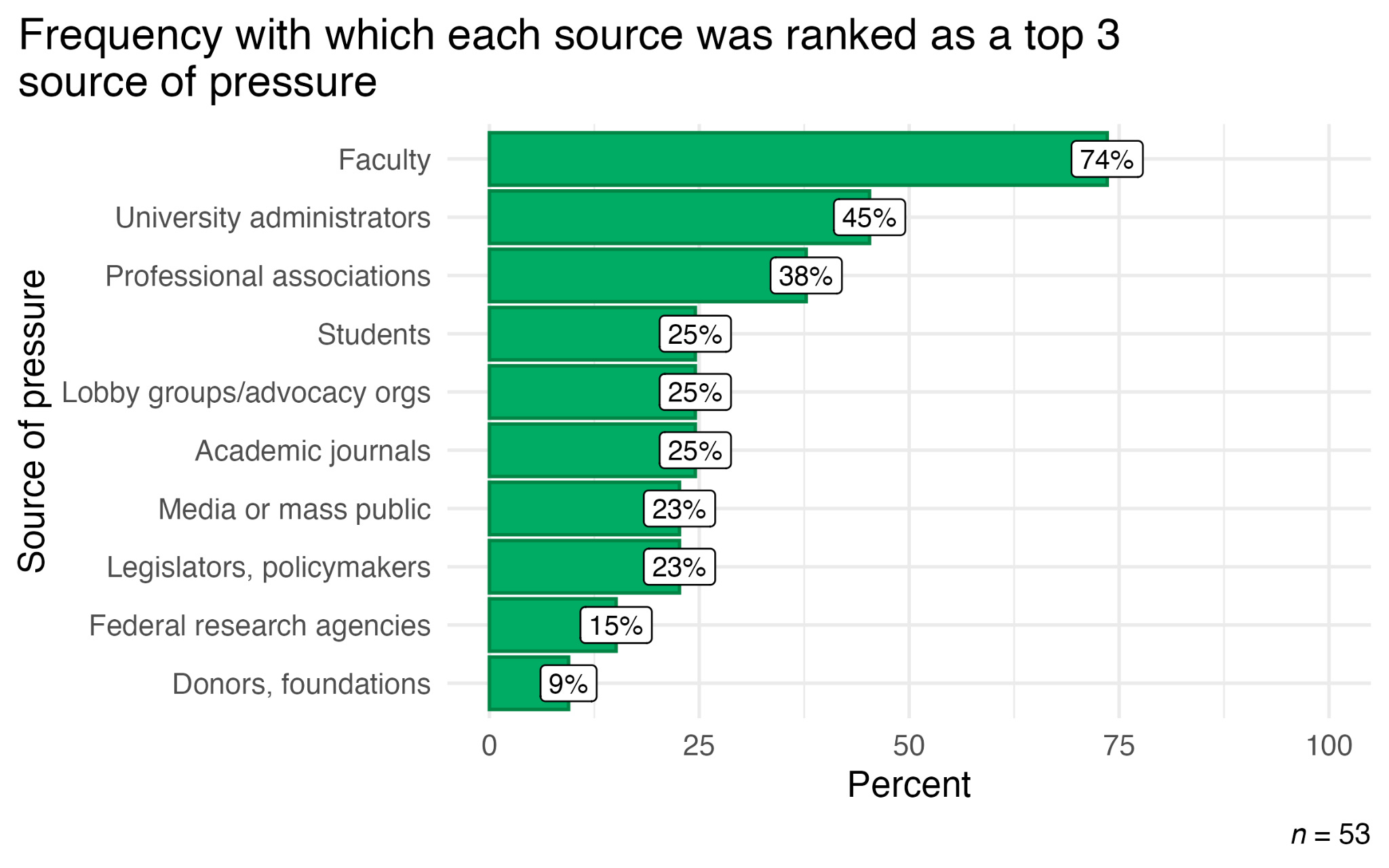
Among the 55 (29%) respondents who answered that the topic was seen as “too controversial,” we asked where they thought the ideological pressure was coming from. Respondents ranked ten possible sources of pressure, including students, the media, politicians, and other professors. Other professors were ranked among the top three sources of pressure by 74% of these respondents, followed by university administrators (45%), and professional associations (38%).
HxA members likely differ in meaningful ways from the general faculty population, making it difficult to draw definitive conclusions from these findings about what the broader professoriate thinks about these same questions. For instance, our sample was more politically diverse than the general professoriate, with about half of respondents identifying themselves as politically moderate, 30% as conservative, and 20% as liberal. Our sample also skews more male than the general population.
As with much qualitative data analysis, there may be different ways to code or categorize the data. And while the survey size and parameters make it impossible to draw the broadest conclusions, these results point to a shared sense among at least some faculty that certain topics are unwelcome in their disciplines, particularly those topics involving contested issues and certain political perspectives.
While the survey falls well short of being an exhaustive list of missing scholarship, we hope that it will help prompt faculty to push worthy understudied topics toward the spotlight. As evidenced by the internal and external momentum for reform, the appetite for open inquiry is clearly growing — it just needs the right conditions to flourish.


https://www.unbekoming.com/p/the-human-instability-principle