


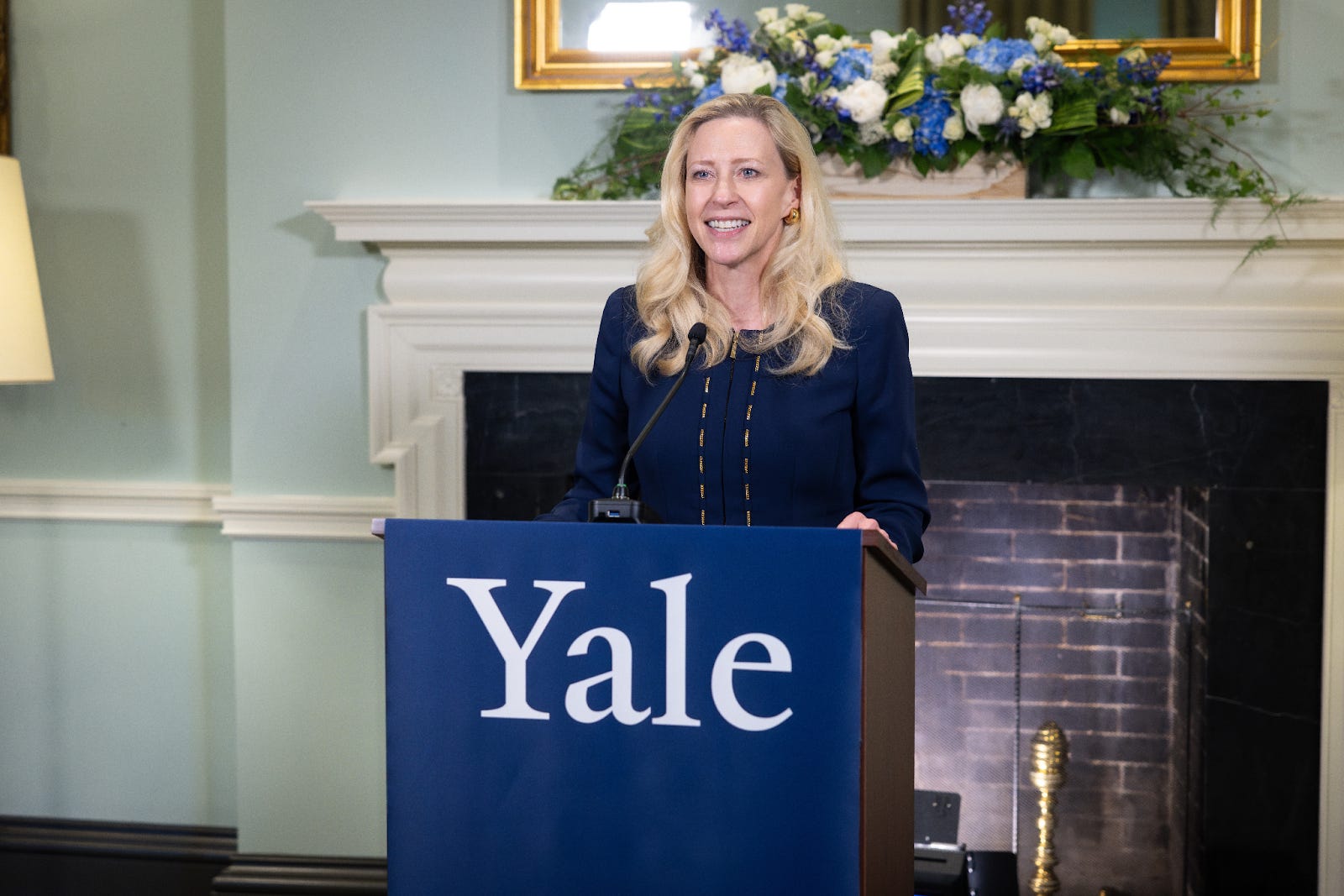
The biggest news of the week is the release of a landmark report from the Yale Committee on Trust in Higher Education. Tasked by Yale president Maurie McInnis to “examine the problem of declining trust in higher education,” the report finds three major factors behind the plummeting public trust, one of which is an “array of issues about what is said and taught on university campuses, including matters of free speech, political bias, and self-censorship.”
Coverage was swift, and the message clear: the blame lay with the academy. The New York Times called it a “brutal assessment” of the academy’s role. The Wall Street Journal said the report explains “why everyone hates the Ivy League.” Fortune remarked that the report “savages” the Ivy League for “destroying American trust.”
The report authors note a foundational issue underlying the decline of trust: a lack of clarity about the purpose of the university.
The range of topics revealed another challenge related to declining trust: widespread uncertainty about the fundamental purpose and mission of higher education. Trust is earned by doing what you say you’re going to do — and, ideally, doing it well. In recent years, however, universities have been expected to be all things to all people: selective but inclusive, affordable but luxurious, meritocratic but equitable. Rather than build public support, this diffusion of purpose has contributed to distrust. Without a clear mission and purpose, it becomes difficult to judge whether colleges and universities are living up to their fundamental commitments.
The Yale Report represents what many Heterodox Academy members have been saying for a decade now: the highest mission of the university, its telos, is truth-seeking and knowledge generation. Teaching and research are fundamental to this mission. Everything else is superfluous to what a university is.
The Yale Report follows a recent shift in the reform discourse that has been playing out all academic year, albeit sometimes quietly: academics, who largely lean left, are increasingly self-critical about the academy and the internal work that must be done. This is probably motivated in part by the onslaught from politicians since Trump’s return to office and the need to get our own house in order before someone else tears it down. But it’s also in part due to an increasingly vocal community of academics who have long called for viewpoint diversity in the academy for the good of scholarship and teaching.
Consider the Yale Report in this context: co-chaired by an HxA member with dozens of HxA members’ scholarship on these issues cited. HxA had a seat at the table alongside organizations like the American Association of University Professors and the Association of American Universities. Even a couple of years ago, this would have been highly unlikely.
This change goes beyond the Yale Report, though. Harvard is “recommitting to free inquiry and civil discourse.” Presidents are increasingly speaking out on the national stage about the need for reform. Folks like Sian Leah Beilock of Dartmouth and Daniel Diermeier of Vanderbilt (who will be speaking at the West Coast HxA conference at UC Berkeley on Thursday) are the most notable examples.
Earlier this month, academics were discussing the impact of the latest large-scale research replication effort in the social sciences, led by the Center for Open Science, which showed that only about half of the thousands of claims evaluated replicated in the same direction. HxA member Ashley T. Rubin told the Chronicle of Higher Education it was “a huge problem.” Ian Adams, also a member, explained to the Chronicle that the lack of transparent sharing of data in his field of criminology is eroding trust in the field and makes replication extremely difficult. Today, academics on the whole are candid about the problems in social science research, and research on political bias continues to make headlines; 10 years ago, many were dismissive.
The humanities are also turning the mirror on themselves. In the Chronicle this week, Justin Smith-Ruiu, a professor of history and philosophy of science at Université Paris Cité, offers his own brutal assessment of why the humanities are collapsing and closing down across the academy.
Have the humanities departments responded to their falling enrollment numbers by renewing their commitment to the great tradition, to helping their students wake up to the wonder of the human mind as manifest in its most enduring monuments? They have not. Instead [...] the humanities are undergoing a rapid process of what Tyler Austin Harper has called “business-schoolification.”
The solution in the case of the humanities is less clear, but many like Smith-Ruiu are advocating for a return to the core of what the discipline historically was, and doing things like returning to the “Great Books” style curriculums and shedding its modernization and vocationalization that have taken hold of many non-STEM areas of the academy in recent decades.
All this to say that there seems to be a genuine turn in the tide this year. Despite the obvious external stress on the academy, it really does seem to be a proverbial “moment.” Large-scale meta-research on ideological bias is coming out consistently across fields; academics are taking to the media and Substack to analyze and discuss fundamental issues like the mission of the university; presidents are taking viewpoint diversity and open inquiry seriously; HxA members are creating institutional policy and driving internal reform. It’s all happening now.
There still remain substantial risks at this moment, though. State legislatures are continuing to gut tenure, programs, and content from public universities; reformers must be careful to not repeat old mistakes from the last decade; and universities risk the presidency becoming a tool of the state. Even internal reform, like what is proposed at Yale, must still be worked out and implemented. There are many outstanding questions, such as the efficacy of department “self study,” and how an “analytically thin” diagnosis of the problem could lead to imprecise solutions, as some academics have shared this week.
Despite all this, “there are indeed some positive signs that university leaders are correcting course.” Yet, “there is much work still to do,” as HxA member Roger Pielke Jr. opined this week.
I agree.
You simply can't say things like "largely lean left" and be taken seriously by the huge number of smart, educated people who have been taught (very well) to despise the universities. They don't "lean" and it isn't "largely". The faculty and (even moreso the entire administrative apparatus) at American colleges and universities are monolithically hard left, anti-American and racist. Not to mention that so many professors are simply not very smart anymore outside the Ivies.
Yes, this Report is a move in the right direction. That is commendable! I would add, though, as others (including Lauren Hall) have, that the Report is not brutal enough. To see some additional, well-articulated, important considerations, take a look at Hall's most recent piece: https://radicalmoderatesguide.substack.com/p/higher-education-doesnt-just-have