


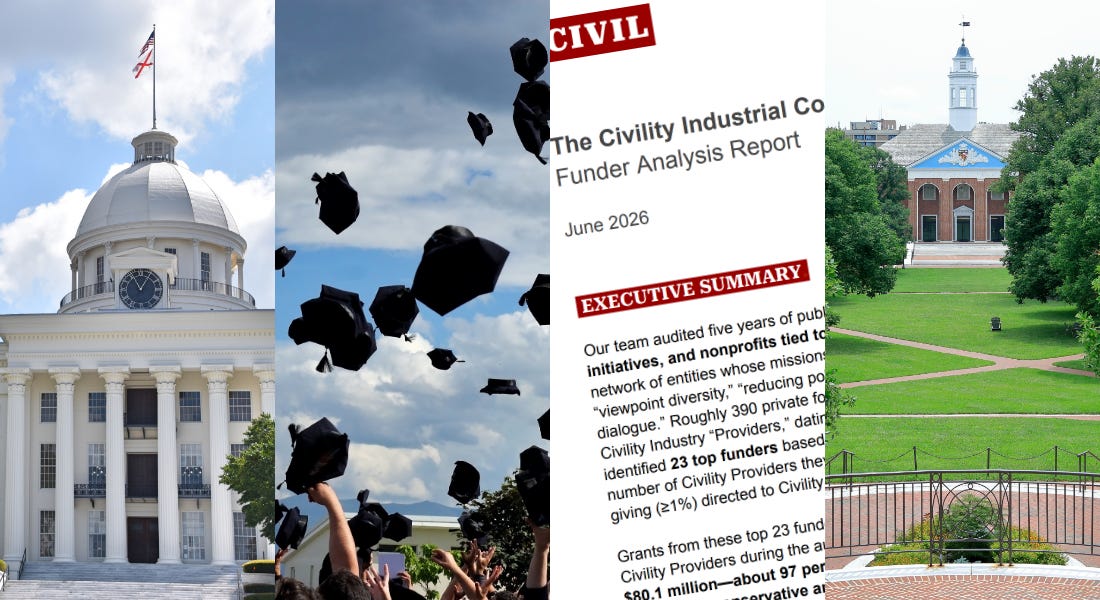
This week we’re following a variety of stories, including a new review policy at the University of Alabama campuses that leaves an open door to dismissal for tenured faculty; a new study showing how the politics of commencement speakers vary; some drama that has ensued from the release of a report about who is funding “civil discourse” programs on campuses; and what Johns Hopkins University is doing to address viewpoint diversity on campus.
Let’s dive into the top open inquiry news stories we’re watching this week at HxA.
University of Alabama system enacts post-tenure review in new policy.
Earlier this year, the Alabama state legislature passed a Republican-backed bill requiring post-tenure review at its public state universities. This week, the board of trustees unanimously voted to put in place that review process for all tenured faculty, which will recur at least every five years. The new rule states:
Post-tenure review is intended to promote ongoing academic quality and institutional excellence as well as to recognize faculty contributions. In addition, it is also to assist a faculty member to improve their service, teaching, and/or research abilities through an assessment of performance and outcomes, identifying any areas of incompetency, serious or pervasive neglect of duty, or other good cause (including serious misconduct), which adversely affects the institution or the faculty member’s performance of duties or meeting of responsibilities.
The last reason in that list is cause for alarm, allowing for the firing of a tenured faculty member if “there is other good cause.” This “good cause” is left undefined and underspecified — a recipe for these rules being used to violate the academic freedom that tenure is designed, in part, to protect.
Tenure has come under greater scrutiny in recent years. On its face, post-tenure review can function as its advocates claim: to hold faculty accountable for their performance, such as underperformance or abusing the security to pursue political advocacy. However, HxA member Deepa Das Acevedo provides a persuasive rebuttal of such claims that everyone interested in tenure policy should read.
Tenure is necessary to ensure the job security needed to do the long-term work of research and teaching and to protect free expression. For it to produce the best scholarship and education, however, these rare appointments need to be given to highly qualified scholars. This suggests the problem that needs addressing is faculty hiring, not tenure.
The politics of commencement speakers are predictable.
A new study published this week provides more data in the ‘what is going on with commencement speakers’ genre. And while, unsurprisingly, they found commencement speakers tend to lean liberal — increasingly so since 2011 — there is also some variation.
…public colleges were more likely than private ones to invite speakers who supported conservative candidates, as were colleges that focused more on occupational and professional programs. Meanwhile, institutions that enrolled more students of color and those with larger endowments were more likely to select liberal-leaning speakers. Unsurprisingly, the state’s political leanings also had an impact; institutions in blue states tended to invite more left-wing speakers, and the same was true for conservative speakers in red states.
A more intriguing finding from the study is what happens in the years after there is public pressure to disinvite speakers from commencement. Commencement speakers are drawing increasing controversy, especially in just the last few years, and the long-term impact is universities selecting for “safer” speakers in the following years.
In principle, commencement speaker politics shouldn’t matter very much, as the event is not about the speaker but the graduates. Speakers shouldn’t use their stage and captive audience as a stump speech for their political advocacy.
Everyone is arguing about what “civil discourse” programs are or are not really about.
The past two weeks have seen a ramp-up in sometimes “uncivil” discourse about civil discourse programs, as the efforts have proliferated across the academy this past year. Besides debates on what these things should be called and whether they will work, there is now argument about where the money is coming from and what that says about whether they are part of a nefarious right-wing plot on campus.
The new report published by a group called “Uncivil” whose goal is to expose the “Civility Industrial Complex” claims that “Based on our analysis, the funders most deeply committed to ‘bridge-building,’ ‘viewpoint diversity,’ and ‘depolarization’ projects are those that also hold a substantial stake in conservative and/or ‘pro-Israel’ causes.” Uncivil’s spokesperson told Inside Higher Ed that the programs are “abetting an authoritarian capture of the public sphere.” The implication, in other words, is that anything conservative is automatically bad for higher education.
Others are pointing out problems with the report’s methods and derived conclusions. Responding in Inside Higher Ed, Michael J. Murray, the head of the Arthur Vining Davis Foundations, which funds many civil discourse-type programs on campuses (including some that HxA runs), fired back, calling out critical issues with their data that arguably presupposed their conclusions.
That funding chart, moreover, was constructed in a way that all but guaranteed its own conclusion. To reach its list of “23 top funders,” Uncivil discarded every foundation that gave less than 1 percent of its total grant making to civility work, a threshold that, almost by definition, excludes large foundations with diverse portfolios, while keeping smaller, sometimes more ideologically focused ones. This threshold thereby excluded 19 foundations active in this space including the Ford, Hewlett, Knight, Packard and Robert Wood Johnson Foundations; the Democracy, Omidyar Network and Rockefeller Brothers Funds; the Lilly Endowment; the Carnegie Corporation; and George Soros’s Foundation to Promote Open Society.
Per Uncivil’s own data, these 19 other foundations gave more money to civility programs, in absolute dollars, than the 23 foundations Uncivil kept in their dataset combined. A filter that excludes the majority of the money in a field before calculating what share of the remaining dollars is conservative is not a neutral filter. It is a selection effect, and it deserves scrutiny before its output gets treated as a “finding.”
Aside from the emerging polarization within the “civil discourse” space, this broad group of programs still needs to reckon with the deeper issue of viewpoint diversity on campus. As HxA president John Tomasi has previously written, these programs risk being mere “academic theater” if the viewpoints that are talked across remain narrow.
Johns Hopkins’s president is taking viewpoint diversity seriously.
Ronald J. Daniels recently sat down for an interview with the Chronicle of Higher Education and made the case that the underrepresentation of conservative scholars in the professoriate is not primarily a fairness problem — it’s a quality problem.
The fact that conservative scholarship is underrepresented in our institutions ultimately means that the left gets flabbier because it’s not being tested and challenged in the way it ought to be. At the same time, the right, to the extent that it moves outside the university and finds itself in think tanks and is not subject to challenges or critiques from the center and the left, becomes more radicalized. This is not just a problem for our institutions. It’s a problem for America. So I do feel urgency in trying to remedy this issue.
And Daniels is working to do so. Under his tenure, Hopkins has opened the Agora Institute to get conservative and progressive scholars working directly with one another, launched a new School of Government and Policy to create a truly pluralist environment, formed a partnership with the American Enterprise Institute to gain advice on faculty recruitment, and created new faculty lines to get more viewpoint diversity across the university.
Have campus news related to open inquiry that we should be aware of? Share it with us by sending a quick email to communications@heterodoxacademy.org
Give me a break!!! Although it has been a while since I matriculated, I spent 8.5 years in college to obtain a BS. M.S, and Ph.D. Some of my professors were brilliant. Three in particular had a huge, very positive impact on my life. But then there was the deadwood.
Let me discuss two of my greatest hits:
1) Stan the Burnout. Stan was in his 50’s when I had him for undergraduate stratigraphy. Stan could not be bothered to make up new tests every year, so he used the same ones over and over again. Then he handed back the corrected versions. Well, it did not take long for us to figure out how that game was played. We got the midterms and finals from our upperclassman friends and memorized the answers. We all got A’s and none of us learned a single thing. And this was before grade inflation. 🤣🤣🤣
2) Charles the Pervert: Charles was in his 60’s, when I was his TA. I don’t think he ever published an original piece of work, and he was a horrible teacher. He did like teenage girls, however. Charles was still an Associate Professor. The department wanted him out for years after he hit on a married woman early in his career and that led to a fist fight with the husband. But you can’t fire someone with tenure, right? So, there he was; 60+ years old and hitting on 19-year-old girls. Fortunately, girls were made of sterner stuff when I was in school. “Karen” used to hold court in the geology student lounge. She had us literally rolling on the floor laughing at Charles’ latest ham-fisted advances.
The idea that you need tenure to do long term research is ludicrous. The researchers at Nvidia did not have tenure when they developed AI chips. Neither did the coders at Anthropic who developed the first LLM. How about the Moderna and Pfizer scientists that invented mRNA vaccines? I could go on. Several scientists at Bell Labs won Nobel Prizes.
Universities are medieval institutions. They originally developed as outgrowths of the church The cap and gown were the hottest thing in fashion for a 13th century European cleric. Tenure is a holdover from that period, in which one was expected to devote his (no hers allowed) life to the monastic lifestyle. You check in but you don’t check out.
Getting a tenure-track position at a university these days is like winning the lottery. There is a vast oversupply of Ph.D.’s. In STEM, most will go to industry but many of those in the humanities are condemned to a lifetime of poverty as adjunct professors. The problem will get worse as the baby bust works its way through the university system. Some of those newly minted Ph.D.’s could be great teachers and researchers. We will never know until we make room for them by putting the burnouts and perverts out to pasture.
The section in this article about civil discourse was so discouraging. It seems there is absolutely no topic exempt from ideological capture or any way to save established institutions of higher education from themselves. Another exemplar of this seems to be that the only way to get universities to balance their scales is through the creation of various civics centers/departments SEPARATE from their established humanities/social science departments. More and more it seems to me that established institutions just can’t get through the knothole to pursue viewpoint diversity. I am a donor to HxA in lieu of donating to my alma mater with hopes there is a glimmer of a chance, but this sort of thing makes me reconsider my decision and instead direct my donations and legacy giving plan to those forming new institutions from the ground up. What a sad state of affairs. Ugh.