


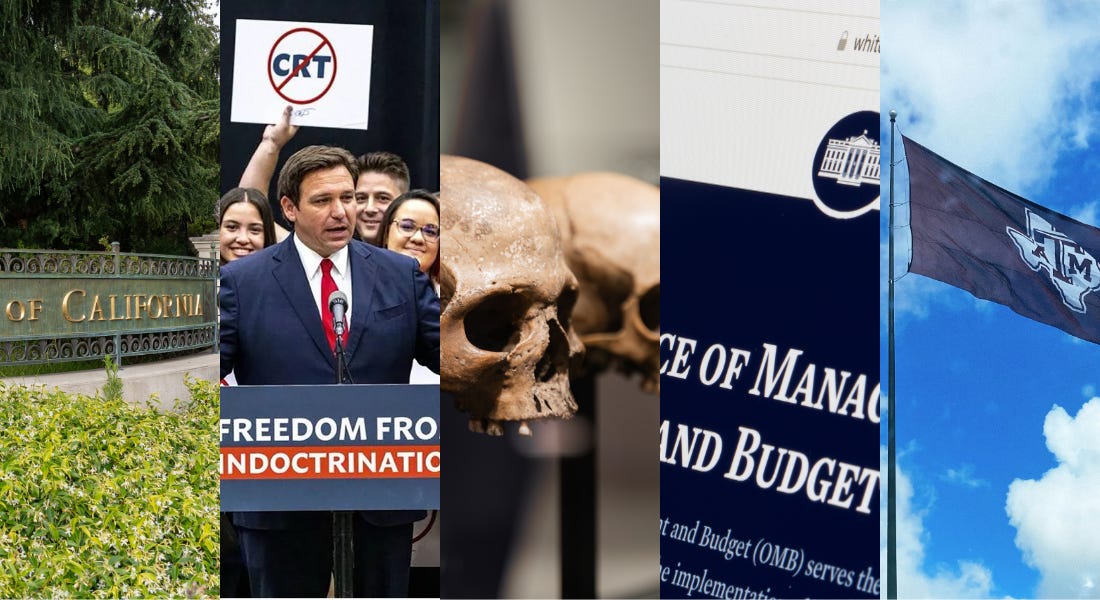
In open inquiry news this week, the University of California sets a plan to reevaluate the use of SAT scores in admissions, as requested by thousands of faculty; a newly proposed rule from Washington gives political appointees final say in federal grant decisions; content bans in university classrooms are still a violation of the first amendment and academic freedom; and more.
Check out the top news stories we’re watching this week at HxA.
The University of California system responds to a faculty letter asking that the SAT be reinstated in admissions.
Last month, thousands of STEM faculty across the University of California (UC) penned an open letter asking the administration to bring back the SAT for undergraduate admissions, citing underpreparedness among undergraduates since the test became optional during the COVID pandemic. Responses to the faculty letter have been overwhelmingly affirmative for reinstatement, with The New York Times Editorial Board running an op-ed urging the UC trustees to “have the courage to admit they made a mistake six years ago and reverse it” after the UC president said they are “revising” their timeline to make an “informed” and “evidence-based” decision, despite countless reports providing that evidence.
A decision is unlikely until next summer, meaning that SAT-free admissions will be in place at least through 2029 (given that many students take the test as juniors in high school). The Chronicle of Higher Education spoke to former president of UC, Janet Napolitano, who was in charge when the system went test-blind in 2020. Even she appears to have changed her mind, stating that the SAT is a “useful data point” in admissions, though she remains skeptical that adding back the SAT will fix the problems UC faculty noted in their letter.
Florida’s Stop WOKE Act still violates the First Amendment.
State legislatures in recent years have pushed laws that would ban certain DEI-related topics from classrooms. Florida’s Stop WOKE act, introduced in 2022, is perhaps the most prominent example. Last week, the Court of Appeals for the 11th Circuit upheld a lower court’s decision to block the law. As applied to higher education, the law would limit professors’ academic freedom in the classroom to speech aligned with the views approved by the State. Classroom content bans are a violation of the First Amendment and academic freedom (as I’ve previously written about here, here, here, and here); the court’s decision is another win for open inquiry and viewpoint diversity in the classroom.
The American Association of Anthropology doesn’t seem to be helping the discipline
In what has become a viral interview between Chronicle of Higher Education reporter Stephanie Lee and American Association of Anthropology (AAA) president Carolyn Rouse, the discipline of anthropology suffered another blow as Rouse failed to quell concerns of politicization of the discipline. Last month’s Vanderbilt-Wash U State of the Scholarship report called out anthropology as “the most extreme case” of scholarly deterioration.
An example of this cited in the report was the AAA’s 2023 decision to cancel an accepted symposium at its annual conference on the utility of biological sex in anthropology research (HxA later hosted that panel online to thousands of viewers). When asked directly by Lee if she regretted that decision, she dug in, arguing:
the idea that there are two sexes is just factually incorrect, and to force biological anthropologists to teach that is the equivalent of turning an astronomy department into an astrology department. So I don’t know why we’re debating that. You may not like it. I don’t know, maybe you want to kill babies that aren’t just XX presenting XX or XY presenting XY, but that’s what we have in this world.
The response has been swift and signals that AAA leadership isn’t helping the discipline bolster its reputation as a serious academic field willing to take criticism seriously.
New proposal supplants peer review with political appointees in federal grant reviews.
A new proposal from the Trump administration is aiming to give grant decision-making authority to political appointees. Section 200.205 of the proposal reads:
…senior appointees must conduct these reviews and apply specific principles when evaluating proposals. These principles include ensuring that discretionary awards advance the President’s policy priorities, prohibit the use of funds for discriminatory or otherwise impermissible purposes, and emphasize ensuring compliance with applicable law.
The revised procedure also clarifies that “peer review remains advisory and does not replace agency discretion” in review of federal grants. Further, “peer review recommendations remain advisory and are not ministerially ratified, routinely deferred to, or otherwise treated as de facto binding by senior appointees or their designees.”
The proposal argues that federal awards have often been used “to promote a ‘woke’ policy agenda” and that supplanting peer review with political appointee “merit review” will bring research in better alignment with the “Gold Standard of Science.”
According to reporting from the Chronicle of Higher Education, 341,699 comments were received during the public comment period. The University of Chicago, The American Association for the Advancement of Science, and The American Association for Cancer Research are among those who have put out public statements expressing deep concern with the new proposal.
Texas A&M cancelled two courses for the Fall semester under a new policy.
Last year, the Texas A&M University system’s board voted to institute a ban on DEI-related topics in college courses. Since then, several course cancellations have caused controversy as open inquiry and academic freedom are stifled. This week, reporting from the Chronicle of Higher Education obtained records showing how the policy altered courses for the upcoming year.
Two courses for the fall of 2026 were canceled outright […] Of 45 courses forwarded to the president’s office for consideration for the fall of 2026, 31 were given a green light, while eight more were allowed to proceed under certain conditions — such as removing or clarifying assigned readings — documents show. Those numbers were similar in the spring, when six courses were canceled and 48 of 54 were granted exceptions. Among the fall courses whose exceptions were approved were “Gender, Race, and Media,” “Racial and Ethnic Relations,” and “Human Sexuality.”
Have campus news related to open inquiry we should be aware of? Share it with us by sending a quick email to communications@heterodoxacademy.org