


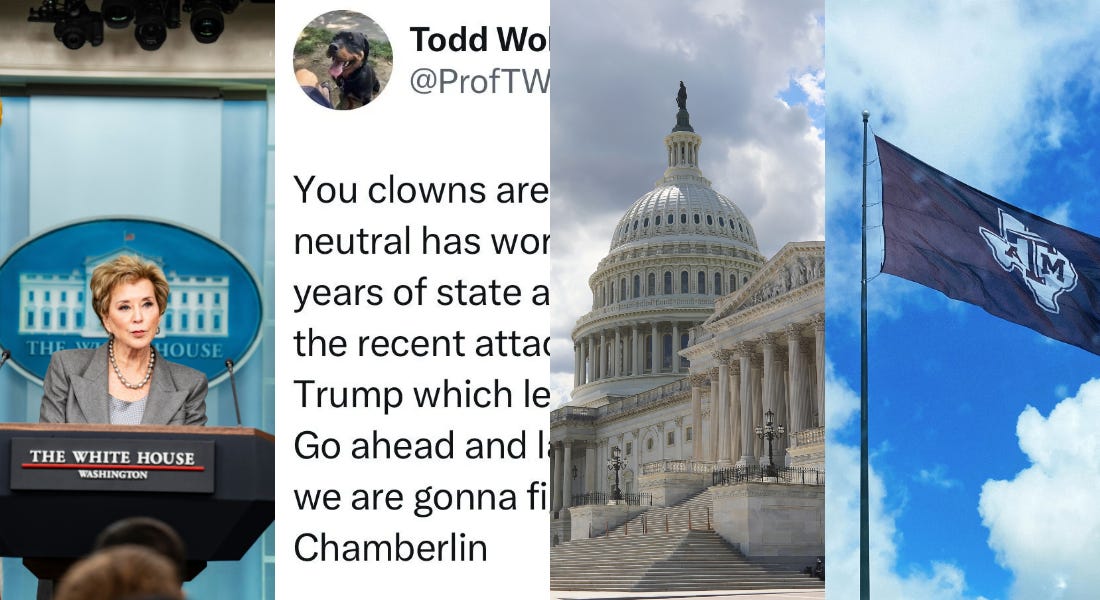
In open inquiry news this week, the Education Department swaps their big stick for a letter; AAUP president Todd Wolfson defends the union’s turn into political endorsements; a bipartisan group of senators make another attempt at banning legacy admissions; and Texas A&M gets sued over its restrictions on teaching race and gender in the classroom.
Check out the top news stories we’re watching this week at HxA.
The Education Department tries a more collegial approach in a new letter.
On August 3, Education Secretary Linda E. McMahon published a letter asking all colleges and universities “to describe to the American public your commitments to rigorous teaching, pathbreaking research, and national service” and post these plans “prominently” on institutional websites. The letter outlines seven topics she wants institutions to address, including increased transparency regarding how merit-based admissions decisions are made (which only impacts about half of US institutions, given that most institutions accept most applicants); plans to protect free expression, and specifically how to tamp down on “unruly and violent” disruptors on campus; plans to encourage intellectual pluralism; improving accessibility, cost, and loan repayment likelihood for enrolled students; how to address AI and ensure academic rigor; how to protect against foreign influence; and how institutions will serve the national interest.
On its face, these are all reasonable requests that every leader of a college or university should have an interest in addressing in some way. The reactions to this latest attempt at reform by the administration are varied. Late last year when the Compact attempted to beat institutions into change, many took more issue with the stick approach by the administration, and less with the substance of the requests. And in light of the hostile approach to reform since Trump returned to office in 2025, many are right to be skeptical. As Inside Higher Ed Editor-in-Chief Sara Custer puts it, there are more or less two ways to read this letter:
A charitable interpretation of the letter will see it as a genuine effort to close the divide between the American public and higher ed. A less generous view would say it’s more federal overreach that tramples on institutional independence. We’ll know by the end of the year if any institutions choose to participate, and what happens if they don’t.
The AAUP’s decision to back political candidates propped up by a 40 person Zoom poll.
In a stunning abandonment of their past principled defense of academic freedom, the AAUP started backing political candidates, in part of their transformation to “an organized, fighting union.” That decision was enough to draw criticism from principled reform groups like HxA, with HxA Board Chair Jeff Flier calling the move a “profound institutional mistake that will cost AAUP whatever credibility it retains as a principled defender of academic freedom.” But the key piece of data AAUP president Todd Wolfson used to support his decision makes the decision even more egregious.
As I shared last week after the news broke, Wolfson cited a big statistic to defend AAUP’s political turn: 80% of Michigan AAUP members supported the national arm endorsing a political candidate. It turns out that 80% was of only about 40 members (of approximately 4,000 state-wide) that were in attendance at a Zoom meeting. The criticism is coming from inside the house, with AAUP members surprised by Wolfson’s use of the poll as justification. Reporting from Inside Higher Ed describes the reactions of several members, including one noting that his “jaw dropped” when he read Wolfson’s statement about the poll. AAUP is obviously defending its position, with Wolfson calling critics “clowns” in a now-deleted X post:
You clowns are right. Being quiet and neutral has worked so well during 55 years of state and federal divestment and the recent attacks from [Florida governor Ron] DeSantis & Trump which led to debt and contingency. Go ahead and lay down & claim neutrality, we are gonna fight. See ya later Chamberlin.
Another attempt to ban legacy admissions reaches the Senate.
The Merit-Based Educational Reforms and Institutional Transparency Act, backed by Republicans Todd Young, Tim Scott and John Kennedy, as well as Democrats Tim Kaine, Raphael Warnock and Andy Kim, was reintroduced to the Senate, in the latest attempt to formally ban the practice of legacy admissions at selective universities. The legislation would tie accreditation to colleges having admissions policies that don’t give preferential treatment to applicants based on their relationships with alumni or donors. Roughly a quarter of four-year universities consider legacy status in their admissions practices. Some states, like California, already ban the practice and tie adherence to public funding, which some universities like Stanford have waived to continue the practice.
Legacy admissions are proving harder to purge than other preferences like race precisely because the practice is inherently tied to the university’s prestige, network, and donations in a way that other admissions criteria are not. As Raphael Montes explains in the Chronicle of Higher Education:
The core reason existing legacy bans are so hard to enforce is that they take aim at something central to the university. Legacy is the mechanism by which universities incorporate themselves into affluent families and create a self-perpetuating alumni network. That network gives elite institutions their pricing power over admission seats and a competitive advantage against younger or less august competitors. We have an antitrust problem without an antitrust solution. It’s one thing to break up a company, but it’s much harder to unwind a genealogy of accumulated prestige.
Texas A&M gets sued over its course bans.
Texas has been in the crosshairs of defenders of academic freedom for its unrelenting push to scrub leftist race and gender topics from classrooms (we’ve covered these issues with frequency over the last couple of years). Now, the AAUP is suing the Texas A&M university system for its banning of courses that “advocate race or gender ideology, or topics related to sexual orientation and gender identity.” The lawsuit alleges “insufficient guidance as to what may or may not be taught, assigned, or said in a classroom, and allows virtually unfettered enforcement discretion such that disfavored viewpoints can be censored.” Texas A&M spokespeople counter that the policies are simply a way to balance academic freedom with responsibility.
Have campus news related to open inquiry that we should be aware of? Share it with us by sending a quick email to communications@heterodoxacademy.org