


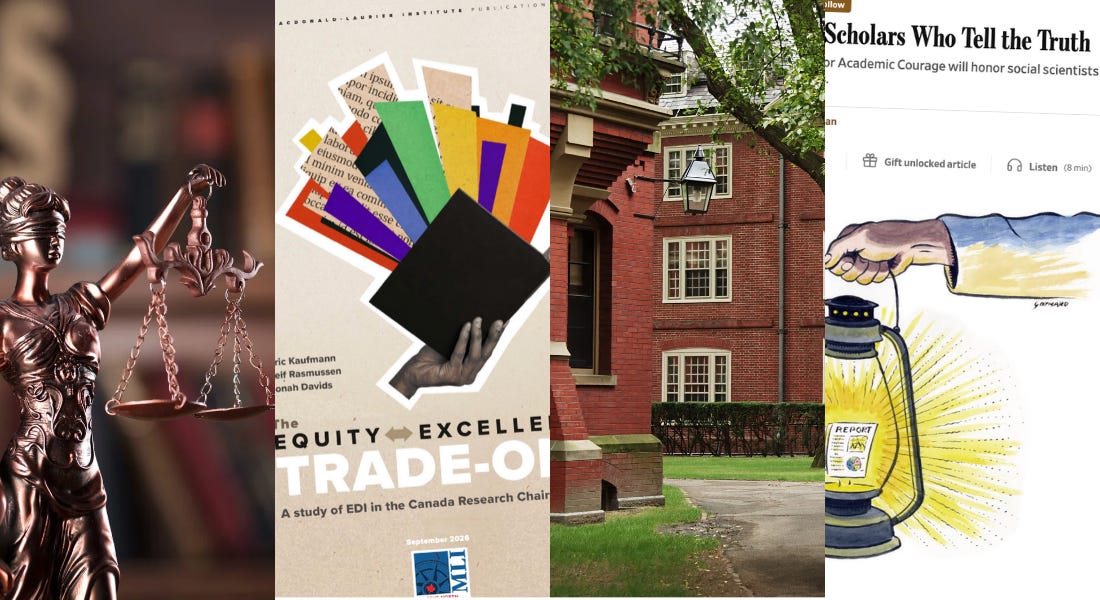
In open inquiry news this week, the American Bar Association’s (ABA) accreditation council repealed its law school diversity standard under federal pressure; Harvard’s faculty tell The Crimson they aren’t sold on the university’s $10 million viewpoint diversity hiring plan; a new report tries to price identity-based selection in Canada’s flagship research program; and Roland Fryer and Bill Ackman launch a $1 million prize for academic courage.
Check out the top news stories we’re watching this week at HxA.
The ABA’s accreditation council repeals its law school diversity standard.
At a meeting on Tuesday, the American Bar Association’s (ABA) Council of the Section of Legal Education and Admissions to the Bar voted 10 to 6 to eliminate Standard 206, the requirement that law schools “demonstrate by concrete action a commitment to diversity and inclusion.” The repeal is final and effective immediately. Although it doesn’t bar law schools from prioritizing diversity-related initiatives, it does remove them as a requirement for accreditation.
The vote was spurred by the Education Department recommending the council be stripped of federal recognition (decision pending for later this month). Several members were candid that they voted in favor of repealing the standard in order to retain the ABA’s status. David Brennen, the council’s interim treasurer, who voted to repeal, defended diversity in a law review article as recently as last year:
I’ve watched very carefully the way a lot of states — state supreme courts in particular — have looked at the issue of Standard 206, and despite my own personal view, they characterize it as a sort of political qualification… I don’t want to see that be an inhibitor.
Dissenters on the council see the decision differently. Deidré Keller of Stetson Law said she could not “in good conscience” support a repeal that “will necessarily be read as a lack of commitment to that project.” Chair Melissa Hart conceded that the whole matter “is political either way.”
An accreditor’s job is to verify that an institution does what it claims to do, not to prescribe its values. But a standard repealed to satisfy a regulator opens the door to continued changes when the political winds inevitably change.
Harvard’s (liberal) faculty aren’t sold on the university’s viewpoint diversity push.
The Crimson’s annual survey of Faculty of Arts and Sciences professors found that 54% of faculty opposed Harvard’s plan to fund viewpoint diversity efforts, particularly through endowed chairs. The more troubling number, however, is that 47% of faculty disagreed that Harvard has a troubling lack of ideological diversity; just 31% agreed.
Yet, this opposition appears less a defense of the status quo and more against the idea of “affirmative action for conservatives” with 60% opposing explicitly political hiring; among the 22 conservative faculty who responded to the survey, 54% supported the effort. Some faculty seem more open to hiring specifically for identified academic gaps in departments, rather than political orientation. Harvard English and Comparative Literature professor Martin Puchner said back in May in response to the initial announcement of the university’s faculty hiring initiative that:
What we need in this context is not just a few hires that carry the label conservative thought, but a broader conversation, discipline or division specific, about the kinds of perspectives that we need for the health of these disciplines that we don’t have right now.
These findings mirror HxA’s recent research showing that faculty are most supportive of strengthening diversity of theoretical perspectives and research methods in their disciplines over explicit political diversity.
While faculty hiring is a clear avenue to help remedy the ideological monoculture and severe political skew in departments, explicit identity-focused hiring based on political party is unlikely to gain broad faculty support. What is needed are hiring approaches that genuinely broaden the perspectives in a discipline and department without explicitly or implicitly alienating minority views.
Explicit DEI-hiring in Canada costs tens of millions of dollars, says new report.
A new report from the Macdonald-Laurier Institute, led by University of Buckingham professor and HxA member Eric Kaufmann along with Leif Rasmussen and Jonah Davids, evaluated the cost of DEI-focused (referred to as “EDI” in Canada) hiring since 2017 for the Canada Research Chair program, which “has moved dramatically in the direction of implementing EDI ideology and quotas.”
The report argues that “EDI has actively weakened Canadian research and reduced overall academic performance at Canadian universities.” The report shows that chairs in the social sciences and humanities, where explicit EDI hiring is most prevalent in job ads, are 17 times more likely to describe their work in activist terms.
The authors close the report arguing that an explicit focus on EDI, rather than scholarly merit, alters the entire landscape of social science in Canada.
The EDI ethos is politically toxic, racially and sexually discriminatory, and a waste of scarce public resources. The legitimacy of Canada’s government-funded research base cannot be taken for granted. It hinges on federal research councils returning to their prior focus on the disinterested pursuit of truth. The goal for the social sciences and humanities must be to study the most pressing social problems for all Canadians, not just those occupying the leftmost end of the political spectrum.
This kind of politically motivated hiring is exactly why HxA opposes using DEI statements in faculty hiring. When political alignment is put above scholarship, the result is a warped scientific landscape.
Academics can win $1 million for telling the truth in their research.
Roland Fryer and Bill Ackman announced in the Wall Street Journal The Carob Trust Prize for Academic Courage, which will award up to five social scientists a year with a million dollars for scholarship that tells the truth despite professional costs for doing so. Their goal is to shift incentives away from conformity.
When the professional cost of publishing an unwelcome finding exceeds the cost of suppressing it, rational scholars suppress it. The result is that social-science literature reflects what researchers are permitted to say rather than what they actually discover.
This is the right diagnosis. Self-censorship is not a character defect but a rational response to real costs for speaking up. FIRE’s 2024 faculty survey showed that 35% of faculty say they “toned down” their professional writing to avoid controversy; four in ten are concerned about damaging their reputation over something they say or write.
The prize alone won’t solve the entire problem, of course, but it’s a welcome sign in the broader reform landscape effort to shift scholarship toward truth-seeking rather than political agendas. It’s also an example of what more institutions could do to help shift incentives and make honest, rigorous, yet contentious scholarship, less professionally costly.
Disclosure: HxA has received funding from The Carob Trust to support our events.
Disclosure: HxA has received funding from The Carob Trust to support our events.
Have campus news related to open inquiry that we should be aware of? Share it with us by sending a quick email to communications@heterodoxacademy.org
*Bill Ackman* funding academic truth-telling is immediately self-parodying and embarrassing.