


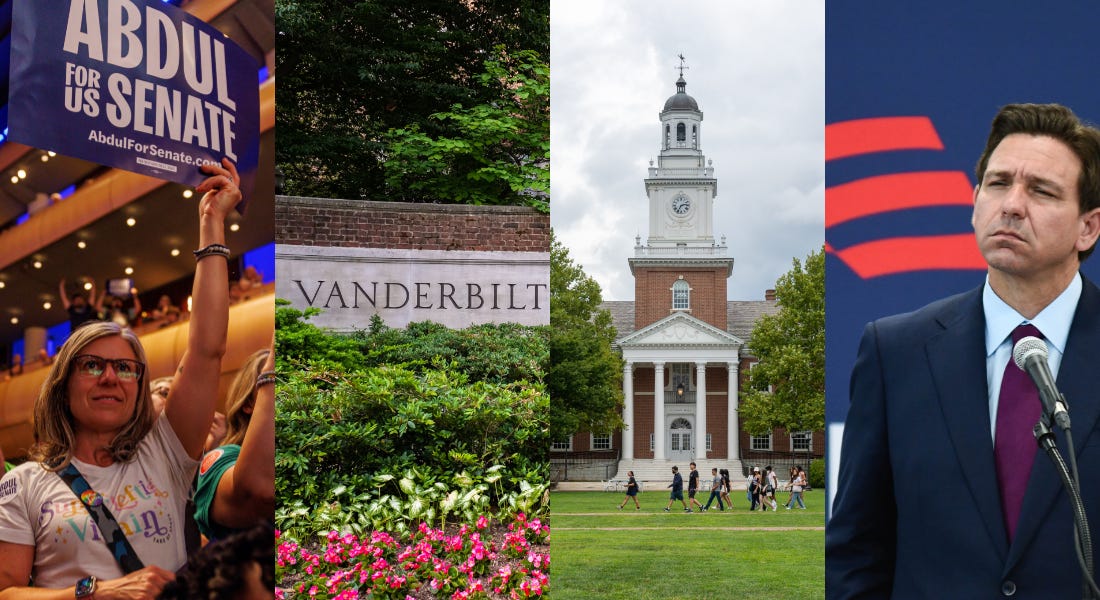
In open inquiry news this week, the AAUP makes its shift to a political organization explicit by endorsing a political candidate for the first time in its history; Vanderbilt releases a declaration on the purpose of the university and its “first principles”; Johns Hopkins is starting a new effort to bring viewpoint diversity to its faculty; and factions form among Florida’s conservative higher education reform movement.
Check out the top news stories we’re watching this week at HxA.
The AAUP is now endorsing political candidates.
For the first time in its century-long history, the American Association of University Professors endorsed a political candidate, Democratic Michigan U.S. Senate candidate Abdul El-Sayed. In defending his decision, AAUP president Todd Wolfson cited AAUP Michigan member polls that found about 80% of respondents favored making an endorsement and about 97% specifically favored El-Sayed.
Ryan Quinn wrote for Inside Higher Ed that “The move continues the AAUP’s evolution from its beginnings as a professional association that wrote seminal definitions of academic freedom and tenure to also becoming a left-leaning faculty union.” The AAUP national decision to endorse political candidates comes after the AAUP started making political statements when Todd Wolfson assumed the presidency.
Jonathan Turley, who debated Wolfson at an HxA event at the University of Wyoming in June, told Inside Higher Ed that the AAUP “has become the loudest part of an academic echo chamber. It only contributes to an environment of orthodoxy and intolerance. As trust in higher education continues to plunge, the AAUP is only accelerating that decline.”
Any semblance of political neutrality at the AAUP is officially gone.
Vanderbilt releases a new declaration on the purpose of the university.
In its continuing efforts to steer the sector in principled leadership, Vanderbilt University released The University and Its Purpose: A Declaration of First Principles, which was adopted by the Vanderbilt University Board of Trust in June 2026. It reads:
The declaration, part of an effort to improve scholarly standards and restore public trust, outlines three purposes for the university
Pathbreaking research. Universities exist to create, preserve and disseminate knowledge.
Transformative education. A university education is meant to teach students how to think rather than what to think.
The covenant between universities and society. Universities depend on public, private and philanthropic support offered in exchange for education and research that serve the public good.
The report focuses heavily on the need to cultivate a university in which inquiry remains free and open, echoing HxA’s own “Open Inquiry U” reform agenda. The Vanderbilt declaration closes with a visionary role of the university in society:
By affirming these commitments, America’s universities can renew public trust and reassert the essential role that higher education institutions play in cultivating a free and self-governing society. These commitments must be lived in practice: Each university has a responsibility to demonstrate how it is upholding and modeling the principles it professes. Such commitments demand courage and clarity of purpose: the willingness to uphold rigorous academic standards and defend free inquiry, especially when it is difficult. In doing so, American universities not only safeguard their own integrity — they use their wisdom, innovation, and principled steadiness to help secure the future of the nation.
Johns Hopkins to open a new school aimed at hiring faculty with diverse ideological views.
In its commitment to broadening viewpoint diversity at Johns Hopkins, a new School of Government and Policy plans to open in 2027 or 2028 in Washington, D.C. Reporting in RealClearInvestigations describes the plans for such a school as an “experiment.”
It’s an experiment based on an untested theory: The hiring of conservative and heterodox thinkers will change the university culture, forcing scholars out of ideological ruts, spurring uncensored intellectual debates on campus and toppling orthodoxies along the way. But a big obstacle to the spread of pluralism is faculty opposition, highlighting the challenge of returning the university to its tradition of open-ended inquiry.
In efforts to broaden viewpoint diversity on campus, many universities are choosing to “build” rather than ban, intentionally creating spaces on campus for more ideological viewpoints to have a home. Many of these efforts have taken the form of “civics centers,” which HxA has been closely tracking, but other forms are also taking shape. Such centers are not without critics, however. Siloing viewpoint diversity into certain centers on campus can create monocultures within the institution, for example. But their impacts need to be evaluated through data over time.
DeSantis administration clashes with Chris Rufo over the University of Florida president pick.
Florida has been a testing ground for Republican-led higher ed reform since Governor Ron DeSantis introduced the controversial Stop WOKE act back in 2022. But the challenge of appointing a new president of the University of Florida is revealing tensions among political reform advocates, according to the Chronicle of Higher Education. Chris Rufo, a previous trustee of New College appointed by DeSantis, has been vocally opposed to the two most recent candidates to lead UF due to a history of DEI policies at their prior institutions. Santa Ono, previously of the University of Michigan, ultimately wasn’t approved for the position. Now, Stuart Bell, the University of Alabama’s former president, seems slated to assume leadership of UF with “full support” from DeSantis. The Chronicle refers to the fissure as “a startling rupture in one of the Republican Party’s most fruitful and symbiotic political partnerships,” continuing:
Even as that conservative higher-ed coalition has scored striking victories in Florida and Washington, DeSantis’s behind-the-scenes advocacy for Bell — and the bad blood it unleashed — shows that the reform crowd still has a lot to fight about as the movement heads into its next chapter.
Have campus news related to open inquiry that we should be aware of? Share it with us by sending a quick email to communications@heterodoxacademy.org
Abdul al-Sayed was not the best opening Gambit. The guy could be a clown show once in office.