


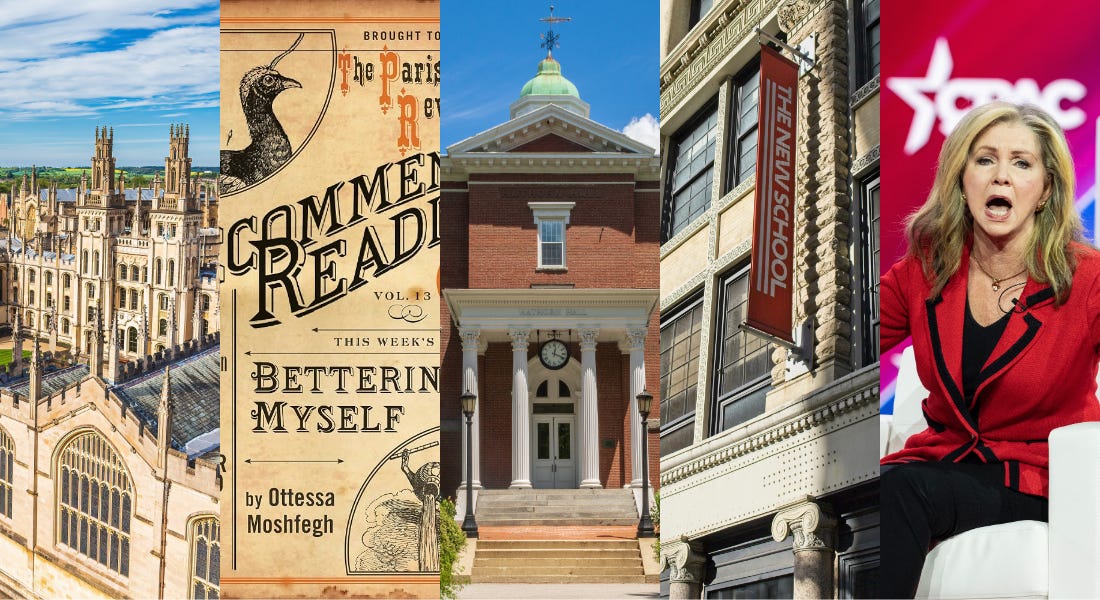
This week I’m rounding up the biggest faculty scandals to hit the press recently, setting off academic freedom alarm bells. Today, we’re covering the ongoing Jason Arday scandal and the questions it’s raising and the suspensions it’s causing; a soft ban in Florida on anal sex talk in the classroom; Tyler Austin Harper releases a scathing essay on why he quit being a professor; a tenured professor being fired in cuts to departments he doesn’t belong to; and professors suing politicians for using social media to get them fired.
Let’s dive into the top open inquiry news stories we’re watching this week at HxA.
The Jason Arday scandal first prompts questions about integrity; his death then prompts questions about blame.
Perhaps some of the biggest news to hit higher ed in the past month is the tragic case of Jason Arday. By now, you probably know that Arday was hired by the University of Cambridge in 2023 as the youngest black professor in the university’s history, at just 37 years old and eight years after earning his PhD. He taught sociology there after a professional pivot from physical education. Then last month, a Substack post from Nathan Cofnas blew the lid off the scandal, showing side-by-side comparisons of his doctoral thesis to that of Paula Zwozdiak-Myers, showing plagiarism. From there a scandal erupted over the plagiarism, the legitimacy of his hiring at a top university, the integrity of his scholarship, and a too-good-to-be-true personal backstory.
Tragically, after resigning from his post amid the controversy, he died last week (presumably by suicide, though the exact cause of death has yet to be reported).
The initial coverage spanned various legitimate questions. Early reports indicate there was a cover-up of sorts, after a Times Higher Education story of Arday’s plagiarism was spiked due to legal threats from Arday. After the news finally broke in July, coverage largely focused on the integrity of faculty hiring and scholarship pitted against the juxtaposition of a scholar who studies race differences in IQ outing a scholar who studied racial inequality.
Since his death, however, the conversation has shifted to whom is to blame. Some academics are arguing that coverage “moved beyond legitimate questions of academic integrity into personal ridicule and vilification,” with the Cambridge chancellor compared the coverage to a “racist feeding frenzy.” Journalists are defending their role reporting on a legitimate scandal at a top university, saying that blaming the media misses the point:
For people on the left, it’s sure easier to talk about the feral excesses of the right-wing press than the willful gullibility of certain elite progressives. But both contributed to the Arday disaster. Denying that won’t protect the left. It will just leave leftists out on a limb that grows ever more shaky.
As of last week Cambridge committed to reviewing its faculty recruitment process. The scandal had a tragic end, yet it has struck a nerve because of how many areas of contention within the academy it is emblematic of, including ideological homogeneity acting as blinders to scholarly scrutiny and criticism, while simultaneously acting as an exemplar for anti-DEI advocates to latch on to. Tyler Austin Harper pointed this out in the Atlantic:
Arday was fetishized in his ascendancy by white liberals, for whom he served as a mirror in which they could see their own goodness. And he was fetishized in his downfall by white conservatives who saw him as a test case for their own obsessions with an academic apparatus that they believe is not meritocratic enough—which is to say, not white enough.
The right would have us believe that the Arday scandal is a story of affirmative action taken to its most caricaturish conclusion. Many progressives see it as something else: a racist witch hunt in which self-righteous zealots with suspect motives hounded a man to death. The problem with these narratives—and it is a sticky problem—is that they are both right.
On August 20, Cofnas shared on X that he had been suspended from his position at Ghent University as a result of his writings about Arday. The day before, Ghent University put out a statement explaining their position on Cofnas, stating:
…we wish to be clear about the values we uphold as a university. Ghent University stands for respect for human dignity and opposes discrimination, hatred and racism. We attach great importance to academic freedom and to open academic debate, even when views are controversial. However, that freedom is not unlimited. It goes hand in hand with responsibility and may be restricted in order to protect the rights of others.
The statement was updated on August 20 to note that Cofnas had been suspended as a “precautionary measure” and the university will be launching a disciplinary investigation. The statement doesn’t even try to veil the fact that Cofnas is being suspended for his unpopular public views rather than any alleged academic misconduct (despite his views being well known to the university at the time of his hiring). Scholars should not be disciplined for calling out the academic misconduct of another scholar; no scholar has a “right” for their scholarship to not be publicly criticized, regardless of the personal views of the critic. Apparently, academic freedom at Ghent University is only protected for those whose values are aligned with the university’s.
South Florida State College: Don’t talk about anal sex in the classroom.
Vinita Prabhakar has been teaching the short story “Bettering Myself” by Ottessa Moshfegh in her literature class for three years, a book which includes a scene of anal sex between the narrator and her ex-husband. But at the start of the spring semester, the “certainly racy” story caught the attention of South Florida State College (SFSC) president Fred Hawkins. Prabhakar was promptly suspended and was told that her contract wouldn’t be renewed. She spoke with Josh Code at The Free Press, explaining how her case has impacted her colleagues and why challenging readings are necessary for student learning:
I think there is a climate that has been created of, “Shoot, can this be on the syllabus?” You have a lot of second-guessing. A lot of whispering in the hallways about what’s next.
I don’t doubt that almost immediately, other colleagues felt like, “Oh, let’s go back to our syllabus and just assign ‘The Gift of the Magi’ and ‘The Story of an Hour’ on repeat.”
Those stories are terrific, but a classroom where you’re reading those things on repeat is perhaps a less complete one. In other words, if you’re only assigning those things out of fear that there will be retribution for assigning something else, I don’t think that’s good.
When faculty are sanctioned for teaching completely relevant content in their classrooms, the result is a culture of self-censorship, not free inquiry. We’ve seen this play out before, and we must stand against bans on classroom content.
Prabhakar is suing SFSC and Hawkins in federal court with the backing of the Foundation for Individual Rights and Expression. Her lawsuit alleges a violation of Florida’s Campus Free Expression Act; Prabhakar wants to be reinstated along with payment for compensatory and punitive damages.
Tyler Austin Harper contributes a hit to academic quit lit.
You’ve also probably come across “that essay” if you’ve been online the past two weeks. Tyler Austin Harper, formerly of Bates College, now of The Atlantic, dropped his essay on quitting his professor job. This isn’t Harper’s first foray into this space — he’s been writing about these issues for years. But this lengthy essay outlines in great (sometimes comical) detail the real excesses and issues plaguing open inquiry in academia, including a faculty search committee’s weighing a candidate’s racial identity more heavily than their actual scholarship. He also showcases how the DEI bureaucracy impacted his job and the campus culture, and eventually what he came to see as the hollowness of it all as a university drifts from its purpose toward a political agenda.
These critiques, however, are not coming from the right. A self-identified socialist, Harper explains in a follow up interview with The Chronicle of Higher Education where he’s coming from:
It really was being at Bates and slowly realizing that what we might call an intersectional version of progressivism was just a grand charade to mask real political and economic problems at both Bates specifically and higher education writ large. I did the work. I read a lot of alternative pedagogy. I quit using grades in my classes. I agreed with some of these critiques, and I still agree with some of them. But it became apparent that it was quite convenient to latch on to these things rather than confront the simmering class warfare on campus.
Financial woes used to fire tenured faculty at the New School.
Tenure for faculty is a fundamental protection for academic freedom that affords faculty the necessary job protections needed to freely inquire, develop their teaching practice, and conduct their research. Increasingly, however, tenure protections are being weakened in statehouses across the country and rules are being stretched to terminate tenured faculty. At the New School in New York, tenured professor Sanjay Reddy was fired along with 18 other faculty.
The New School said that the firing is in accordance with its faculty handbook that allows the firing of tenured faculty if there are “serious financial considerations or curricular change(s)” that require the university “to discontinue an academic department/program or college/school,” according to The New York Times.
Reddy finds this reasoning suspect. He was the only economics professor let go, and his department wasn’t directly impacted by the restructuring. AAUP representative Mark Criley told The New York Times that “a bureaucratic restructuring that leads to the selective elimination of faculty members really puts academic freedom in jeopardy,” especially professors “who have displeased administrators or trustees or donors,” which Reddy did, having criticized the university’s finances for years, which is exactly the kind of speech tenure is supposed to protect.
Reinstated Austin Peay State University professor sues politician who called for his firing on social media.
A theater professor at Austin Peay State University was one of dozens of faculty fired when social media posts in the wake of Charlie Kirk’s murder at Utah Valley University last fall drew attention from politicians. Darren Michael was fired just two days after making a Facebook post showing a screenshot of an article written by Kirk saying that gun deaths are a necessary downside to the second amendment. The university cited “reputational damage” to the university as the cause. Michael already successfully sued the university, gaining position reinstatement and a $500,000 settlement. Now, Michael is suing Tennessee Republican Senator Marsha Blackburn for leveraging her political power to get him fired, Inside Higher Ed reports.
Have campus news related to open inquiry that we should be aware of? Share it with us by sending a quick email to communications@heterodoxacademy.org
The Cambridge authorities, who hired an unvetted fraudster due to insane DEI policies, bear direct responsibility for this tragedy.