


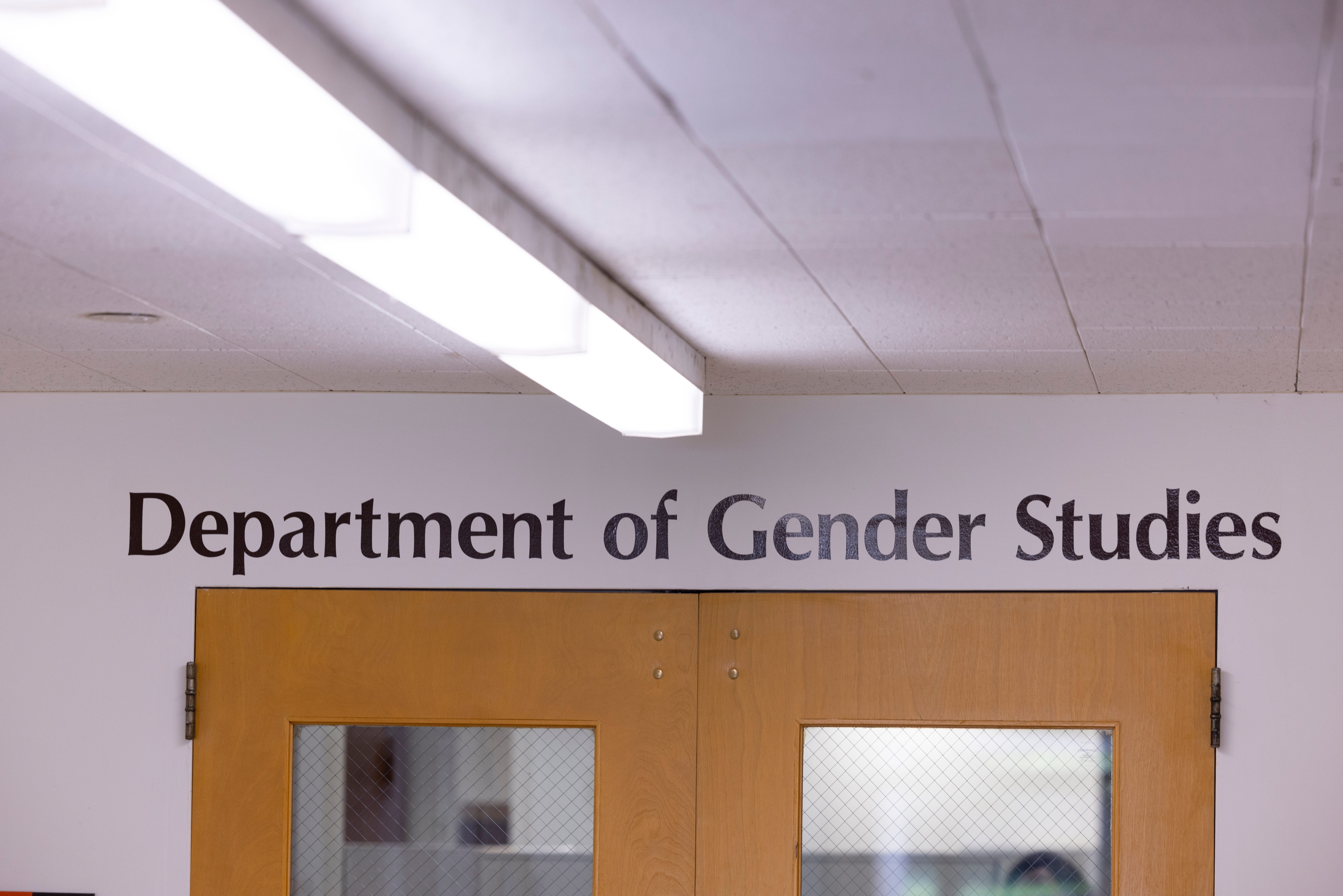
Women’s and gender studies departments have been some of the most embattled on campuses in recent years, with the problems plaguing this field being emblematic of the viewpoint diversity crisis in social-oriented disciplines. While many critics are eager to shut these departments down completely, and scholars in these departments instinctively double down in defense, these aren’t the only viable options anymore: efforts to reform this arguably wayward discipline now have real traction thanks to scholars publicly coming forward and calling for change.
Abigail Saguy, HxA member and professor of sociology and gender studies at UCLA, called for change in a recent Chronicle of Higher Education op-ed, arguing that while it’s an “understandable impulse to close ranks and defend” the current state of these disciplines, doing so “would miss an opportunity to ask hard questions about our teaching and scholarship and, where needed, transform our disciplines from within.”
Saguy continues by explaining how she transformed her own classroom to platform viewpoint diversity and elevate constructive disagreement. For the past decade, she has taught her sociology of gender course jointly with an evolutionary psychologist and human geneticist. Saguy writes:
Since teaching this class, I no longer use biological theories as a foil. Instead, I acknowledge that there are biological differences between women and men and that these are exaggerated and emphasized through social mechanisms. In the past few years, I have incorporated political-viewpoint diversity by adding Richard Reeves’s book, Of Boys and Men: Why the Modern Male is Struggling, Why It Matters, and What to Do About It, and short opinion pieces by political conservatives to my syllabus. By assigning authors who disagree with each other, I signal to my students that disagreement — with the readings, with each other, and with the professor — is not just OK, it is expected.
Others are also calling for the discipline to embrace viewpoint diversity. LuElla D’Amico, an English professor and coordinator of women’s and gender studies at the University of the Incarnate Word, recently penned in The Dispatch that “the discipline needs a feminism that can disagree.” Importantly, she broaches the need for genuine viewpoint diversity in gender studies to conservatives in an effort to push back against calls for shuttering and censorship.
The goal of my classes is not to produce agreement or to create Catholic feminists who all think the same thing I do. Rather, it is to cultivate judgment—the kind that can live with disagreement and remain. And if women’s and gender studies is to survive—and to matter—it may need, like Miss Prim, to learn to admire what it does not yet possess.
What makes this situation especially noteworthy is the complexity. On the one hand, Republican controlled states have pushed to exert legislative control over classroom content and anything that falls under the “DEI” umbrella. Across states, including Texas, Florida, and Iowa, women’s and gender studies departments are being shut down, majors cut, research censored, and faculty fired over what they are teaching. Moreover, faculty hiring is down along with student enrollment in many of these departments.
These legislative maneuvers involve clear violations of academic freedom in which the state exerts inappropriate control over classroom content. And while these infringements on academic freedom are rightfully condemned, the attacks are explained — though not justified — by the closed boundaries of inquiry and lack of viewpoint diversity that have characterized many of these women’s and gender studies departments for decades. Both things can be true: the legislative pressure is often overreaching, yet much of the underlying grievance is not.
Ilana Redstone, a sociology professor at the University of Illinois Urbana-Champaign, wrote about this complex dynamic in a Substack essay this past week, explaining how we must decry state censorship while still understanding that internal dysfunction across disciplines was an impetus for such intense legislative action in recent years.
For years, the academy closed questions it had no authority to close and waved away — as ignorant or bigoted — the people who said so. Many of those people are now in power, and they have seized on the visible effects of that closure as their justification: the universities, they say, abandoned open inquiry long ago, so why should open inquiry shield them now? Whatever the motives behind it, the accusation is not false — and its truth is the academy’s own doing. By using the shield of academic freedom to justify treating contested questions as closed, the academy built the opening the state is now driving through.
Why does this matter, if the state is still in the wrong? It matters because of what follows for the academy that wants the intrusion to stop. The state’s pressure draws its force from a real grievance — that the universities closed questions they had no business closing. As long as that grievance stands, the coercion has a justification to point to, and resistance in the name of academic freedom rings hollow, because the academy is invoking a principle it spent years misusing. The way to take the justification away is not to deny the closure more loudly. It is to end it — and ending it has to begin with admitting it was there.
Academic freedom grants no one the authority to close a question — not the state reaching in from outside, and not the scholar quietly closing it from within. The academy is right to resist the first. It will only have the standing to do so when it stops doing the second. And that begins not with a louder defense, but with an admission: that the closure was real, that it was ours, and that academic freedom never authorized it in the first place.
The only way to remedy women’s and gender studies — and all disciplines that are being crippled by ideological homogeneity — is internal reform. An aggressive legislative approach may appease a voting base, but it also carries the risk of eroding the academic freedom that makes great scholarship and innovation possible, and made the U.S. university system the envy of the world in the 20th century.
We must continue to look critically inward to bring genuine viewpoint diversity to social and humanities disciplines within the academy while protecting and defending academic freedom (a point I’ve made before and a mission that HxA is actively pursuing with universities across the country). The good news is that professors within these disciplines are making public calls for internal reform. We also have witnessed universities’ broader internal reform work make a public splash, such as the recent Yale Trust Report, Harvard Medical School Open Inquiry Report, and the Vanderbilt-Wash U State of Scholarship Report.
The work is urgent. The moment is ours. The faculty and scholars calling for reform shouldn’t have to do it alone. You can be part of this reform movement by becoming a member of Heterodox Academy. You can also join us April 12-14, 2027 in Boston for our next national conference dedicated to shaping what comes next for higher education.
I always thought gender studies would be really interesting if it allowed more perspectives. What parts of the differences between men and women are nature, and which ones really *are* nurture? How much of gender arises from sex? What about the ways society and stereotyping disadvantages *men*? I've heard endlessly about body image, the second shift, and 'gray rape' and nothing about the draft or custody or divorce battles.
Not that I expect our current progressive academics to address these questions, but they do exist.
If an entire academic field is dominated (a few brave scholars and substack posts notwithstanding) by a political consensus that vigorously polices internal dissent and sits far outside the views of most people in society, why is outside political pressure illegitimate? If biology departments across the country were dominated by racists of the most base, skull-measuring kind, would you still oppose political pressure on them to reform?