


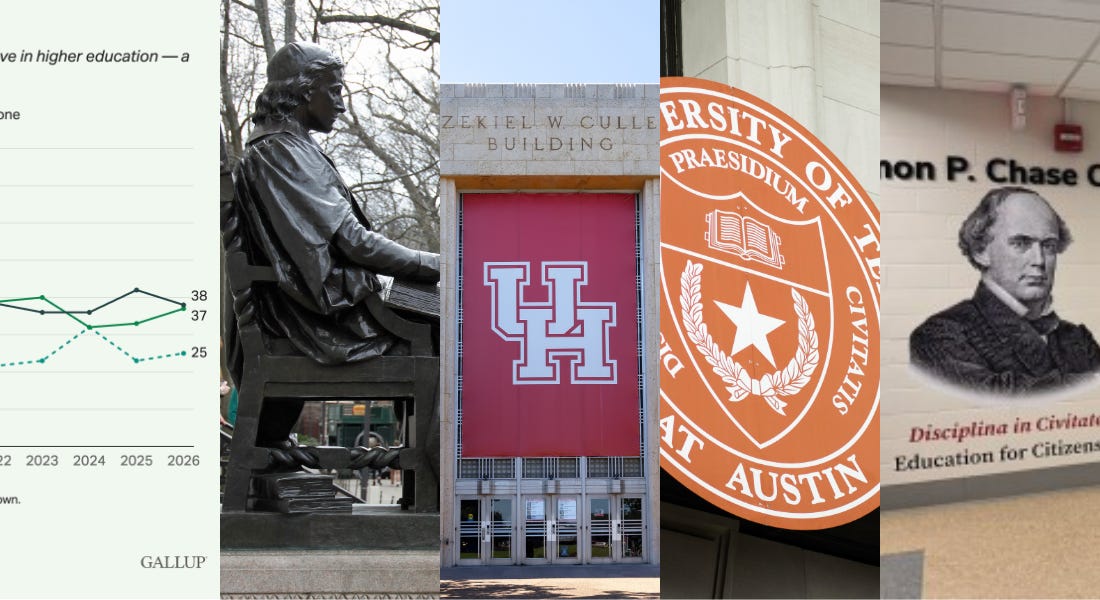
In open inquiry news this week, Texas continues to make headlines with an ambiguous tenure denial at UT Austin, and the potential cutting of over 100 courses at University of Houston. Alan Garber, the president of Harvard University, took the stage at the Economic Club of Washington this week to condemn threats to open inquiry from the Trump administration; and civics centers in Ohio and West Virginia are trying to solve low student enrollment.
Check out the top news stories we’re watching this week at HxA.
Confidence in higher education drops after last year’s uptick.
Gallup’s annual poll assessing the American public’s confidence in higher education shows that last year’s hopeful uptick was just a blip. While 42% ofU.S. adults last year said they had “a great deal” or “quite a lot” of confidence in the institution, this year only 38% said so. The biggest story in this year’s numbers, however, is the record-breaking drop among Democrats, whose confidence fell 11 percentage points to just 50% — the largest single-year drop since polling began in 2015 and a record low. The lack of confidence stems from perceived political agendas, cost, and workforce preparation.
More on this coming from me on Monday. Subscribe to Free the Inquiry so you don’t miss it.
Harvard president lauds his decision to not settle with the Trump administration.
Alan Garber, president of Harvard University, expressed his pride in not settling with the Trump administration to a crowd gathered at the Economic Club of Washington this week. His remarks hit on many issues related to open inquiry, including concerns with the new OMB proposal from the Trump administration that aims to give grant decision-making authority to political appointees I discussed last week the importance of protecting tenure to ensure faculty free expression.
Even as Garber continues to push back on political influence in Harvard’s operations, Garber has made an effort to broaden viewpoint diversity on campus. As the Harvard Crimson reports:
…the University has shown it is responsive to political pushback. Under pressure over the overwhelmingly liberal makeup of its faculty, Harvard has made several efforts to broaden the intellectual scope of its ranks. Over the past year, top administrators have socialized an effort to hire dozens of new faculty members in the name of “viewpoint diversity.” Some schools and departments have also separately pursued faculty searches intended to widen the range of scholarly perspectives represented on campus.
Course cuts to appease lawmakers continue at Texas universities.
Reporting from the Chronicle of Higher Education says that the University of Houston could soon cut up to 40% of its core curriculum, over 100 courses, to comply with a state law passed last year.
Houston’s provost convened a working group to review the university’s core courses over the summer, according to documents obtained by The Chronicle. That group’s recommendations, which were shared with the faculty this month, are to be considered by the system’s Board of Regents in August. The recommendations cap a curriculum-review process at Houston that has been underway since the fall. But the latest installment of that work has been done in secret, faculty critics say, raising “serious concerns” about violating shared-governance principles and whether the university’s interpretation of state law is overly expansive.
The American Association of University Professors (AAUP) is asking the administrators to halt the review process, citing over-application of the law and violation of shared governance. The decision by the Board of Regents will be made next month.
University of Texas at Austin professor denied tenure without explanation.
UT Austin American Studies professor Iván Chaar López was denied tenure by the president’s promotion and tenure committee despite having unanimous support at lower review levels and recieving no indication at mid-year review that his tenure was at risk.
A UT spokesperson said that “The tenure review process is handled thoughtfully, fairly, and professionally with a thorough system of checks and balances to ensure the highest standards of teaching and research.”
Chaar López, whose research centers on the history of information infrastructures used for border enforcement since the mid-20th century, told Inside Higher Ed that he thinks politics are at play.
…the dean … never explained why I was being denied tenure. I asked point-blank what happened, and he literally said, “I don’t know. I can only speculate.” And then he went on to speculate that, probably, the president’s promotion and tenure committee had a negative view of my research, and that the committee had a negative view of my field.
Just before being notified of his denial, his university announced plans to consolidate several departments, including his own American Studies department, which can often be legitimate grounds for relieving tenured faculty. But Chaar López said that “it’s very hard not to see a relationship” between the politics of the state and its ongoing censorship and his tenure denial from the highest level of the university.
University “civics centers” make news for low student enrollment.
Since 2021, colleges and universities across the United States have created dozens of “civic centers” through a mix of external state legislation and internal organic initiatives. Although these centers are in their operational infancy, they are not all thriving from an enrollment perspective. This week, Ohio State University’s Salmon P. Chase Center for Civics, Culture and Society, and West Virginia University’s Washington Center made news for their low student enrollment. Lawmakers in Ohio want to mandate that students take the Center’s courses by making it the sole provider of certain required courses. The change aims to boost enrollment after just 131 students enrolled last semester. In West Virginia, the university said just two students are enrolled in four of the Center’s courses as of last week. The center lists 19 course offerings.
Supporters see civics centers as a constructive way to promote viewpoint diversity, while critics have raised concerns about faculty governance, academic freedom, and potential political influence. HxA has the only comprehensive database to track civics centers (available exclusively to members) in our effort to evaluate how these centers are impacting viewpoint diversity on campuses.
Have campus news related to open inquiry that we should be aware of? Share it with us by sending a quick email to communications@heterodoxacademy.org
The idea that Harvard--or any Ivy League school, and the vast majority of non-Ivy League schools--can actually reform its sustemic Leftist biases is laughable. As if a few token hires of "conservatives" (according to who's definition?) will reverse the now decades-long institutional commitment to Leftist ideology and scholarship. C'mon man! As Sleepy Joe would say.
Really, Dr Simovski, stop feeding us this twaddle. You come across as damage control for the corrupt institutions you pretend to critique. More Neo-Orthodoxy from the supposed "Heterodox Academy."