



Commencement season may be winding down, but commencement speaker controversies show no sign of slowing. Inside Higher Ed reports speaker cancellations at Rutgers, Utah Valley University, and South Carolina State University along with protests at Harvard, Princeton, and Duke. Students at New York University demanded the university disinvite their own professor, Jonathan Haidt, hoping for someone more “representative of their values,” such as past luminary Taylor Swift.
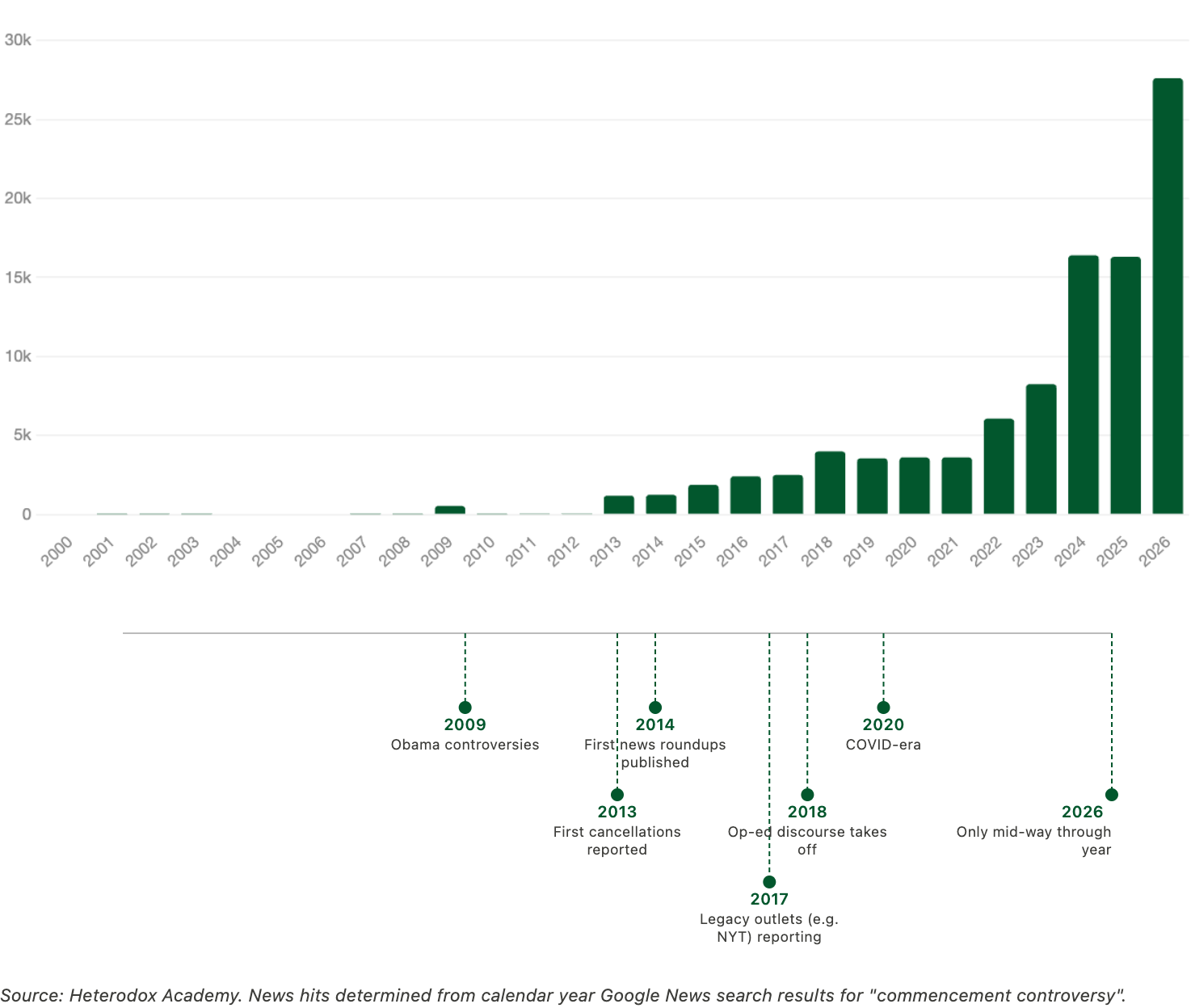
As I ingested this news the past few weeks, I couldn’t help but wonder whether controversies like these show any signs of ending. Starting rather arbitrarily in 2000, I did a quick Google News search for “commencement controversy” to put recent trends into perspective. For nearly the entirety of the aughts, nothing really showed up except for a blip in 2009 when then newly-elected President Obama made the commencement speech rounds, stirring up controversy for his views on abortion.
In the dawn of the 2010s, the opening of what we’ve come to call the “great awokening,” we began to see a small rise in controversies over commencement speakers. The first widely reported speaker cancellations occurred in 2013; by 2014, so many controversies were happening that news roundups at major outlets like Today began. In the latter half of the decade, the coverage made its way into legacy outlets such as The New York Times, and op-eds on the topic became commonplace. There was a temporary plateau during COVID, followed by an extreme takeoff in news coverage in the last couple of years. We’re only mid-way through 2026 with nearly twice as many news stories covering campus speaker controversies as last year.
The controversy over commencement speakers is not entirely novel, but it has taken on a new form in the PR-driven social media era of higher education. The arms race over high-octane speakers really kicked off after Steve Jobs delivered his memorable address at Stanford in 2005. Writing back in 2011, Pablo Eisenberg opined in Inside Higher Ed that celebrity commencement speeches were simply a “cash cow” for speakers, earning tens of thousands of dollars — and some over six figures — to deliver their inspirational talks for 30 or so minutes.
The issue is that prestigious commencement speeches have largely become PR events for universities in the modern era. As Sonel Cutler of the Chronicle of Higher Education reported this week, “Selecting a commencement speaker has become a high-wire balancing act for colleges,” involving a delicate calculation of bringing someone exciting to the stage for the commencement event, making (hopefully positive) news headlines, and of course, making the university look good, prestigious, and important.
None of this really has to do with the graduates themselves or their accomplishments. It’s quite clear that these events, especially at prestigious institutions, are about the university’s bottom line. The person invited to speak at this institutional event in front of a captive audience, for better or for worse, reflects on the institution’s status and prestige. These, in turn, bring in donor dollars. But when money and prestige are on the line, controversy inevitably follows.
Over the past 15 years or so, we went from basic speeches to political posturing on stage. And in a left-leaning academy, the speakers are overwhelmingly left in their political leaning. HxA member Robbie George called the lack of viewpoint diversity among commencement speakers “scandalous.” Earlier this week, John Tomasi and Jeff Flier went live for an HxA webinar to argue for the position that commencement speakers should not use the podium for politics. Jeff Flier pointed out the irony of the political commencement speech he gave in 1972 as a graduating medical student — a speech he emphatically said he wouldn’t give today given that it violates his changed position on the matter.
We now seem to have evolved into a state of pre-commencement controversies. This year’s protest over Haidt is a case in point: Haidt was announced and students protested the idea of him speaking because of his perspectives. In the case of Haidt, who delivered a neutral yet inspirational speech, the media only came running to confirm that students booed him. The PR machine driving commencement isn’t about the actual speech, it’s about the headlines that can be churned out about the controversy.
During the Q&A in HxA’s webinar on the topic earlier this week, an audience member asked a question that has been asked with increasing frequency for over a decade now: “Are commencement speeches really necessary?” Despite the question earning laughs on the call, it’s one worth taking seriously given how much PR risk is now involved in selecting a speaker.
One obvious answer is, “of course not.” While big names at prestigious commencements seem banal today, they are relatively new in the long arc of higher education history, and limited to a subset of universities. I didn’t go to an Ivy but I’m pretty sure the only speaker at my undergraduate graduation was a senior administrator, maybe the president, and a student or two. Graduation ceremonies were — and still are at your average college or university — primarily an internal affair among students and faculty with little fanfare.
But another answer, and the one I tend to favor, is that graduates deserve a send-off that feels commensurate with their effort over the preceding four years; they should be genuinely celebratory for the graduates. Flier and Tomasi put it eloquently in the Boston Globe this week:
Universities should adopt a simple norm: Commencement speakers are guests at an institutional ceremony, not partisan advocates seeking to energize supporters. Whether students, faculty, or invited guests, they are speaking to and for the whole university. Their goal should be to inspire graduates across differences, not drive them into ideological camps. In an increasingly fragmented and distrustful society, to preserve a civic and institutional ritual that transcends political division is to advance a public good.
Graduation is, by design, a moment of transition between what was and what will be. Commencement speakers should honor that glorious passage and the special nature of the university — not hijack them in service of political goals.
Despite existing in a PR era of higher education, universities can and should focus on bringing speakers on stage who want to excite the graduates in this moment of transition in their lives. Maybe those are celebrities, but maybe they are not.
Defund, dismantle, and re-invent higher education--Now.
There's really nothing else left to say.