


Faculty across the country are increasingly deciding what not to say, what not to teach, and what not to study. This isn’t an isolated problem either. At least three faculty surveys this year, from different types of institutions and situated within different political contexts, all converge on one finding: roughly a third of faculty are self-censoring on campus, and the trend is getting worse.
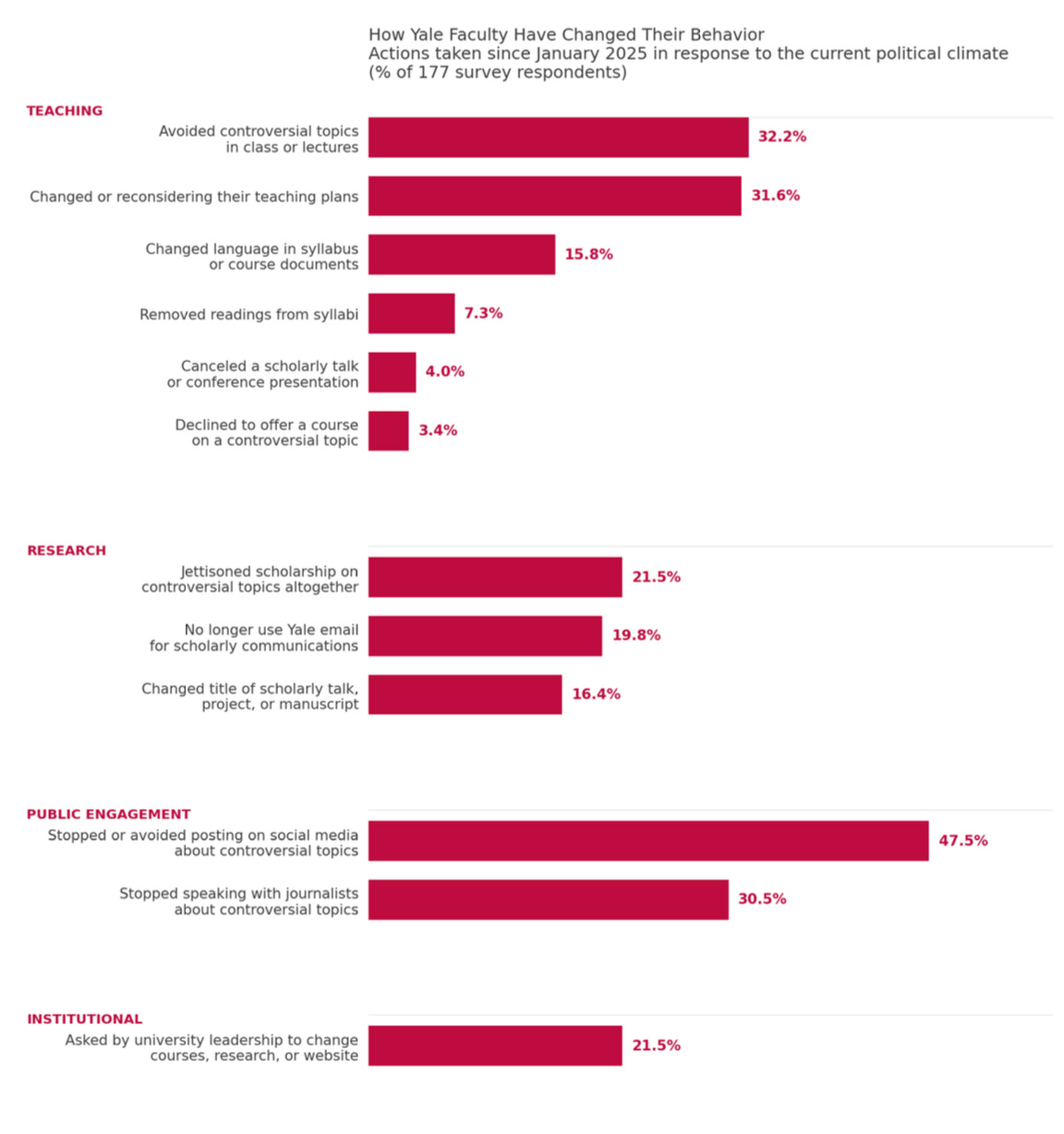
At Yale, an AAUP Chapter survey of 177 faculty showed that more than 30% of faculty have avoided contentious topics in class (32%) and a similar share have changed or reconsidered their teaching plans (32%) in response to the political climate since 2025. Over a fifth of faculty said they avoided scholarship on contentious topics too.
A survey across Iowa’s public universities released last month shows that 32% of faculty did not feel that their university “provides an environment for the free and open expression of ideas, opinions and beliefs” — a 10-percentage-point drop from the 2024 survey.
And at the University of Michigan, results shared in February show that 31% of respondents say they’ve censored themselves or have been censored by others in teaching and 28% have felt pressure to censor their research.
The Yale survey frames the faculty experience as an outcome of the federal political climate, which changed in January 2025 when Trump returned to the White House. The University of Iowa survey, which has been administered three times since in 2021, suggests that changes in the state’s political climate (where several bills have been introduced to change state university policies regarding DEI) is the impetus for self-censorship. The University of Michigan hasn’t yet released the full report, but given that Michigan state exerts less anti-DEI pressure on its public institutions, it may be reasonable to speculate that federal pressure is at least partly to blame.
Yet, the obvious external threats to academic freedom are not the only cause here. These recent surveys confirm a troubling trend that has been gaining traction for years, even before the latest bout of legislation: a significant portion of faculty do not feel free to teach or conduct their research. Nationwide faculty surveys from FIRE in 2022 and 2024 (before the political tenor reached its current heights) found that the share of faculty feeling unfree ranged from 20% to 40%, with faculty generally perceiving their academic freedom in teaching to be more restricted than in research. Internally, censorship pressure mostly came from the left in the 2010s — given the large campus political skew and alienation of right-of-center viewpoints — whereas the 2020s have been marked by retributive censorship from the right in the form of federal executive and state legislature policy changes.
As the Yale report states, “a quieter faculty is not the faculty of a great research university. Self-censorship is not conducive to extraordinary teaching and scholarship.” And this is certainly true. For years we’ve known that generally conservative perspectives were more likely to be censored than liberal ones, as documented by many surveys on self-censorship among students and faculty. But in the changed political climate of recent years, liberals are increasingly self-censoring to evade political retribution. The causes of this self-censorship may be different depending on which side of the aisle you’re on, or which year you’re looking at, but the resulting education is the same: a vapid middle in which the bounds of inquiry are cut off and expressed viewpoints reflect merely what is politically or socially “safe” rather than what is intellectually lively.
There continues to be debate about whether the left or the right pose the greatest threat to universities. The reality is that pressure campaigns, regardless if they stem from internal left homogeneity or external right political forces, are corrosive to higher education’s purpose and to the trust people have in our great institutions of knowledge. Neither source of corrosion exists independently of the other.
A safe “middle” that appeases both the campus left and the political right won’t allow free inquiry to flourish. It will only undermine the mission of universities, and at great cost to our students, ourselves, and the future of knowledge. To protect free inquiry, academics must work within their institutions to effect lasting change that rebuilds our institutions in a way that is oriented around foundational principles, and empowers reformers to fight bad policies originating from both within and outside their institutions.
Heterodox Academy’s growing membership shows that a critical mass of faculty believe in these principles and are willing to stand up for principled change. Michigan’s survey indicates that not all faculty who feel pressure necessary submit to that pressure — a sign that many faculty feel emboldened to hold the line.
We can exercise the power we hold in our unique positions to rebuild the academy. As the research shows, this is not an acute problem; this is a generational problem that will require long-term solutions. The question is no longer whether the academy must change, it is who will show up to do the changing and what changes will occur.
The findings are disturbing. I believe that self-censorship undermines the primary goal of higher education as the foundation of the free exchange of ideas.
Correction: a rough guess based on decades of hard-earned experience tells me that about 90% or more of faculty are "self-censoring," at both "elite" institutions like Yale as well as at Podunk State. It is the sad reality of the modern American university: faculty (with a few exceptions) keep their mouths shout and their heads down. I continue to be amazed at how hard it is to get my (former) colleagues to actually engage and express an opinion on a controversial topic that is any more than a few microns outside of what perceived to be the accepted safe position... Faculty often lament how hard it can be to get students to express an opinion in class because they fear retribution or ostracism (esp from the other students in the class) , and that is true, but as I pointed out to a group of undergrads last year, "I know that many of you are afraid to express yourselves for fear of the consequences, but don't feel bad, the faculty are even more scared than you are to speak up."
That is the cold, hard reality re: "free speech" in today's American university. Anybody disagree?