



Nearly sixty years after institutional neutrality was articulated in the 1967 Kalven Report, institutional neutrality has become more visible, more contested, and more politicized than at any point in its history. Institutional neutrality calls on universities to refrain from issuing statements on sociopolitical matters unrelated to the university’s core mission in order to preserve the university’s role as “the home and sponsor of the critics,” rather than act as the critic itself. Despite notable successes in recent years, institutional neutrality finds itself in an ironic position: designed to buffer against the unnecessary politicization of universities, the practice has itself become politicized.
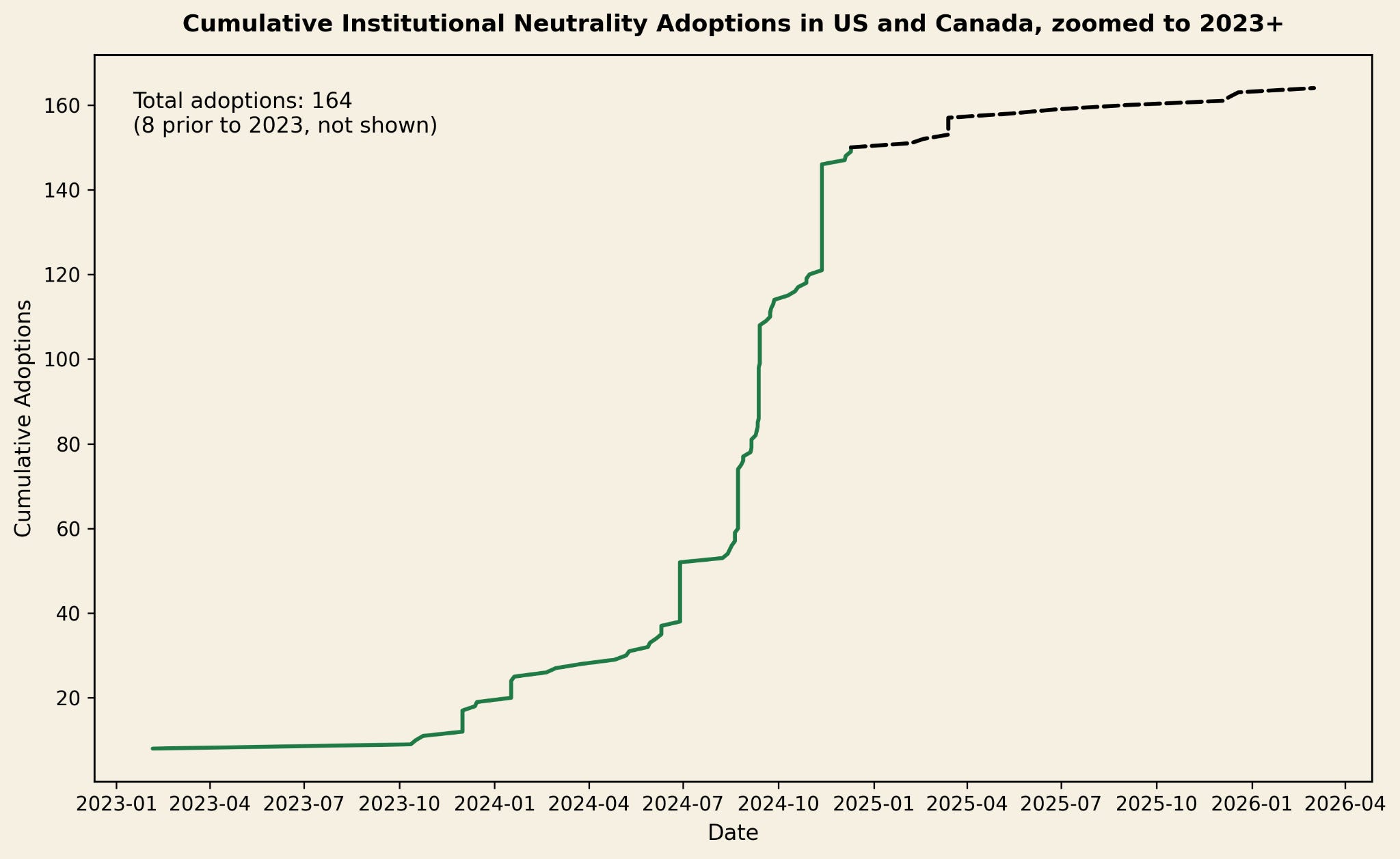
As Heterodox Academy (HxA) documented in a first-of-its-kind report last year, what was once a relatively obscure governance norm has become a guiding policy adopted by over 160 institutions as of early 2026. But it continues to evoke a range of reactions from faculty, university administrators, and legislators, ranging from fervent opposition to curious ambivalence and ardent support. In many ways, debates about institutional neutrality may be proxies for broader disagreements about the purpose of the university and how best to engage with internal and external demands for reform.
As expressed in HxA’s Model of Statement Neutrality, the practice of institutional neutrality “helps the institution avoid enshrining ‘orthodox’ opinions; chilling debate and discussion; or contradicting academic norms about how to approach complex topics.” Other proponents of neutrality have similarly argued that neutrality promotes free inquiry, is part of the groundwork for freedom, protects free expression, and encourages debate on campus.
More ambivalent observers have described neutrality as an imperfect compromise, an impossibility that is still worth striving for, or per the AAUP’s equivocal stance, “neither a necessary condition for academic freedom nor categorically incompatible with it.”
Meanwhile, critics have suggested that neutrality is censorship, a cop-out, and a convenient excuse to avoid upending the status quo. Efforts by the Trump administration and state legislatures to incentivize adoption of neutrality policies have probably done little to convince skeptics that neutrality is a boon, not a threat, to open inquiry.
HxA recognizes that institutional neutrality is a powerful lever for unleashing the free exchange of ideas on campus. Thoughtfully crafted institutional neutrality policies ensure that curiosity and scholarship thrive, unencumbered by institutional stances on contested matters. We strongly encourage institutions to adopt our Model of Statement Neutrality in order to preserve the conditions of open inquiry on campus.
But just as much as policy adoption, we also care about policy implementation and how policies are actually being experienced by campus members. Given the range of perspectives on institutional neutrality policies and the breadth of adoptions across the academy, it’s time to reflect on how neutrality has been unfolding in practice.
Our observations over the past year reveal two key trends. First, there is a great deal of variation in how institutions choose to apply and implement their policies across campus, particularly when it comes to academic sub-units and departments. Second, some public institutions are misapplying their neutrality policies to avoid legislative backlash, squelching legitimate (if controversial) expression in the process.
Who Must Be Neutral?
How an institution applies the principle of neutrality across campus departments, sub-units or centers, and leadership personnel reflects the extent of the university’s overall commitment to neutrality. But there’s considerable variation in how explicitly different institutions have chosen to implement their policies throughout campus, particularly with regard to departmental and sub-unit speech.
Departmental speech is one of the most persistent sticking points in neutrality debates. As articulated by thoughtful critic Brian Soucek, departmental speech raises thorny questions about academic freedom, collective voice, and expertise. Institutions have dealt with this thorniness with a range of approaches. Many current institutional neutrality policies gesture toward some degree of applicability to departments and other sub-units, but with varying degrees of scope and specificity. Some policies take a clear stance against departmental statements — a position that HxA supports, given that the close professional proximity of departmental peers may create a particularly strong chilling effect. Other policies offer only gentle discouragement of departmental statements. Still others remain silent on the issue altogether, sending mixed signals about the institution’s stance on neutrality and potentially sowing confusion among faculty.
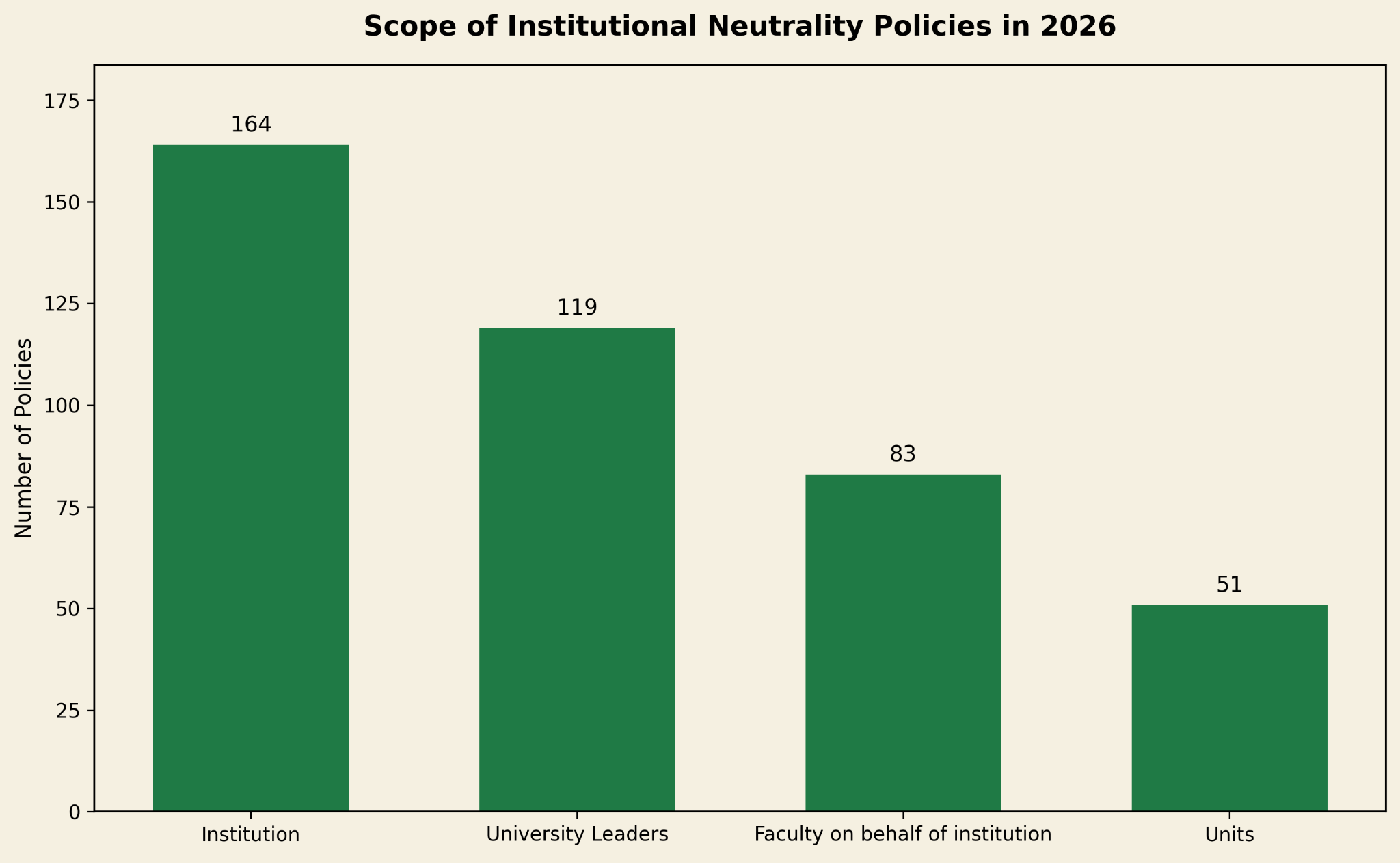
Some institutional neutrality policies clearly state that departments should uphold their institution’s commitment to neutrality. The University of Tennessee System and Barnard College have taken this approach, for example. This means that departments, just like the broader university, should refrain from issuing sociopolitical statements.
But even policies that initially seem straightforward may be ambiguous when it comes to sub-unit speech by academic leaders versus the collective speech of faculty. For example, Harvard’s policy explicitly commits departmental leaders to institutional neutrality, but only suggests that the policy should apply “in principle” to faculty within departments acting collectively, leaving significant wiggle room for a department to make sociopolitical statements.
Another kind of policy is found at Johns Hopkins University, where university leaders expanded upon their “posture of institutional restraint” and clarified that academic departments are also committed to institutional neutrality, but centers and institutes are afforded more flexibility to speak on matters relevant to their expertise. Thus, not all sub-units are treated equally under the university’s neutrality policy.
At Dartmouth, departments are encouraged to uphold neutrality but are allowed to weigh in on areas within their expertise, pending requirements like an anonymous departmental faculty vote and Provost approval. Similarly, Brown University’s policy on public statements grants some latitude to departments and suggests that departments could potentially issue statements under certain conditions and pending administrative approval.
Faculty are sometimes at odds with their institution’s stance on departmental statements. At the University of Minnesota (UMN), the Senate Committee on Academic Freedom and Tenure praised the adoption of Kalven principles at the institutional level, but ultimately concluded that departmental statements are protected by academic freedom and may even be considered under the umbrella of “service.”
But the UMN Board of Regents was unconvinced, and later barred academic departments, centers, and institutes from issuing statements (although official guidance from UMN appears to offer more latitude for centers and institutes). After the policy was implemented, a series of departmental statements were removed from university websites, and the campus AAUP chapter alleged censorship. At least one faculty member has publicly decried the policy, describing it as “destructive and wrongheaded.”
What is HxA’s position on all of this? We urge neutrality for all non-voluntary sub-units at universities, including departments. Departments can engage with contested issues within their area of expertise in a number of ways, such as by hosting debates, panels, or speakers, and defending faculty speaking as individuals on contested matters. But as with institutional statements, departmental statements risk chilling speech (especially from dissenting faculty and students in the department) and flattening the dynamic perspectives of faculty into singular points of view. As expressed in our Model of Statement Neutrality:
Indeed, position statements by institutional sub-units can be especially pernicious, since they affect closer communities. At the limit, partisan positiontaking by departments, centers, or programs may alienate students and other members of the community who see the issue differently and wish to explore the topic free from bias. A commitment to neutrality requires that institutional sub-units at the college or university refrain from taking positions on social controversies.
As evidenced above, there is not currently a consensus model in practice at universities for departments, programs, and other sub-units. Moving forward, departmental speech is likely to remain one of the more contested aspects of neutrality, as institutions continue to balance their commitment to neutrality with faculty governance.
Unleashing vs. Constraining Free Expression
Institutional neutrality empowers faculty and students to vocally engage in matters of moral and political significance. Many institutions have embraced this driving principle of neutrality, and incorporated precise language into their policies that protects individual speech.
Many current neutrality policies affirmatively acknowledge the freedom of faculty to publicly engage in contested matters. For example, neutrality policies at the University of Alabama, Michigan State University, the Purdue System, and the Indiana University System state clearly that faculty are free to speak as individuals, not as representatives of the university.
At Harvard University, the harmony between neutrality and free expression was demonstrated by the co-chair of Harvard University’s Institutional Voice Working Group, who recently strongly criticized Immigration and Customs Enforcement and encouraged his readers to “participate in sustained, sustainable resistance.” Critics who frame his stance as contradictory to his support for institutional neutrality are mistaken: support for neutrality is perfectly consistent with extramural speech.
For public institutions, especially those with legislatively mandated neutrality policies, perceived violations of neutrality may carry heavy-handed consequences for faculty and university administrators. To avoid controversy, these campuses may be inclined to over-comply with neutrality. But in doing so, they stifle expression and open inquiry.
For example, the University of Texas at Austin invoked neutrality to prevent Graduate Student Assembly (GSA) members from voting on resolutions, one of which condemned a Texas state law banning DEI initiatives at public universities and another which condemned faculty governance changes. As FIRE and the ACLU of Texas wrote in their letter to UT Austin, the “use of its institutional neutrality policy to restrict GSA and its members from engaging in political speech undermines the very purpose of adopting such a policy.”
Institutional neutrality was also cited at the University of Utah, where a student was ordered to nix language referring to “environmental justice” and related concepts from flyers advertising a student government-sponsored event. This was apparently prompted by the university’s legal team, who argued that the student government body is an arm of the university itself and therefore subject to the institution’s neutrality policy. But as with the incident at UT Austin, this invocation of institutional neutrality is a fundamental weakening of free expression.
Another puzzling incident occurred at North Carolina State University, where officials cancelled a book reading from an American-Palestinian author and cited institutional neutrality. But HxA noted with alarm, invoking neutrality to cancel a campus speaker is a misapplication of a policy that is meant to elevate discussion, not squelch it.
There may be countless other less-publicized instances in which neutrality was quietly invoked to avoid even the appearance of partiality. Public institutions are especially vulnerable to political interference, and accusations of wrongdoing at these institutions can come with big consequences. This potential risk-aversion, combined with broader confusion from both faculty and administrators regarding the specifics of their institution’s policies, raises concerns about the misapplication of a neutrality policy actually undermining open inquiry rather than protecting it.
HxA strongly opposes misapplications of institutional neutrality. While we acknowledge the legislative pressures faced by public institutions, silencing campus voices under the guise of institutional neutrality violates free expression and undermines open inquiry. Such actions are not consistent with our policy model, and we view them as antithetical to a healthy intellectual climate on campuses.
The Next Era of Statement Neutrality
The last couple of years of institutional neutrality policy adoptions have created conditions for reflecting on the success and challenges of policy implementation. Clarity and precision in policy language are key to successful implementation, particularly when it comes to departmental and other sub-unit speech. Departmental statements, like institutional statements, undermine the intellectual freedom required of a lively and robust academic culture.
But perhaps the greatest implementation challenge is being faced by public universities whose neutrality adoptions came at the behest of state legislatures. These institutions, and their leaders, may face political pressure to implement institutional neutrality as a tool of censorship rather than a tool for expression. When faced with a choice between risking controversy or sacrificing academic freedom, at least a handful of institutions have opted to put academic freedom on the chopping block.
Institutional statement neutrality has transitioned from a relatively unknown governance principle to a widely debated policy. Its rise is a welcome development for open inquiry. But the work of stewarding and implementing neutrality is far from over, and will be an ongoing process of refinement and, we hope, vigorous debate.