


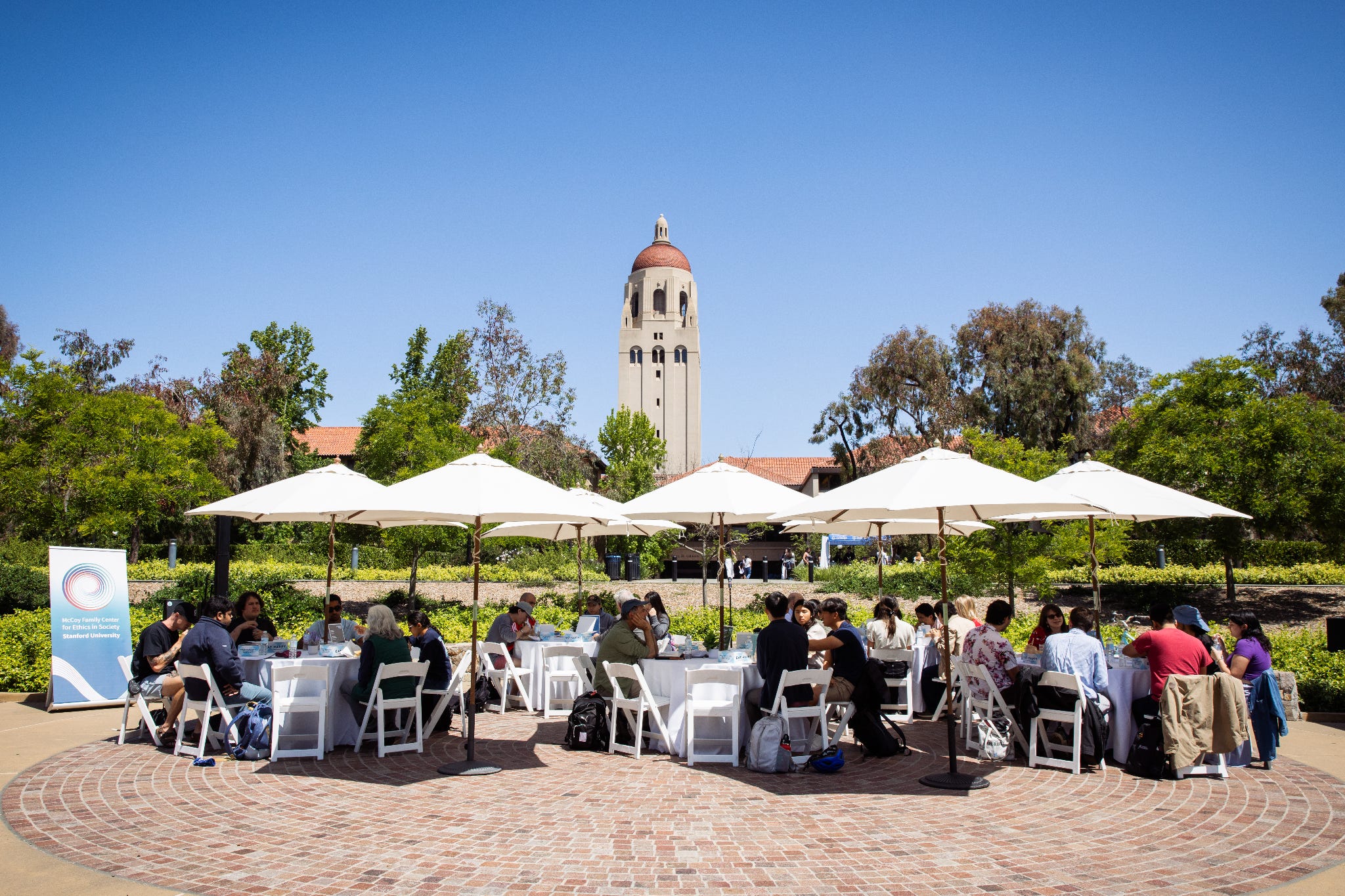
In January, HxA hosted a member-only workshop hosted by HxA member Mary Kate Cary who originally launched the “Disagree with a Professor” event series at and University of Virginia. Inspired by the success of the event, HxA Chapter co-chair at Stanford Adam Spitzig and Director of Graduate and Undergraduate Programs at Stanford’s McCoy Family Center for Ethics in Society Collin Anthony Chen hosted their inaugural event on campus last month.
In the conversation below, Spitzig and Chen explain how students and professors engaged constructively on contentious topics, plans for their next event given the success of this first event, and offer advice for others wanting to start this series on their campus.
Nicole Barbaro Simovski: The “Disagree with a Professor” event featured some genuinely contentious propositions for students to engage with — abolishing the presidency, scrapping in-person voting, questioning whether we’re less pandemic-ready now than before COVID. How did students actually engage with those positions? Were you surprised by any of the conversations that unfolded?
Adam Spitzig and Collin Anthony Chen: While we weren’t able to observe the conversations directly — we were managing logistics during the event — we did speak with participants afterward, and a few things stood out. Students came in genuinely energized, not just to listen but to contest and push back, which was exactly the spirit we’d hoped for. One exchange that seemed to generate particular heat involved a faculty statement about whether student medical data could be used without consent for research purposes. Many students actively disagreed with the position, and the faculty member pushed them to go beyond a gut reaction and articulate precisely what bothered them about it, which by all accounts made for a really constructive back-and-forth. Students also told us that the informal setting mattered: without the grader-gradee dynamic in the room, both sides seemed freer to engage more honestly and go deeper than a typical classroom exchange might allow. They also mentioned appreciating being challenged with evidence when they pushed back, having their counterarguments taken seriously and tested, rather than simply validated.
Simovski: This was described as the “inaugural” event at Stanford. What was the impetus for launching this new event series to foster constructive disagreement between and among students and faculty?
Spitzig & Chen: Stanford already has a robust and growing ecosystem of constructive dialogue initiatives — COLLEGE, Summer Frosh Civil Dialogues Program (which Chen runs), several ePluribus initiatives — and we wanted to add to that, filling a niche by specifically targeting the interactions between professors and students. This was partly motivated by surveys of students at Stanford and elsewhere that have suggested that a majority of students are reluctant to publicly disagree with their professors (likely for some of the reasons noted in our answers above). We were also inspired by the Disagree with a Professor program series at UVa, and thought a similar program would draw lots of interest from students and faculty at Stanford. I should note that we benefitted from HxA’s January member workshop on launching a “Disagree with a Professor” event, which offered lots of helpful guidance for launching our event series at Stanford.
Simovski: You helped build this as part of HxA’s Chapter at Stanford. What was the organizing process like? How was the experience of recruiting faculty willing to argue a provocative position and getting student interest?

Spitzig & Chen: The organizing process was lots of work, but lots of fun. It was a great way to connect with professors from across campus, and across a wide variety of research domains, schools, and departments. This was one of our favorite parts of the organization process. The faculty response, generally, was very positive: there was lots of interest, across schools, disciplines, levels of seniority. Ultimately we had more interested faculty members than spots, and had to postpone some faculty members’ participation until our next event. Some HxA members were among our faculty participants, but most were not HxA members. Faculty seemed to really enjoy the chance to develop their own statements to defend, with several developing more than the three we requested (in these cases, it was difficult to narrow down their great suggestions!). We also had more students sign up than we had spots, indicating a strong interest.
HxA co-sponsored the event with an established center on campus, the Stanford McCoy Family Center for Ethics in Society (where Chen is the Director of Graduate & Undergraduate Programs), which helped strengthen the event and further integrate our new Stanford HxA Chapter into the university ecosystem. The McCoy Center provided financial and administrative support for the event, and probably helped to boost name recognition and event legitimacy in the eyes of the university, students, and faculty, who are already familiar with the McCoy Center.
Simovski: In a campus climate where many students and faculty feel the need to self-censor on contentious public topics, what do you think this event format does to help change the culture on campus?
Spitzig & Chen: Students reported that engaging with faculty outside of the classroom lowered the stakes of the conversation and gave them deeper insight into how faculty members think about topics as an interlocutor rather than an authority figure. The format helped make students more comfortable trying out different ideas since it is in the context of a conversation rather than a formal paper or classroom discussion where there is heightened concern about grades and appearances.
Simovski: Beyond the conversations that happened in the room, what’s the lasting effect you hope this event has — on the students who attended, on the faculty who participated, and on Stanford’s broader campus culture? How do you measure success for something like this?
Spitzig & Chen: We hope this event spurs broader excitement for similar events in the future. We are already planning follow-up events in the fall and hope to expand the “Disagree” series to include events with alumni, administrators, graduate students, and other groups, encouraged by the positive feedback we’ve received. We hope that the event adds productively to the existing Stanford constructive dialogue ecosystem, addressing the specific opportunity of facilitating more student-faculty dialogue outside of the classroom. Measuring success is challenging, but we intend to track participation rates, seek and record participant (student and faculty) feedback, and expand to include greater numbers of Stanford students, faculty, and other community members.
Simovski: What advice would you give to other HxA members who are interested in launching their own “Disagree with a Professor” series on their campus? What things should they keep in mind when organizing this?
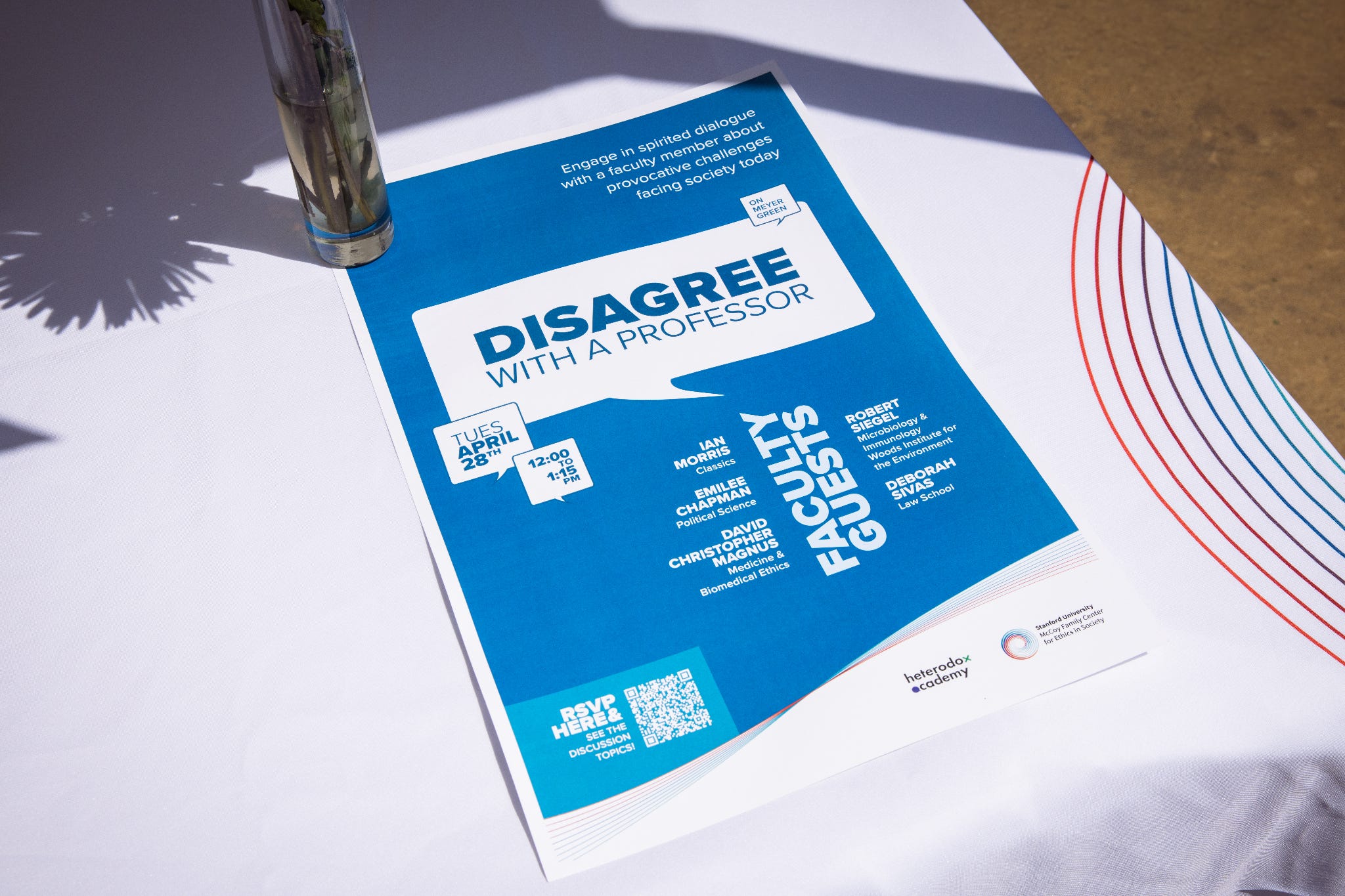
Spitzig & Chen: Don’t underestimate branding and marketing — try to develop a quality logo and coordinated marketing materials well before the first event. Try to recruit students or others to help promote and document the event (by conducting, editing, and posting post-event exit interviews, for example, which one of our student assistants did). Seek campus newspaper coverage, if possible. Cast a wide net when inviting faculty members. Drum up interest and clarify the event format, among faculty members and students, by providing examples of statements that faculty have developed and will defend; this was a key moment in our organizing process – once we started using a few great faculty statements in our promotional materials (see below), student interest expanded quickly. Use the event as an opportunity to develop and expand relationships between your HxA Chapter and other established organizations, centers, or groups on campus (as we did with the McCoy Family Center for Ethics in Society).
Try to hold the event in a visible, central, semi-public space on campus, and use great signage to pique the curiosity of passersby and generate a buzz. We had one member of our team speaking with individuals in the general vicinity of our event, and many people came up to our registration-table during the event and wanted to know more about what was happening (we gave them pre-printed flyers). We also had a large, professionally-made banner that we had pre-ordered, with our “Disagree with a Professor” logo on it, hung up on our registration/food tent. It was visible from a distance, and likely helped generate interest and increase our brand recognition.
We also had placed printed flyers in a stand-up plastic menu-holder on each table. They displayed the professor’s name and their three statements, and included our “Disagree with a Professor” branding and logo. These helped orient the faculty and student participants and were a nice visual touch on the tables.
We also worked with Stanford’s event services to pre-plan the event layout and request specific tables, chairs, umbrellas, food, registration tables, canopy tents, audio system, etc.
Cater the event with easy-to-grab food (we got pre-made boxed lunches with sandwiches, and bottles of water) so that everyone can smoothly and quickly check-in, confirm which table they are at, grab food and a drink, and sit down at their table.
Want to launch your own “Disagree with a Professor” event on your campus this fall? Use HxA’s official How-To Guide to get started.

Another excellent program and idea from HxA and its members. I am an HxA donor and will continue to increase my donation to your excellent organization. Thank you for your long hard slog to return higher education to being a positive force in our much beleaguered culture.
The “Disagree With Your Professor” will effectively build more dialogue with all sides. Brilliant idea!