


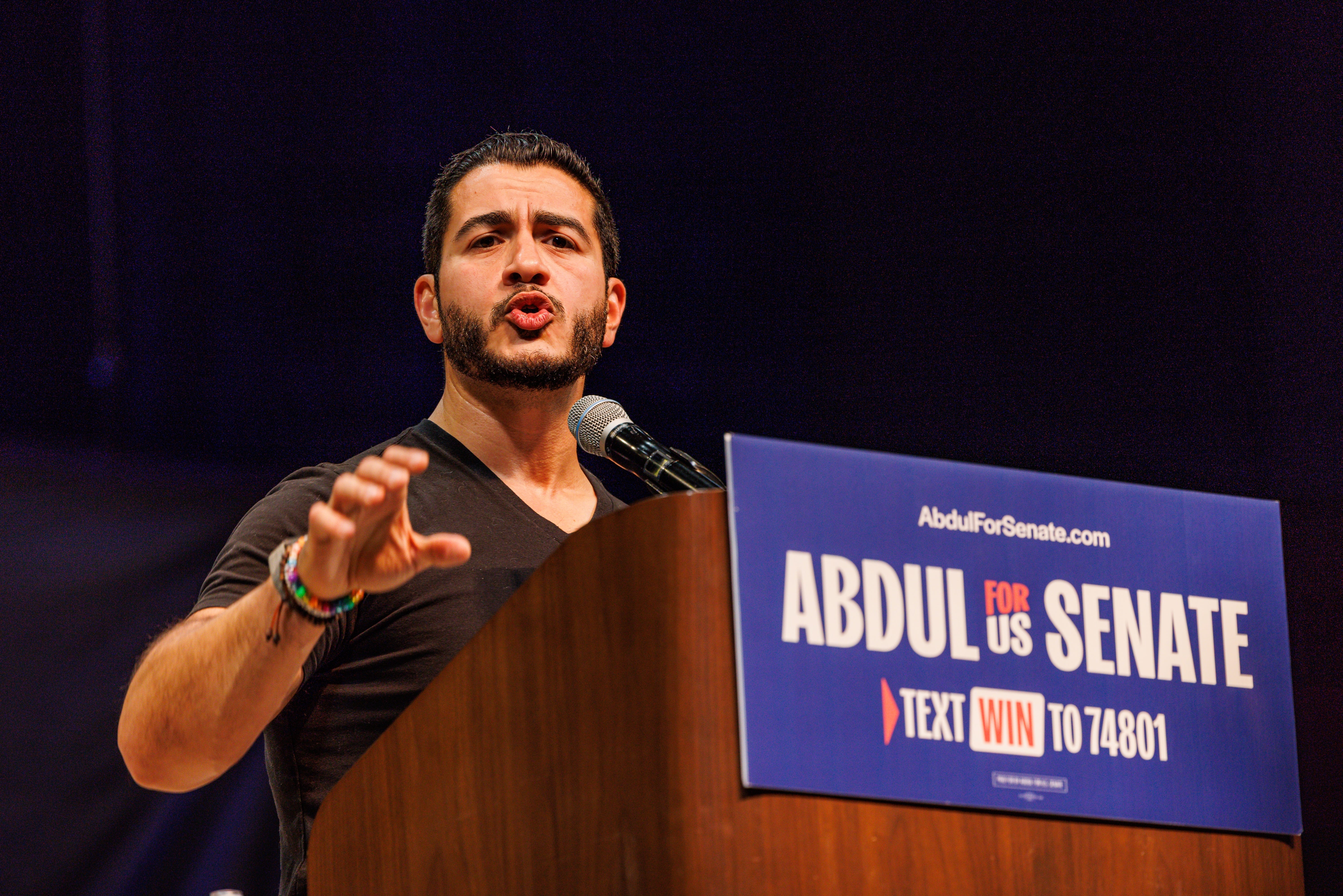
In July of this year, the American Association of University Professors endorsed Abdul El-Sayed, a candidate in Michigan’s Democratic primary election for U.S. Senate. Reactions from higher ed commentators played out exactly how you might expect: where defenders saw an obligatory bulwark of academic freedom against GOP incursions, critics saw an own-goal that only further justified those attacks.
However justified the AAUP’s decision may have seemed to some, new research suggests that it will only further fracture public trust in higher education. Worst of all is that this will play out along well-worn political lines: the biggest losses of trust will happen among the science-skeptical conservative public, while leftwing, self-avowed allies will continue to #TrustTheScience.
Across three studies conducted around the 2020 and 2024 elections, Syropoulos and colleagues found that left-leaning candidate endorsements by scientific journals undermined trust among moderates and conservatives. After reading a press release describing either a neutral announcement or a Democratic political endorsement, participants were asked to indicate their trust in science, assessed via agreement with statements such as:
“Scientists and scientific results are biased.”
“Information from the scientific community is trustworthy.”
“Scientific research is influenced by the political values of scientists.”
Conservatives, and to some extent moderates, trusted science less if they read the press release with the political endorsement compared to the one without it. Liberals’ trust in science was unaffected, whether or not the press release contained an endorsement. The takeaway, according to the researchers, is that scientists should think very carefully about the kinds of political statements they make if they want to retain authority with the public. I fully agree with this note of caution from the authors, and I’m equally concerned about what the results suggest. But what worries me even more is the psychological process that I think explains their results, although it’s not the interpretation the authors take.
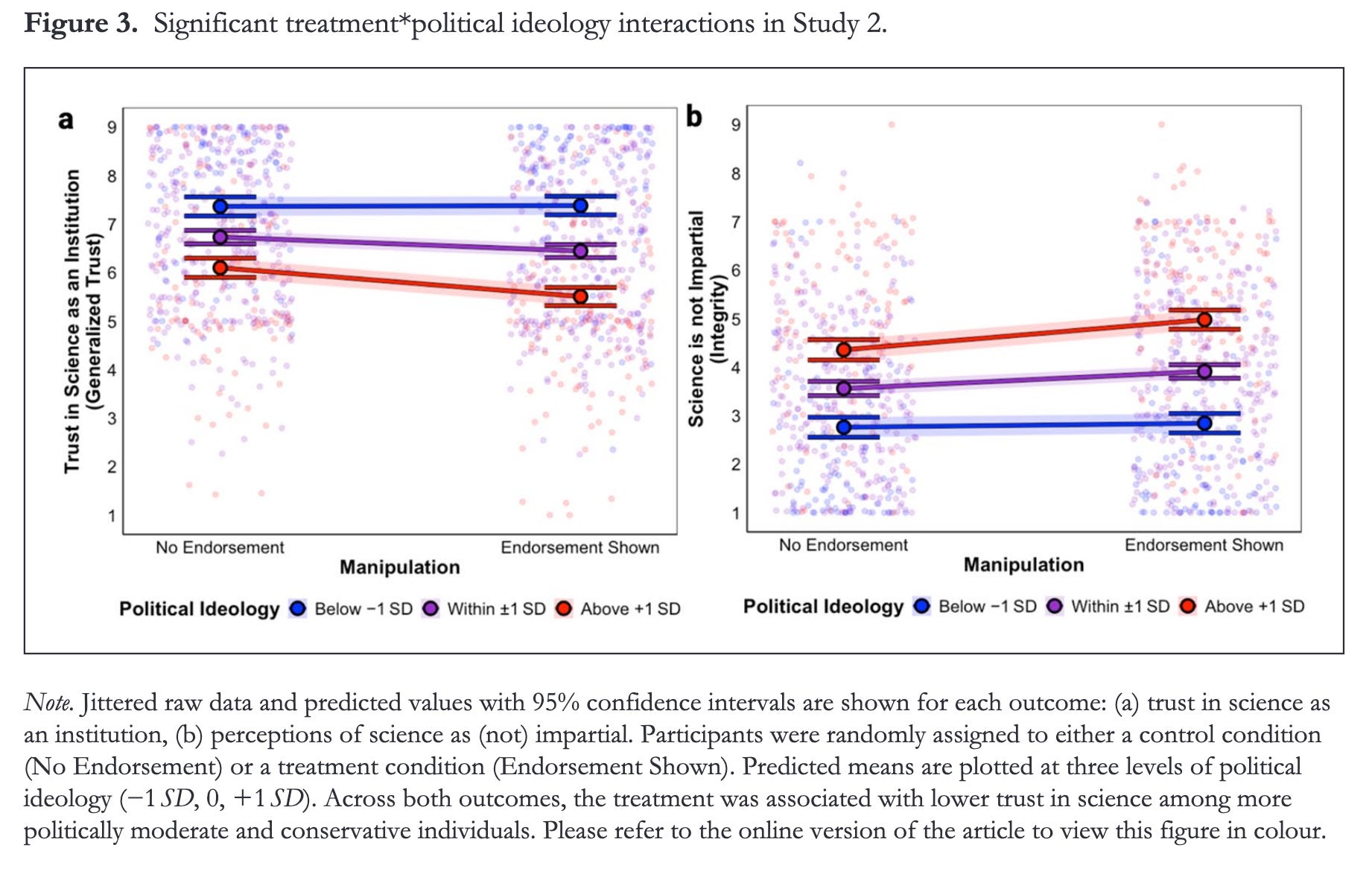
The researchers attribute the pattern of results to conservatives engaging in motivated reasoning, but I’m not so sure. In the authors’ view, a political endorsement by a scientific journal shouldn’t influence views of science generally. To quote the authors, “[t]hese endorsements, though unrelated to the methodologies of science [the object of evaluation in the study], reinforced existing skepticism and deepened perceptions of bias, illustrating how ideological narratives shape interpretations of even peripheral aspects of science” (p. 794).
I don’t doubt that conservatives harbor significant doubts about the capacity for science to uncover knowledge. And the authors are right to note the existence of cues that carry no signal about how science as an institution is functioning and should therefore not influence general trust in science. (The classic cue for motivated reasoning research is the political implication of a scientific finding: people evaluate otherwise identical scientific studies as higher quality when the results affirm, rather than undermine, their political views.)
But the cue used in this study — public endorsement of a political candidate in an election — seems to me like a legitimate reason to lose trust in an institution we rely on to be objective. Trump and his coalition railed against school closures during the COVID-19 pandemic. Who knows how much the reasoning was based on empirical evidence versus COVID denialism, but at least some evidence now suggests that the long-term costs of school closures will outweigh the benefits. For a 2024 voter, knowing that the editors at Science have communicated their desire to see Kamala Harris elected over Trump, and the dire stakes they attach to the outcome of the election, would it be unreasonable to lose confidence in the editors’ ability to fairly evaluate evidence that would incidentally vindicate team Trump? (The question is not whether such research could get published at all, but whether it is evaluated at each outlet by the same standards as research suggesting the opposite conclusion.)
In fact, you don’t have to be aligned with any particular party to raise an eyebrow at a scientific community that so clearly communicates a stake in specific political outcomes. (After all, in Syropoulos et al.’s study, the candidate endorsement caused even moderates to lose a degree of trust in science.) If you simply value finding out what is true and accurate about the world, then it should be concerning to observe a scientific body issuing blanket political endorsements, seemingly accepting certain priors about contentious issues.
For the same reason I’ve argued the non-liberals were right to lose trust in science following the political endorsement, I’m equally concerned with why the endorsement had no effect on liberals’ trust in science. The same pattern of results that suggests undue conservative skepticism is equally compatible with undue liberal credulity: already expecting science to affirm their worldviews, they don’t particularly care when gatekeepers signal a commitment to something other than truth. Of course, the true explanation is probably somewhere in the middle, with each side engaging in the distortion that suits their own political ends. The political psychology literature is littered with examples of similar double standards.
It’s not that scientists should never make politically relevant statements. As foremost experts in their fields, scientists are uniquely positioned to help the public make evidence-based political choices. But the quality of those choices depends on the accuracy of our information, and reality is messier than any one political party would like to admit. In advocating for a particular candidate, the gatekeepers of scientific knowledge signal a conflict of interest in their ability to recognize and disseminate knowledge irrespective of which policy conclusions it may support. That is what I believe the conservatives and moderates in Syropoulos et al.’s study were responding to, and what the liberals didn’t notice because they already agreed with the endorsement. Bias is like bad breath; we mostly notice it in other people.
So how should scientists tread the delicate boundary between communicating politically relevant information and trespassing into inappropriate advocacy? Luckily, we already have evidence regarding styles of political communication from scientists that win and lose trust from the public. One such piece of evidence comes from a 2024 experimental study where researchers had participants read news articles containing quotes by scientists offering policy advice. The scientists delivered their advice in one of two styles: the “epistocrat,” where the scientist framed one policy alternative as the only justifiable one based on the science, or the “honest broker,” where they identified likely costs and benefits of the policy and explained that it’s up to the public to weigh them. For example, in an article on restricting domestic flights to combat climate change, both scientists outlined how short-haul flights contribute to rising global temperatures. The difference was that one scientist used this to shut down debate about the appropriate policy response, whereas the other used it to invite one.
On average, participants trusted the epistocrats and their findings less than the honest brokers, but the biggest loss in trust happened among participants who were opposed to the policy proposal being discussed. Trust among participants who already agreed with the policy proposal wasn’t affected by the scientist’s communication style, echoing Syropoulos et al.’s findings regarding political endorsements.
These findings were about an individual scientist claiming to settle a policy debate in their area of expertise — a relatively minor overstep. But a scientific body that endorses a candidate for office implicitly asserts that its members’ expertise can settle architectonic debates about the correct ordering of priorities on every issue of public significance. (Similarly, in endorsing El-Sayed specifically for his stance on higher education, the AAUP implicitly argues that that issue supersedes others, such as healthcare, foreign policy, or technology, in importance when deciding how to vote.) I can understand why someone would think twice about the credibility of such an organization, and I agree with Syropoulos et al. when they argue that organizational statements correcting misinformation, explaining scientific consensus, and defending science as an institution may be better alternatives. In my view, they are also much more legitimate.
I believe that the AAUP, along with the scientific organizations that issued endorsements in recent elections, were trying to protect the infrastructure of science and higher education. Actions taken by the second Trump administration have undoubtedly undermined scientists’ ability to pursue knowledge through funding cuts and potentially illegal idea bans, often automated by blunt-force keyword searches. I am just as concerned about these attacks. But I see them as excellent reasons to stop politicizing expertise in ways that alienate half of the voting public, entrench political fractures within universities, and subvert higher education away from its purpose as a non-partisan, public good. That doesn’t mean disengaging from political discussions altogether — but being truly pro-science means accepting evidence that full-throated political advocacy won’t solve our issues, and may even make them worse.

Your piece does a great job explaining why people trust science less over time. I find it concerning when endorsing a candidate stands in the way.
What actually causes distrust is the inability to reproduce much of the clinical, medical, "social science", etc. research. Political endorsements only reinforce the distrust. COVID showed a lot of us the insidious lengths politicians would go to pressure big tech to label sound scientific opinion as "misinformation" and justify censorship.