


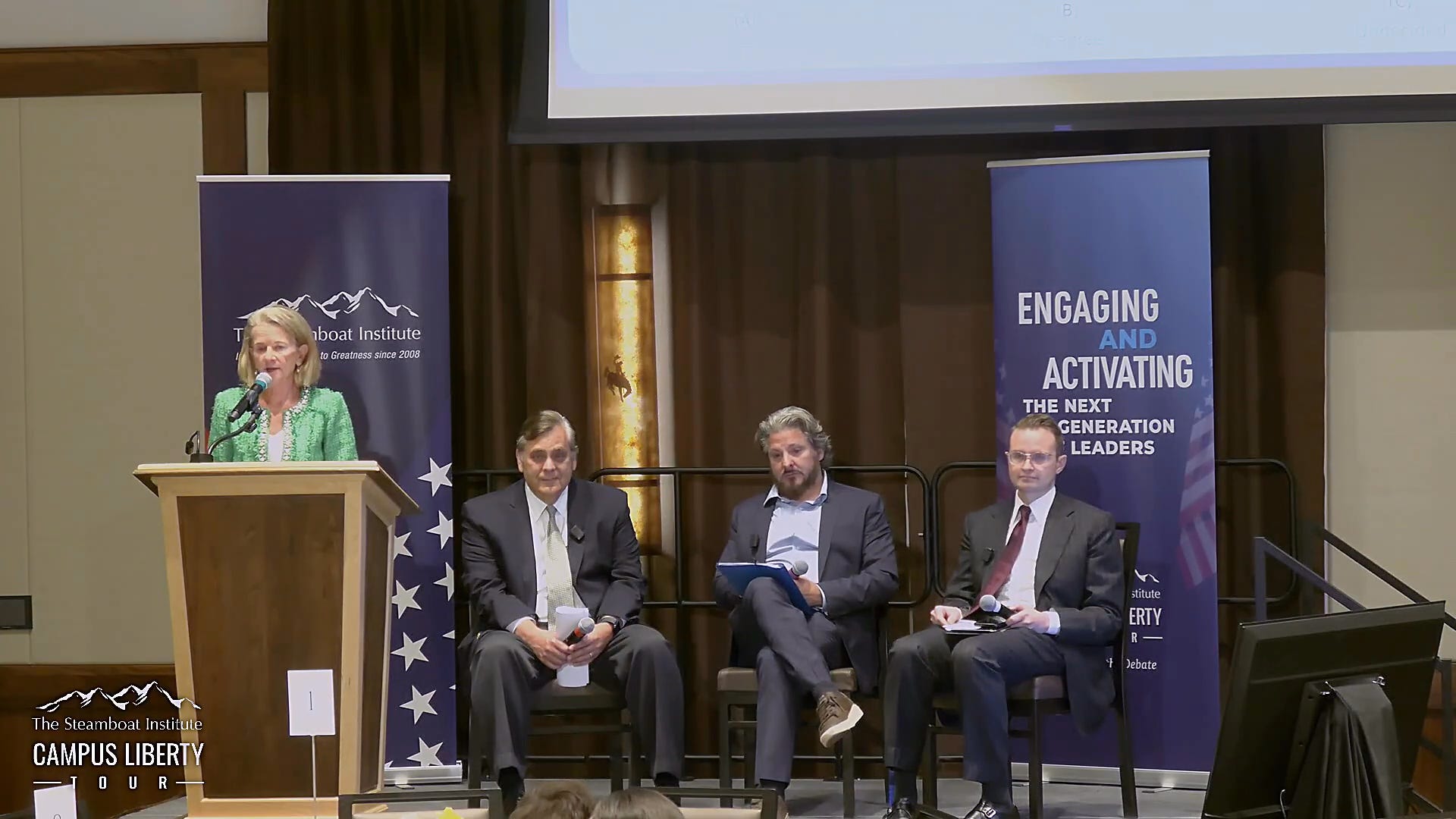
Attendees of Heterodox Academy’s Mountain West Regional Conference were treated to a debate on the following question: Is institutional neutrality necessary to preserve the university as a forum for open inquiry? Legal scholar Jonathan Turley argued the affirmative, while Rutgers professor and president of the AAUP Todd Wolfson argued the negative.
While both speakers made thought-provoking arguments, neither was a clear winner on their arguments alone, in my view as an audience member. (According to the live audience poll during the event, Turley began and ended with more votes, but Wolfson changed more minds.) But even setting this aside, is an all-or-nothing focus on necessity distracting from the more practical questions that campuses wrestle with every day: namely, who would do best to stay neutral, and why?
First, some thoughts on the debate. Strikingly, the speakers agreed that universities issue too many statements on issues not relevant to their core missions. Wolfson’s public skepticism toward claims that typically motivate the need for institutional neutrality (such as the existence of political bias in academia), and his comfort with the AAUP’s overt partisanship, had instead led me to expect an ardent defense of institutional statements. (I was not alone in this reaction, as it turns out.)
But Turley and Wolfson were asked to settle whether neutrality is necessary, not just prudent.
Turley’s arguments, although familiar and agreeable to most in the heterodox world, did not directly address the necessity of institutional neutrality for open inquiry. Turley emphasized the hostile climate for conservatives and libertarians on many college campuses, and his examples of institutional statement-making, such as a UC Santa Cruz departmental statement about Gaza being a feminist issue, illustrated the one-sidedness and performativity of institutional statements. At most, he noted that institutional neutrality’s most vocal critics tend to be openly hostile toward non-progressive views, as if to imply that neutrality is an important protection against political exclusion. All of these pieces of information are logically compatible, but still the case for why open inquiry is impossible without institutional neutrality — rather than just more challenging — was never made.
Wolfson opened by describing a hypothetical university that was perfectly neutral but whose curriculum and research were dictated entirely by external political actors. Obviously, open inquiry could not take place in such an academically unfree environment. From this Wolfson appropriately concluded that institutional neutrality cannot be the decisive factor for open inquiry — because as his example clearly showed, it can’t counteract restrictions imposed on the university from outside. But this wasn’t the question on the table. Wolfson’s example showed that institutional neutrality may not be a sufficient condition for open inquiry, but plenty of conditions are not sufficient and yet remain necessary. Someone who gets plentiful sleep but is the victim of abuse from a partner would not be flourishing, yet nobody would conclude from this that sleep is unnecessary.
The rest of Wolfson’s argument turned on the claim that political statements need not hinder open inquiry, and thus that institutional neutrality cannot be necessary for open inquiry to take place. When seven universities publicly rejected Trump’s Compact for Academic Excellence, Wolfson argues these statements were political, not neutral, and yet they protected open inquiry rather than undermined it. This is true on its face, in the sense that a statement addressing the actions of a political administration can’t help but be political. But “neutrality” isn’t meant to be a property of institutional statements; it describes an institution’s decision to refrain from issuing them. The Kalven concept (and HxA’s own model) of institutional neutrality makes clear that universities can break this neutrality to protect their operations and mission, as Turley pointed out in the Q&A. The idea, in Turley’s words, is to provide a “bright line” to help institutions make consistent decisions about when they should express a position. But in a way this was Wolfson’s point: even proponents of neutrality don’t advocate for perfect neutrality, so shouldn’t we be talking about where to draw the line?
Although neither speaker convinced me on the all-or-nothing question of the necessity of institutional neutrality for open inquiry, I’m also not convinced that that’s the question we should be asking. The resolution packed a lot into a single statement: “Institutional neutrality is necessary to preserve the university as a forum for open inquiry.” I wonder whether we would be better off breaking the question into two parts and riffing off of each.
The first part is “Institutional neutrality is necessary.” To me, that question is incomplete without specifying whose neutrality we are talking about. Neutrality for top-level leadership seems wise. What about departments? As we recently reported, institutional neutrality policies vary in their guidance regarding departmental statement making: some strongly caution departments against weighing in, while others offer no guidance. I would argue that the more consequential a unit is to an individual’s professional trajectory, the more important it is not to introduce pressure on them in one way or another. Being a member of a department where your colleagues, who will soon review your tenure case, urge you to sign a statement denouncing the results of the latest political election, may be very different from seeing the same statement in a press release from the university president’s office. This seems to be a point of agreement even with critics of neutrality like legal scholar Brian Soucek, who notes in his recent book The Opinionated University that individually signed departmental statements may be the most coercive of all.
The second part, “to preserve the university as a forum for open inquiry,” addresses why neutrality is valuable. While open inquiry is perhaps the most popular justification for neutrality, we can also ask whether neutrality might protect other goods as well. In addition to its internal cultural and epistemic challenges, higher education faces a crisis of trust among the public — and one that is increasingly being weaponized by political actors. Even if one questions the necessity of institutional neutrality for safeguarding open inquiry, it could be critical for recovering public trust in higher education, as Jeffrey Sachs has argued in the Chronicle of Higher Education. Given that politicization has been shown to undermine trust in institutions, there also seems to be solid empirical grounds for thinking that institutional neutrality would be a step in the right direction. Here, again, although institutional neutrality may be necessary to win back the public’s trust, it would likely be just a first step down a long road.
Although I’ve offered some critique of this debate and the arguments put forward, it bears emphasizing that even the occurrence of this debate is a success. That both speakers accepted the invitation to engage in good faith over this question (which has generated no shortage of heated discussion) was a powerful demonstration of constructive disagreement within the academy in action. In fact, unearthing so much common ground is possibly the debate’s most useful outcome. Both speakers rejected free-wheeling institutional speech, and both accepted that a university may speak to defend its own operations and independence, as several institutions did in refusing the Trump administration’s Compact. If both sides can agree on that, maybe the next debate can reveal even more common ground about who should be neutral and why.
