


Some heartening higher ed news, hot off the press: faculty value viewpoint diversity! In our latest report published yesterday, Faculty Attitudes Toward Diversity in Their Disciplines: A National Survey, we asked over 3,500 faculty from 80 different institutions about the extent to which they think teaching and research are improved by exposure to a wide range of viewpoints along eight specific dimensions of diversity: 1) political perspectives, 2) socioeconomic backgrounds, 3) race, 4) gender identities, 5) religious views, 6) methodological diversity, 7) sexual orientations, and 8) disability statuses.
The bottom line: Overall, every one of the aforementioned dimensions of diversity was viewed by a majority of faculty in our survey as improving teaching and research. Even the least popular form of diversity, that of religious views, was viewed positively by just over half of respondents.
And the most popular form of diversity is not one that shows up on a census form or on a voter registration application. Methodological diversity was, by far, the most popular form of diversity, with over 8 in 10 faculty in our survey agreeing that methodological diversity improves the quality of teaching and research.
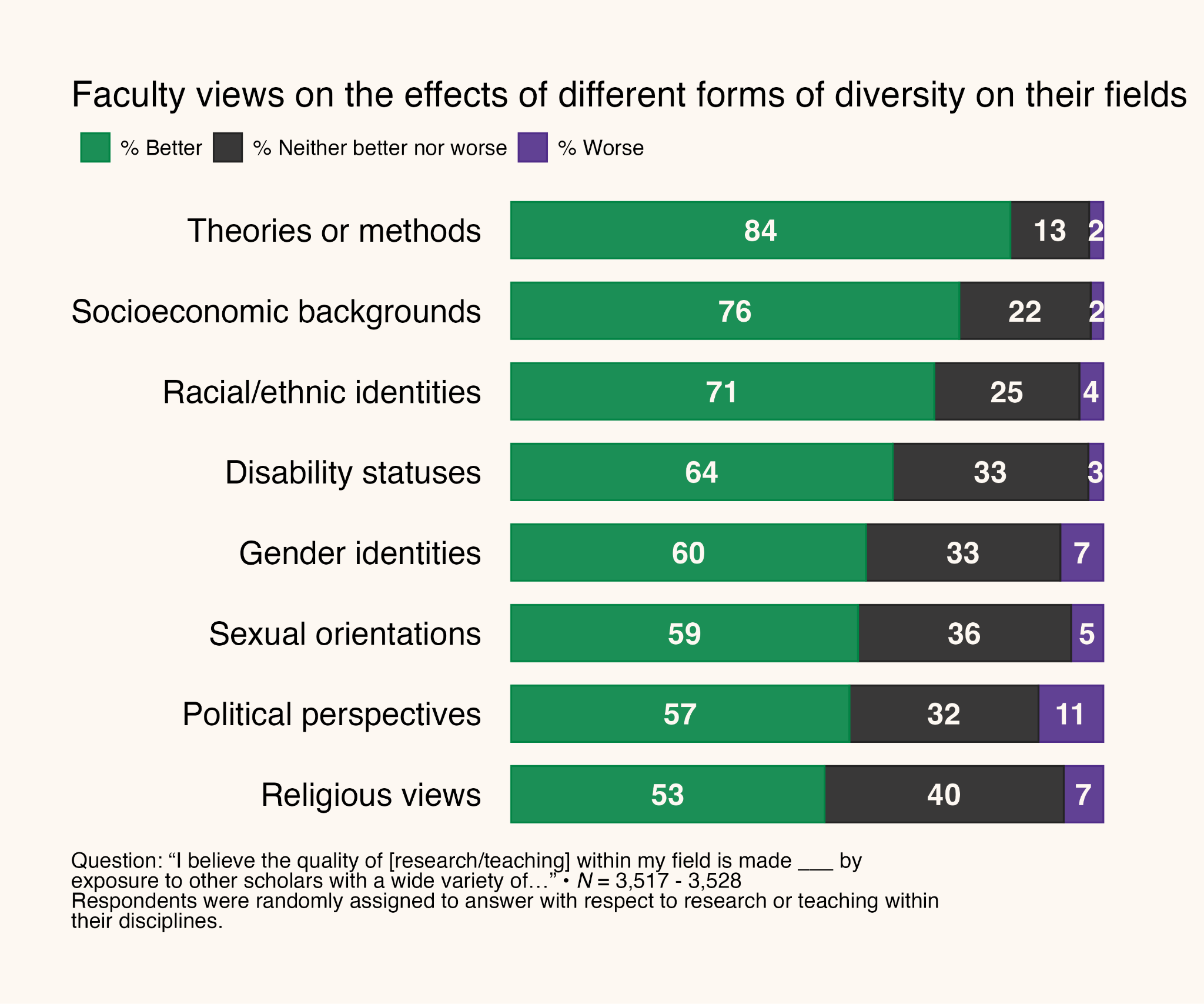
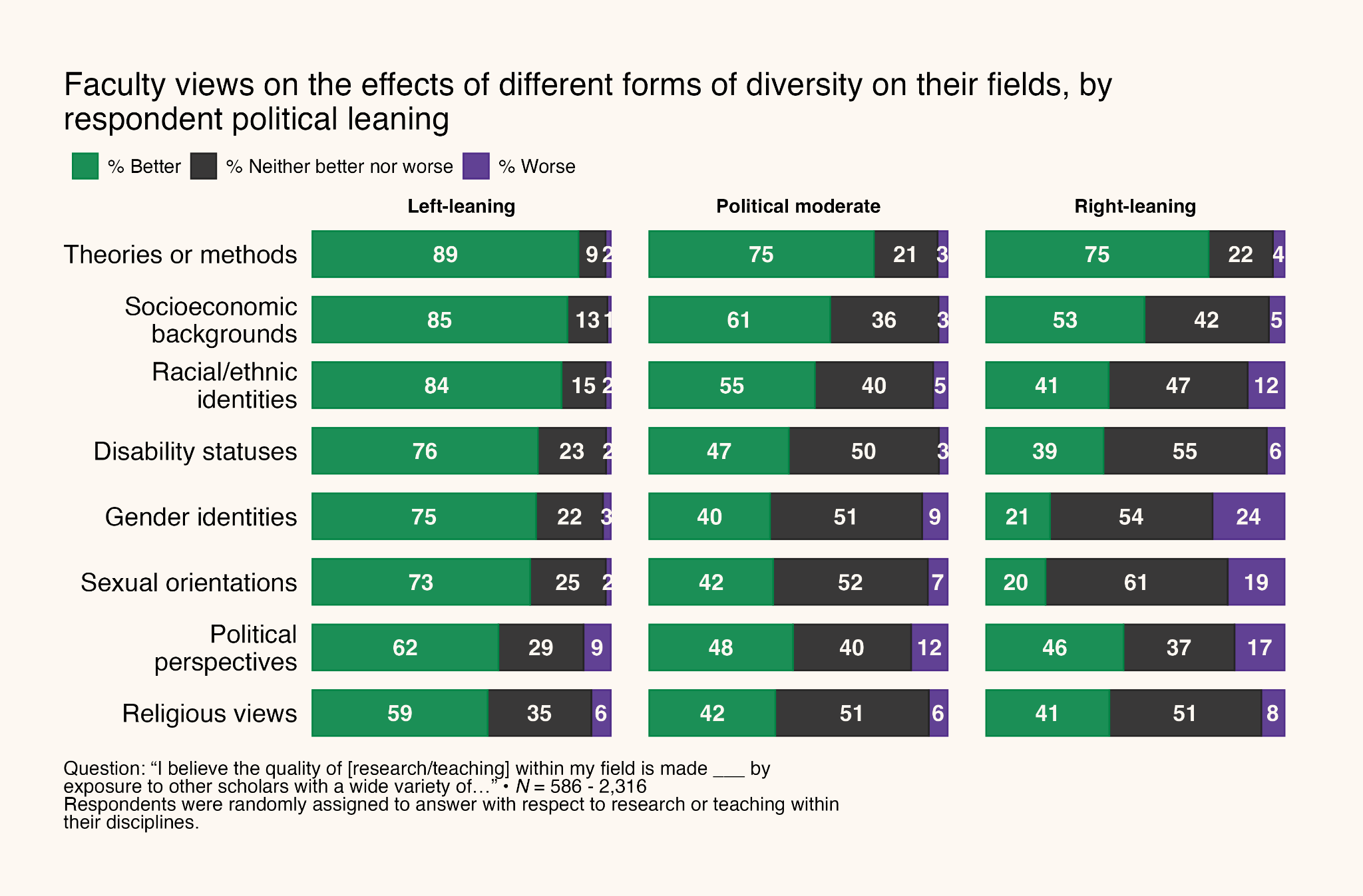
Not all of the eight dimensions of diversity were equally popular with everyone, but the findings didn’t break down the way many might expect. For example, contrary to the suggestion that political diversity among faculty is a conservative cause, we found that liberal faculty were actually more likely to report that political diversity improves the quality of teaching and research. This was the case within all disciplines except STEM.
Another striking finding is that faculty collectively underestimate how much their colleagues also value diversity, especially religious and political diversity in the social sciences and arts/humanities. Though faculty members in these disciplines on average saw these forms of diversity as beneficial for their fields, they wrongly estimated their colleagues’ views as lukewarm at best. This indicates an important perception gap: if faculty generally underestimate how much their peers value viewpoint diversity, they may be less likely to advocate for it on their own campuses, which feeds into the cycle of academic self-silencing and groupthink.
Here’s what HxA really wants university leaders and faculty to take away from this survey: Most likely, faculty on your campus already think that teaching and research are made better by exposure to a broad range of viewpoints. Broadly speaking, your faculty don’t need to be convinced; they need to be mobilized.
Each institution may encounter different challenges in cultivating viewpoint diversity, with some faculty perhaps feeling more reticent than others. Here, drawing the clear connection between viewpoint diversity and the purpose of the university is key. Universities exist to pursue truth and knowledge. The conditions for this mission are made fertile by a robust array of viewpoints that don’t just complement each other, but compete to drive truth forward.
There is a growing pool of experience to draw from, as many universities have already undertaken measures to broaden the range of perspectives on campus. Tufts University’s Center for Expanding Viewpoints promises to help the Tufts community “break out of ideological bubbles to drive research and teaching forward.” Harvard University is undertaking efforts to promote viewpoint diversity on campus through hiring for professorships dedicated to “viewpoint diversity.” At Duke University, the Provost’s Initiative on Pluralism, Free Inquiry, and Belonging brings together scholars and students of all viewpoints for constructive disagreement and civic engagement, while the University of Wisconsin-Madison’s Wisconsin Exchange: Pluralism in Practice initiative pledges to foster “the robust exchange of ideas” throughout campus life.
These different initiatives illustrate that there’s not a single, one-size-fits-all approach to viewpoint diversity. Institutions need to do what works for them — but whatever “it” is, it needs to be backed up by a genuine commitment from university leaders and support from faculty.
University leaders and faculty can draw from these initiatives to build cultures of open inquiry on their campuses through a number of means, such as: investing in under-explored areas of scholarship; incentivizing syllabus diversification so that students are engaging with good-faith versions of contested positions; supporting faculty in adversarial research collaborations; building infrastructure to enable co-teaching across ideological differences to give both their students and themselves a deeper academic experience; protecting the expression of students and faculty; transforming classrooms into spaces for intellectual risk-taking; and more. There is a wellspring of possibility here to cultivate broad viewpoint diversity within our institutions — and the majority of faculty are likely ready to get to work.
As HxA President John Tomasi often says, academics are a “community of imperfect learners.” No one has all of the answers. At HxA, we’ve been having a lot of internal discussions about how best to embrace the “messiness” of teaching and scholarship. After all, knowledge production is not a particularly tidy endeavor. It requires intellectual elbow grease, epistemic tussles, a few bruises to the ego every now and then — and it’s so worth it.
If this “messiness” resonates with you, join HxA if you haven’t already. And free up space on your calendar to get your hands dirty with faculty and university leaders at the 2027 Annual HxA Conference in Boston, April 12–14, 2027, to discuss how to Renew. Reform. Rebuild. See you there!

Very interesting and timely! I have one barb, though. I have to request the poll without the usual "data available upon request." Are you filtering requests? If not then why the form?
This is an important measure of faculty opinions -- and very revealing. I am pleased to see that the majority view the methodological diversity in a positive light -- but I am appalled to see that a large fraction of faculty sees immutable characteristics of researchers--such as race, sexual orientation, and disability--as being relevant to the quality of research. Who in the sane state of mind would say: "I believe that having more disabled practitioners in the field of quantum computing leads to more breakthroughs in research"? Overall, these results do not paint a flattering picture of the academe.