


I have two boys in college, and their university experiences are very different from the one I had in the 1990s. While many of those changes are for the better, some are for the worse. And on the whole, I would be reluctant to trade my experience for theirs. If you are reading this essay, most likely you know about many of the concerning trendlines in higher education. I resigned my full professorship to work for Heterodox Academy to do something about it.
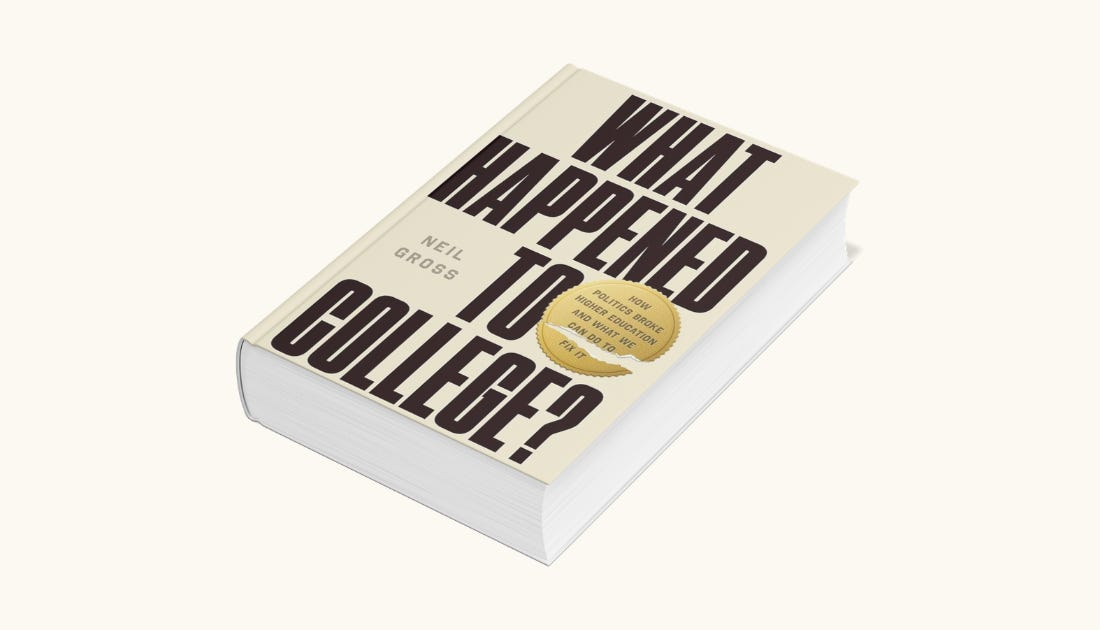
But fixing something requires having a good handle on the problem. If you don’t know why a system broke down, it will be difficult to bring it back online. Neil Gross, a sociology professor at Colby College, has an answer: universities have been caught in the crosshairs of political polarization.
If you don’t know Professor Gross’s work, you’ve been missing out on one of the most honest and thoughtful observers of higher education. His 2013 book, Why are Professors Liberal and Why do Conservatives Care? is one of the very best takes on faculty ideology that I’ve read. He argues that the current political imbalance in faculty is the result of political typecasting. A historical contingency--the need for universities to pivot from religious institutions to knowledge-producing ones--created a long-lasting stereotype of professors as liberals. That stereotype affects how students see the occupational options open to them with liberals seeing it as a live option and conservatives not taking a professorship seriously.
In his new book, Gross relies on years’ worth of survey and interview data to paint a picture of university life. And from the students to the faculty, everyone views college through a political lens in a way they weren’t only a decade ago. A student’s political ideology, values, and interest in politics increasingly influence each of the following:
Where the student applies to college
Where the student decides to attend college
Which major the student selects
Which clubs the student joins
Who the student rooms with or dates
Whether the student speaks up in class.
Faculty are also far more likely to allow their political ideology to shape everything from their decision to go to graduate school to how activist they are in their classrooms. Gross concludes that “the restructuring of undergraduate life along political lines is at the core of the current crisis, turning the university into valuable and contested territory in the ugly fight between left and right. Students are paying the price” (217).
If polarization is the problem, what is the solution? Professor Gross sketches six concrete changes universities could make to turn down the political heat on campus. Here are the key moves:
Change admission standards. Professor Gross recommends that admissions committees go beyond markers of intelligence and achievement to probe applicants’ commitment to reasoned debate. Gross also recommends that admissions committees build incoming classes that are more politically diverse. In particular, holistic admissions criteria that focus on an applicant’s overall “fit” are likely to perpetuate the politics and bias of whomever is judging the fit. Instead, let’s charge admissions directors at elite universities to shape incoming classes in ways that foreground constructive dialogue and increase opportunities for engaging with “the other.”
Improve students’ constructive dialogue skills. Honing students’ constructive dialogue skills will make cross-ideological encounters more pleasant and productive. Professor Gross urges universities to collaborate to determine which interventions are most effective and incentivize faculty to add constructive dialogue skills into the learning outcomes of their courses. The empirical evidence shows that we consistently overestimate how unpleasant conversations about political issues will be, and college campuses are a great place to recalibrate those expectations.
Intentionally structure campus life in ways that foster cross-ideological interactions. This includes randomizing roommate assignments and sponsoring events and activities that bring together student groups that don’t ordinarily intersect. Given how much political polarization undermines the serendipitous interactions and alignments that generate friendships, this strikes me as a vital suggestion. I was a faculty in residence on my campus, and over five years of living in the residence hall made it clear to me how important the college experience outside the classroom really is. As HxA President John Tomasi put it, the real test of intellectual vitality on campus is whether students are having free-ranging conversations about hard topics on a Tuesday night in the dorm.
Make space for faculty to have explicit conversations about good teaching in the age of polarization. Professor Gross acknowledges how little teaching training most of us receive in our PhD programs, and he calls on academic administrators to provide professional development on how to handle controversial topics, how to design courses that attract a wider breadth of students, and how to build a general education that provides students with a common intellectual foundation. Intrepid administrators will make space and funding available for this sort of professional development.
Increase the political diversity of faculty. Professor Gross’s final recommendation is to increase viewpoint diversity across the faculty. Even if the political imbalance is the result of benign factors, it contributes to the overall politicization of campus. He calls on us to remove ideological thumbs on the scale when hiring, to broaden the academic tent by investing in underrepresented but academically important topics, and to nurture a pipeline of graduate students from across the ideological spectrum.
It’s remarkable how many of these suggestions align with Heterodox Academy’s own recommendations. HxA’s Open Inquiry U agenda calls for the elimination of ideological sorting in all university processes, explicitly mentioning admissions, and the fourth pillar of the agenda focuses on constructive disagreement skill-building. To that end, HxA has developed a constructive disagreement resource guide and a constructive disagreement hub with tools and resources, including a great lineup of YouTube videos. And, of course, the importance of viewpoint diversity in the faculty has been at the core of HxA’s reform efforts from the earliest days, emphasized in our very first blog post by Jonathan Haidt and standing as the third pillar in our Open Inquiry U agenda. It’s encouraging to see these recommendations echoed by a leading scholar of higher education.
In all, Professor Gross’s book offers anecdotal illustrations, wide-ranging data, and a compelling explanation for the polarization taking place on campus and a range of HxA-aligned suggestions for how to do better. I recommend the book not just to those working in higher ed reform but also those of us who have children in college. Our family has had several good conversations about how political tribalism confounds my boys’ life on campus, and this book will shape the next round of conversation over Thanksgiving dinner. I’m particularly interested to know whether my sons’ experiences of friends, roommates, and dates mirrors the polarized trends sketched in the book — that feels really different from my own undergraduate experience 30 years ago.

https://indepnews.org/en/what-the-laval-case-shows-about-academic-freedom/
https://hxlibraries.substack.com/p/when-collegiality-becomes-censorship
https://mises.org/profile/luc-lelievre