


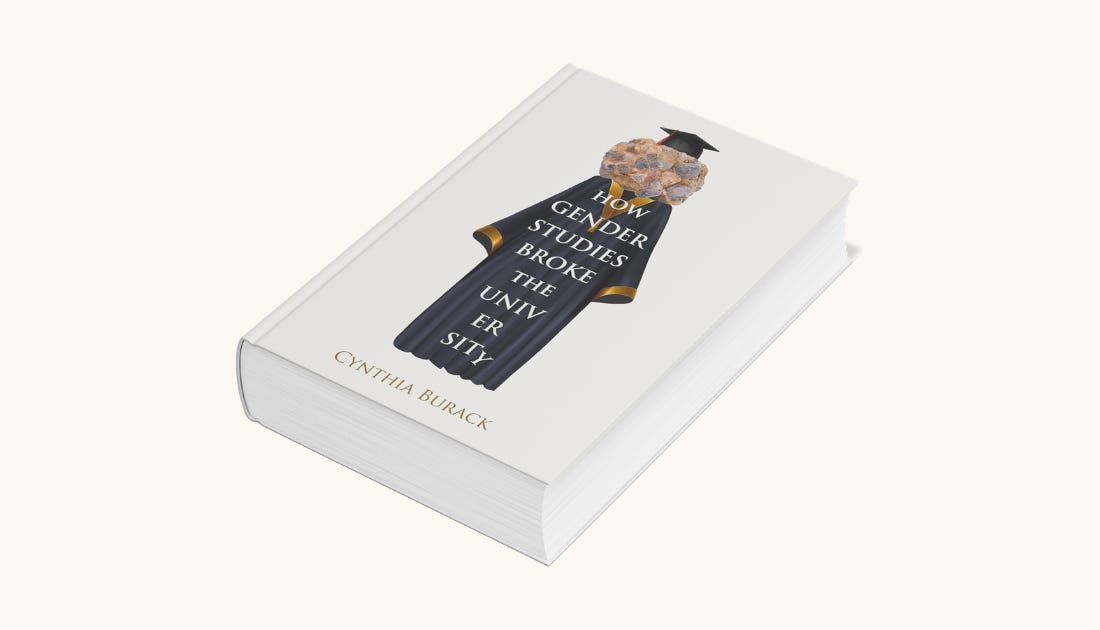
Gender trouble continues — women’s (and gender) studies trouble, that is. With courses canceled and departments shuttered, the beleaguered field of women’s studies is at a crossroads. As a former feminist killjoy turned regular killjoy, I increasingly find myself agreeing with those who express concerns over ideological dogmatism within women’s studies. And according to a new book by HxA member Cynthia Burack, emerita professor of women’s, gender, and sexuality studies at Ohio State, these concerns are more than merited.
Burack’s recently published How Gender Studies Broke the University gives an insider’s perspective on how women’s studies became an early adopter — and perhaps even patient zero — of modern illiberalism in the academy. Having spent 26 years in Ohio State’s Department of Women’s, Gender, and Sexuality Studies (née the Department of Women’s Studies), Burack levies credible critiques against the field, informed by decades on the job. “The big argument of the book,” she writes, “is this: gender studies had a key role in creating an alarmingly effective habitat for anti-intellectualism, political dogmatism, and populist left-wing authoritarianism.”
Rather than saving her conclusion for the end, Burack opens with it: “As painful as it has been to come to this place, I think that universities, students, and the academic enterprise would be better off if women’s and other identity-based ‘studies’ had never been institutionalized in US higher education.” A harsh verdict, but one the book defends well.
From her vantage point as a longtime women’s studies scholar, Burack expresses deep skepticism, even regret, about women’s studies and her role in a discipline that is arguably at odds with the truth- and knowledge-seeking purpose of the university. She briefly traces the evolution of women’s studies back to Black studies, which itself grew out of an activist movement (a history meticulously described in Fabio Rojas’s From Black Power to Black Studies). Early women’s studies programs were under-resourced, consisting of a patchwork of courses offered by scholars trained in more traditional disciplines. The first women’s studies PhD program was not offered until 1990. (Burack herself was trained as a political theorist in the late 1980s.)
The author acknowledges pioneering critiques of the discipline, particularly Daphne Patai and Noretta Koertge’s Professing Feminism, published in 1994, long before Burack herself began to question the field. (Indeed, Burack even candidly admits to “trolling” Patai on a women’s studies listserv in the 1990s.) Patai and Koertge offered early insider critiques of women’s studies, presenting interviews with women’s studies faculty and students who detail a range of concerns: from “constant emphasis on political purity” and fear of being denounced by colleagues, to an overly therapeutic model of teaching, to students literally stomping in class when their professor made a remark that they disagreed with.
Patai and Koertge argued that women’s studies faculty “have too often succeeded only in subverting both the values of the academy and the goal of improving women’s condition.” More than thirty years after the publication of Professing Feminism, not much has changed — or maybe a lot has changed, and none of it for the better.
The bulk of How Gender Studies Broke the University is spent detailing various ways in which women’s studies stifles inquiry and cultivates dogmatism both within its own ranks and within academia at large. Some insights are specific to women’s studies — such as the field’s rejection of a coherent disciplinary “canon” while still imposing narrow intellectual guardrails — but most of Burack’s account will resonate with scholars from any field. For example, she describes the “sacralization” of favored groups, such as those who fall under the amorphous BIPOC umbrella, “Latinx” people (who are unlikely to use the label “Latinx”), and Asian Americans (though she notes that they “have presented a stubborn impediment to academic progressive narratives of oppression” given their above average-achievement).
Burack dedicates several pages to DEI and its many arms: DEI statements in hiring, how faculty actually evaluated DEI statements (as reported by John Sailer), and the recent rush to rebrand DEI offices to get around Trump administration directives. She also identifies a number of other common mechanisms through which illiberalism spreads, such as speech codes, bias reporting systems, and ideologically driven Institutional Review Board practices.
Burack identifies two features that arguably account for most of the field’s troubles: scholar-activism, in which activist and political aims drive scholarship, and poststructuralism, in which truth is relative (along with just about everything else). On scholar-activism, she notes that “when confronted with even the possibility that there may be a conflict between what activism requires of us and what scholarship requires of us, academic progressives deny that there can be such a conflict.” And what happens when scholar-activism meets a worldview in which everything is relative? “While poststructuralist theories pave a path to relativism, identity activisms promote doctrinaire demands and truth claims,” she writes. “Critical theories are a grab bag of relativisms and doctrinaire truth claims.”
In my view, the fact that the field is an incoherent mix of non-falsifiability and activism is the heart of the problem with women’s studies, and all other problems arise from it. Concepts like oppression, patriarchy, and heteronormativity can rarely be proven true or false. They can only be asserted and defended. In a fair academic fight, these ideas rise, fall, or transform into something new on the basis of merit. But when activist goals supplant scholarly ones, contested ideas harden into dogma, acquiring an unearned patina of academic rigor. Scholar-activism is likely toxic to the health of any discipline, but when paired with claims that cannot be tested, it’s especially ruinous.
Claiming that women’s studies is characterized by scholar-activism is a fair description: many women’s studies scholars actually describe the field as such, and research from the discipline regularly embraces activism as a professional pursuit.
Consider the National Women’s Studies Association (NWSA), one of the largest professional organizations in the field. The NWSA makes a few appearances in Burack’s book, including a 2021 NWSA statement highlighting the issue of caste-based discrimination in U.S. universities (a claim that Burack regards dubiously). But further exploration of NWSA materials reveals more of the group’s explicit embrace of scholar-activism. For example, the NWSA’s formal guidance on how deans, department chairs, and other university leaders should evaluate the teaching, research, and service of women’s studies scholars states plainly: “the discipline recognizes that activism with women and other groups inside and outside of academic institutions produces knowledge and contributes to the development of women’s and gender studies scholarship.”
The NWSA’s conference programming is similarly illustrative. The 2026 NWSA conference featured a session on Resisting Public Records Requests: Strategizing from NWSA in an Age of FOIA, which explored “how we can resist public records requests while enacting our wildest pedagogical dreams.” The description explains that “our field faces hostile scrutiny as legal means such as the Freedom of Information Act (FOIA) and metrics such as enrollments are weaponized” and “roundtable participants will collectively strategize about feminist refusals and radical unruliness in these contested political times.”
“Feminist refusals” and “radical unruliness” read more like activist agendas than scholarly ones. I am sympathetic to the idea that records requests feel invasive or threatening, particularly when the field is under pressure. But public universities are generally obligated to share certain records — that’s part of the whole “public” arrangement. Proudly attempting to resist records requests is not only unethical, but a bad look for a discipline whose scholarly merit is up for debate.
Last year’s NWSA Conference opened with a session on Teaching as Activism: Organizing in Perilous Political Climates at Public Universities, suggesting that not only is scholarship intertwined with activism, but so is teaching. According to the conference website, the conference attracts attendees “interested in the expanding scholarship and activism that shapes our interdisciplinary field.”
Don’t get me wrong, academia is better off with a little bit of kookiness. But the “unpacking,” the “decolonizing,” and the “queering” all need to be dwarfed by serious scholarship and methodological rigor. The NWSA conference offerings aren’t reassuring on this front.
Burack gives a compelling overview of the many ways in which beliefs, practices, and norms within women’s studies have inculcated an illiberal environment. But some of her arguments left me wanting more. For one, she notes that many of the illiberal beliefs that flourish within women’s studies can be found in other identity-based fields. But there is much left unexplored here. Because Burack’s expertise lies within women’s studies rather than, say, Black studies or disability studies, she may have felt that it was prudent to stay in her own academic lane. But illiberalism in the academy was likely a team effort — a small but mighty team of similarly situated identitarian fields. Women’s studies needn’t carry the blame for all of it.
And perhaps because of this laser focus on women’s studies, the book doesn’t quite answer exactly how troubling ideas spread from one discipline to another. It reads a bit like a highlight (or lowlight) reel of academia’s dysfunction from the last several years: DEI, safetyism, cancel culture, and so on. But there are unanswered questions about how ideas from a small number of esoteric disciplines escaped their academic petri dish and colonized the rest of the university.
Finally, I wanted more on how the amorphous concept of gender identity has shaped the culture of women’s studies and its related fields. The fact that many of the discipline’s leading scholars can hardly agree on the definition of “woman” (the discipline’s founding category) strikes me as the most powerful evidence that the field is in crisis. Burack does discuss the tensions between pronoun policies and free expression, but in my opinion, the larger story is about how gender identity supplanted the female experience as the field’s primary object of study.
Overall, I found How Gender Studies Broke the University engaging, accessible, and a little too relatable. Years ago, I was briefly enrolled in a women’s studies master’s program. I had naively assumed such programs focus on meaningfully improving the lives of women and girls, but it was immediately apparent that I was wrong. I soon switched to a global health program, which offered a much more robust (but still imperfect) set of tools for measuring, understanding, and improving human wellbeing. Perhaps because of this near-miss with women’s studies, How Gender Studies Broke the University kept revealing uncomfortable glimpses of the lives I might have led — maybe as a true believer, or maybe as a shunned heretic — had I gone down that path. I’m grateful that I didn’t, and a little anxious for those who do.
Burack, like her predecessors Patai and Koertge, does not claim that the lives of women are unworthy of study. Neither do I, which is why the failed project of women’s studies breaks my heart. Questions about how power, sex, identity, and our physical bodies shape our lives still matter, but the very field that foregrounded those questions has mismanaged itself. As a mother, I feel the weight of these questions more than ever. But I no longer trust that the discipline itself is fit to answer them honestly.

When Boghossian and colleagues got satirical articles like "the dog park study" published in peer reviewed journals, he exposed the rot of activism and political agendas at the root of this field. When his employer Portland State went after him for fraud, rather than congratulating him for being a whistleblower, we learned all we needed to know about how corrupt higher education has become.
The main harm caused by feminism is harm to men. Not to epistemology. Not to the scientific method. Not to women. To men. Yet no mention of this harm to men whatsoever. Even in critiquing women's studies many women still demonstrate the blinding gynocentrism of feminists.