



No tricks here — just treats for your brain. Creep away from the horrors of chilling effects, zombie-like ideological homogeneity, and the eerie silence of self-censorship — and dive straight into this month’s research roundup.
Most don’t actually favor harm-based article retractions
Readers of Free the Inquiry are likely aware of concerns that journal articles are at least occasionally retracted due to perceived misdeeds of the moral kind, rather than the methodological kind. A new study sheds light on what both academics and everyday people think of these “harm-based” retractions. Brown et al. ran four different experiments, two with lay people (undergraduates, naturally) and two with federally funded research scientists, all of which point to the relative unpopularity of retractions of controversial articles over other possible actions.
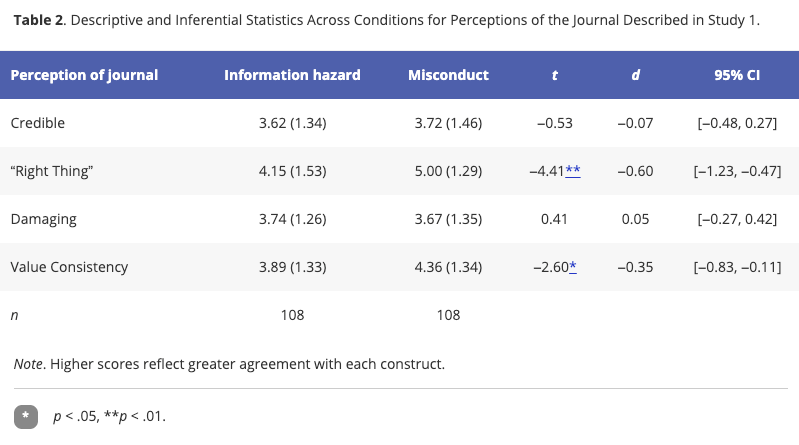
In Study 1, undergraduates read one of two vignettes about a researcher campaigning to retract a journal article either over “information hazards” (a harm-based retraction) or over suspected research misconduct. Participants were warmer toward the researcher pursuing the misconduct-based retraction than the one pursuing the hazard-based retraction, as indicated through perceptions of the researcher’s trustworthiness, their likeability, the appropriateness of their retraction campaign, and agreement with the campaign. They also saw the researcher as valuing science more and having science’s best interest in mind. The journal in the scenario fared better too, with participants more likely to believe that the journal “did the right thing” when it retracted the article accused of misconduct, compared to the one accused of harm.
Studies 2 and 3 went on to assess undergraduates’ (Study 2) and academics’ (Study 3) views on how a fictitious journal handled a controversial paper. In the vignette, controversial papers could be handled one of four ways: through a retraction, a replication, adversarial collaboration, or commentary. The undergrads in Study 2 viewed adversarial collaboration as a more credible outcome than both retraction and commentary, while the academics preferred commentary as the most credible route. (Perhaps, as the authors suggest, this is because academics have keen insight into the effort required to undertake a new collaborative study and view commentary as a more realistic approach.)
Finally, in Study 4, academic researchers were presented with a controversial journal paper vignette — now with new details to emphasize that the original article was statistically robust and peer-reviewed — with the addition of a fifth possible outcome: inaction on the part of the journal. Participants viewed inaction as no more or less credible or damaging to science than the more active alternatives. Retractions were the least popular outcome for nearly all measures, including credibility, consistency with scientific values, and damage to science.
The finding that academics and non-academics both oppose retraction on “harm-based” grounds is reassuring, although a successful retraction campaign only needs a handful of impassioned individuals. Still, these public scuffles over controversial articles often surface only after an article has cleared peer review. Team HxA frequently ponders how many potentially controversial articles never make it past that hurdle in the first place — a future research question, perhaps?
Whither the dissertation?
Recent attempts to measure intellectual drift in the social sciences and humanities (SSH) tend to look at published journal articles, abstracts, course catalogs and syllabi. A new report from the American Academy of Sciences and Letters analyzes the full text of 443,543 doctoral dissertations in the SSH written at 678 U.S. universities between 1960 and 2025 and shared on ProQuest. The authors’ rationale: “PhD dissertations, written within a given field at a given time, provide a uniquely clear window into the language and underlying conceptual assumptions dominant in that field at that time.”
The authors built five “baskets” of 60 to 105 words each and counted how often each appeared, year by year and field by field.
Facts/Truth Claims holds the vocabulary of evidence and inference (fact, archive, empirical, hypothesis, proof).
Power Dynamics covers authority and hierarchy (hegemony, oppression, resistance, subaltern).
Evaluation is the language of judgment (good, wrong, moral, persuasive).
Aesthetics is beauty and form (sublime, composition, genre).
Identity is the critical-theory lexicon (intersectionality, positionality, whiteness, decolonization).
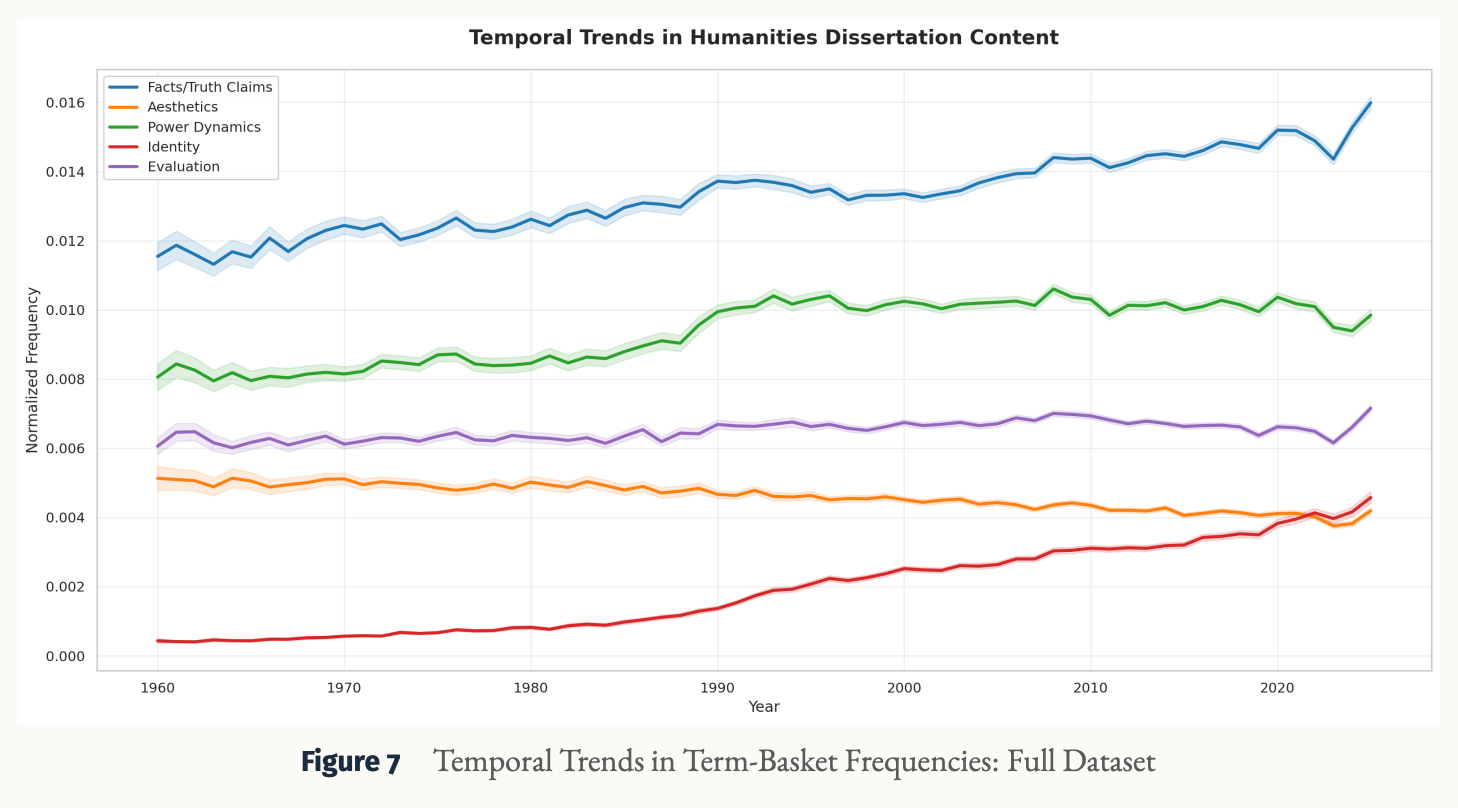
What they found: Facts/Truth words were the most common category in every field and every decade, and their frequency rose over time. Power Dynamics vocabulary jumped around 1988, led by literature and language programs. Identity vocabulary grew fastest of all, roughly 5 to 8 percent a year after adjusting for differences between universities (a doubling every 8 to 12 years). Aesthetics declined modestly and steadily. Philosophy and theology was the one subfield where Evaluation still outranked Power Dynamics.
“Depending on one’s perspective, the situation for the humanities can appear either quite dire or in a state of renewal and vitality,” the American Academy of Arts and Sciences’ Robert Townsend and Norman Bradburn wrote in 2022. On the numbers, the report says both: humanities dissertations fell 49 percent from their 2015 peak, while social sciences fell 4.5 percent (the authors caution that both declines are overstated in part by a ProQuest registration lag that undercounts 2023 to 2025), and the fastest-growing fields are anthropology, psychology, and communications, which the authors call a possible “functional successor to the traditional Humanities.” On what it all adds up to, the authors are similarly equivocal: “The evidence here supports neither the most alarming nor the most dismissive version of these claims.”
At UT Austin, contemporary issues are mostly framed through one lens – but at least the philosophical canon is still going strong
A new report by The Curricular Review Council maps UT Austin’s curriculum, focusing on the American civics and great books. The authors were interested in how well the curriculum covers — and exposes students to disagreement about — issues of central public importance. Using Syllabus Lens, an AI tool they built, they extracted readings from syllabi, counted how often authors and texts are assigned, and examined how they were paired together.
The authors first looked at texts on American history, politics, and literature. Breaking the syllabi into three 5-year periods (2011-2015, 2016-2020, and 2021-2025), they found that the mix of texts grew more focused on racial oppression and inequality over time. During 2011-2015, 10 of the top 20 assigned texts addressed race, rising to 13 in 2021-2025. The curriculum didn’t elevate all Black perspectives, however. Critical works by Black authors were among the most frequently assigned (Michelle Alexander’s The New Jim Crow was assigned 84 times; Ta-Nehisi Coates’ Between the World and Me, 38 times), while influential works by non-critical Black authors were assigned relatively rarely if at all (Orlando Patterson’s Slavery and Social Death, cited 9,414 times, was assigned 18 times; William J. Wilson’s When Work Disappears, cited 11,651 times, was never assigned).
The authors further critique how UT’s curriculum handled controversial topics in this period. According to their analysis, the most assigned titles addressing police and the criminal justice system from a critical perspective (The New Jim Crow and Simone Browne’s Dark Matters) were assigned 84 and 41 times, respectively, between 2021 and 2025, while the most assigned titles presenting an “alternative perspective” (Wilson and Kelling’s “Broken Windows” essay and Patrick Sharkey’s Uneasy Peace) were assigned six times and twice, respectively. They find similarly one-sided treatment of issues like the Israeli-Palestinian conflict and only the faintest trace of influential-but-heterodox social science (e.g., Cherlin’s The Marriage-Go-Round, which critiques divorce, cited nearly 2,000 times but assigned twice; Waite & Gallagher’s The Case for Marriage, on marriage’s societal benefits, cited over 3,000 times but never assigned).
As for the great books, the authors partly refute the idea that the traditional canon is in trouble at UT Austin. Shakespeare and Plato remain the most frequently assigned canonical authors at the university, with each assigned hundreds of times between 2021 and 2025. Although Western canonical literature declined in frequency between 2011 and 2025 (with Enlightenment and Renaissance texts experiencing declines of 42% and 38%, respectively), Western works of philosophy and social theory were assigned 15-28% more often, depending on the specific historical period. (Classical philosophy was an exception to this trend, with a 17% decline over the same period.) At the same time, UT’s canon is diversifying, with world literature seeing a particular surge in frequency (an increase of 93% across the 2011-2025 period). Students also have a fair shot at encountering thought-provoking pairings of authors, for instance in courses co-assigning founding-era thinkers like Locke and Madison alongside later scholars of racial politics like Frederick Douglass and W.E.B. Du Bois.
The report arrives as UT adopts a revised core curriculum to provide undergraduates across campus a more consistent learning experience, with the task force recommending special emphasis on the Great Books and Western canon. The new core will be stewarded by a newly announced University College (housing a Center for Humanities, separate from the School of Civic Leadership).
A call to resurrect Mertonian norms
In a commentary article, Urs and Clark make the case for Mertonian norms in scientific practice. These norms were developed by sociologist and philosopher of science Robert Merton in the 1940s, who argued that for science to effectively make true discoveries about the world, scientists needed strong institutional norms to guide their work. These norms include universalism, or the idea that scientific ideas need to be evaluated on their own merits, rather than the characteristics of those who developed the ideas (thus, not privileging some people’s ideas over others), as well as disinterestedness and organized skepticism, which serve as checks against psychological biases and conflicts of interest.
Urs and Clark argue that these norms guide good scientific practices and are important to uphold, and that recent efforts by some scholars to inject ideological commitments into science is a threat to Mertonian standards. They point to proposals like citation justice (citing papers based on the ethnicity or gender of the author, independent of the papers’ relevance or merit), positionality statements (authors describing their own attributes in the context of the research they’re conducting), and harm-based editorial standards (rejecting or retracting manuscripts based on concerns about unintended consequences, such as stigmatization of vulnerable groups) as all undermining the scientific enterprise.
Then the paper takes an interesting turn, as the authors argue that treating viewpoint diversity as an explicit goal is also a departure from Mertonian norms. The authors argue that if universities and academic disciplines attempt to balance faculty based on political viewpoints, they risk violating disinterestedness, since ideas should be judged on their merits, not on the identities of who hold them. The authors draw a comparison between viewpoint diversity initiatives and DEI, which they argue similarly privileges researcher identity characteristics above merit. Moreover, they also suggest that hiring scholars through viewpoint diversity efforts risks those scholars being labeled as out-group members.
But the authors also see value in viewpoint diversity. Rather than place it as the goal or outcome to strive for, they instead position viewpoint diversity as an indicator of the health of a field. Essentially, when a field lacks viewpoint diversity, that’s a sign that something has gone awry. But increasing viewpoint diversity should not be the target for reform efforts. Instead, scholars should reorient themselves to Mertonian standards, which would make the scientific enterprise function better and thus make fields more hospitable to scholars with diverse viewpoints.
That wraps up October’s roundup. Got interesting research to share? Drop us a line at research@heterodoxacademy.org.


The gap between the undergrads and the academics in Studies 2 and 3 is interesting. Students leaned toward adversarial collaboration, while the scientists picked commentary, which probably says something about how expensive a real replication is in practice. Either way, both groups seemed uneasy with pulling a paper over 'information hazards' when nobody alleged misconduct. That matters for journals, because a retraction used to signal that something went wrong in the work itself. Once it starts signaling that a finding upset the wrong people, readers may begin discounting retractions in general, including the ones that flag real fraud. Curious whether the authors looked at how political lean shaped those answers, since the pressure for harm-based retractions has mostly come from one direction on campus.