



Welcome to this month’s installment of the Heterodox Research Roundup, in which we serve our readers a roundup of research-style hors d’oeuvres that have made their way across the HxA Research Desk over the last month.
Survey finds that most faculty favor institutional neutrality.
In a recent survey of 250 tenure-line faculty at R1 institutions without institutional neutrality policies, Eren (2026) found that about 60% of respondents would prefer that their institutions remain neutral on political and social matters not directly related to the institution’s core academic mission. About 35% reported that they had withheld their opinion about university statements because of job security concerns, and 44% reported that they would feel discouraged from engaging with an issue if their position and the university’s position were to be misaligned.
The findings also point to some nuances around perceptions and interpretations of institutional neutrality. For example, even though 60% of respondents prefer their institution to remain neutral, only 53% of respondents disagreed when asked whether universities should make statements on political or social issues outside their academic mission. This may reflect confusion or ambiguity about what institutional neutrality actually refers to in practice. It could be that many faculty find the principle of institutional neutrality appealing, yet do not necessarily object to institutional statements. What’s up with that? Well, as academics love to say, this may warrant additional research. (Don’t threaten us with a good time!)
We’d be remiss not to mention that the author, Colleen Eren, is a former Faculty Fellow at HxA’s Segal Center for Academic Pluralism and we’re delighted to revel in the fruits of her labor.
Institutional neutrality gains traction in the UK.
Research from across the pond that reminds us institutional neutrality is not only a US conversation. A new report from Alumni for Free Speech (AFFS), a non-partisan, alumni-led campaign group, found that 32 of 178 UK universities have now made a formal, public commitment to institutional neutrality. Among elite UK institutions (referred to as Russell Group institutions) the number of adoptees has risen from three in January 2024 to seven institutions as of the report’s release. Adopters span the country, from the University of Edinburgh and the London School of Economics and Political Science, to the University of Bristol and the University of East Anglia.
The AFFS report evaluated the strength of each of the 32 institutional neutrality policy statements. The majority of statements (78%) earned a “good” or “excellent” rating, while the remaining seven statements were “materially’” or “seriously flawed.” The ratings system relied heavily on the precise wording of the policies. Consider the methodology for awarding bonuses and penalties across several distinct qualities: schools gained +0.5 points for robustness and comprehensiveness, including specifying that neutrality extends to social and cultural matters, not just political ones. They earned +1 point for not affiliating with external organizations that would require the school to commit to a particular perspective. Meanwhile, schools were dinged -0.5 points for affording too much discretion to the Board of Trustees, and -1 point for limiting institutional neutrality to not “normally” or not “usually” taking a position.
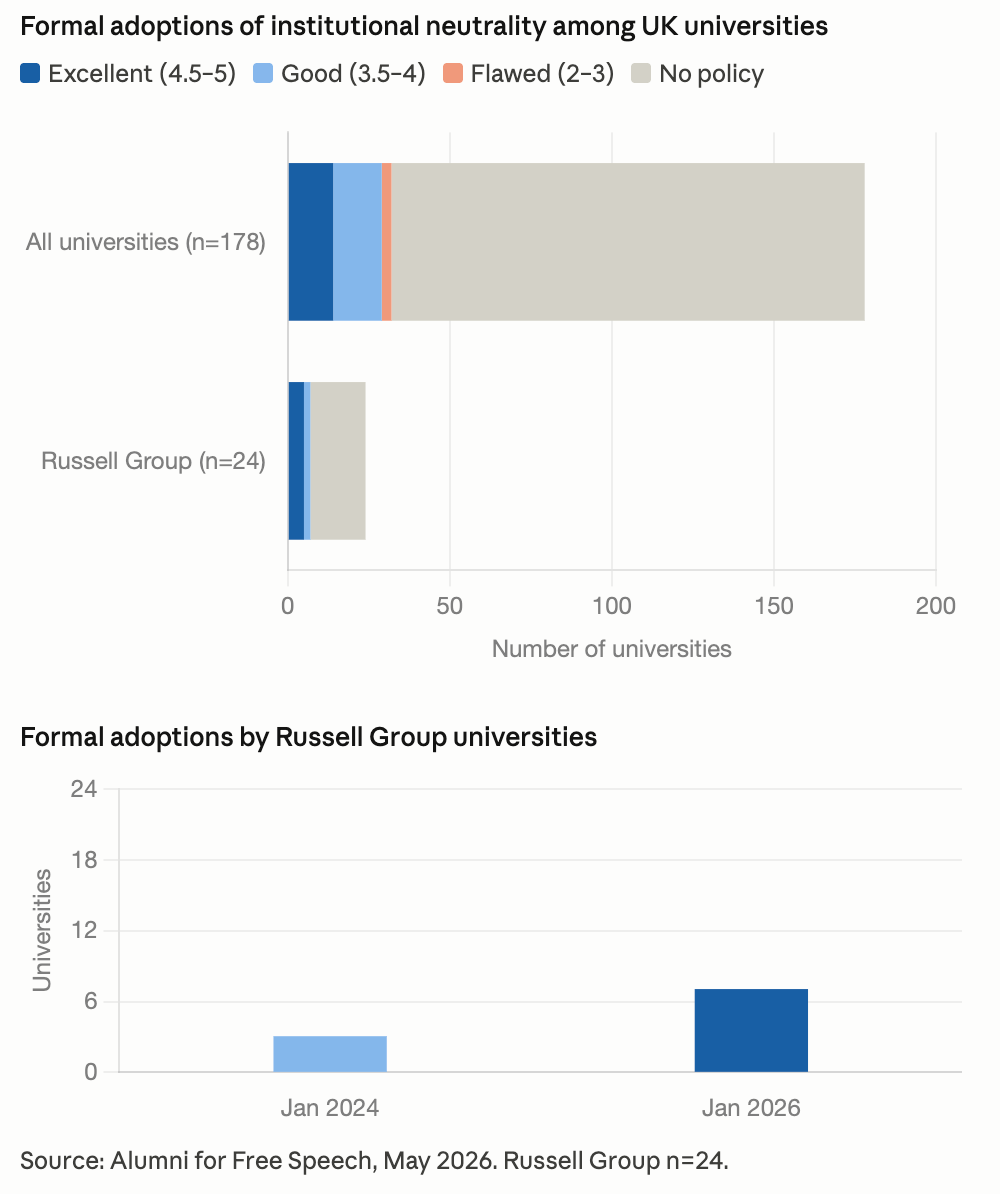
Indeed, as HxA has recently documented on the state of institutional neutrality in the US, policy adoption alone is not enough. Important questions remain, such as, how will implementation be realized? What topics fall under institutional neutrality? Which units of the institution does the policy apply to? So while a growing number of UK universities have been recognized with generally positive ratings, when pressure arrives, an enduring commitment to institutional neutrality may depend on policy clarity and its consistent application.
In academic publishing, prestige and testability are substitutes in evaluation.
Author prestige boosts the citation count of papers with claims that don’t lend themselves to empirical testability. But when testability increases, as indicated by use of empirical and statistical analyses, name recognition matters less. Hingl (2026; working paper) examined academic papers published between 1900 and 2015 and found that a 10-percentile rise in testability corresponded to a 9% decrease in the concentration of author citations (year held constant).
Hingl applies a supply and demand model of scientific research, in which researchers represent the supply side, and evaluators (e.g., referees, editors, and funding agencies) represent the demand side, or the “consumers of science.” The upshot: researchers have an easier time “selling” their work to the scientific community when they have some name recognition, when their claims lend themselves to empirical testing, or both.
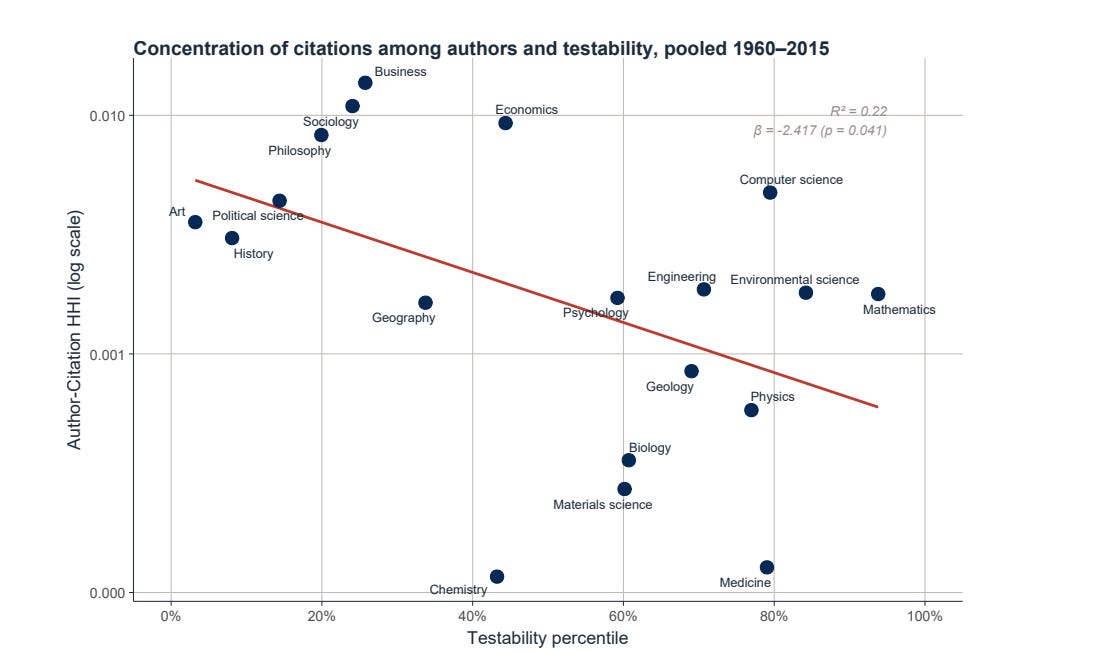
The author also highlights the role of the “credibility revolution” within economics in pivoting the field towards more testable hypotheses, and uses this era as a case study in the testability-prestige relationship. During the 1990s and in response to internal criticism, the field of economics began leaning more heavily towards testable and empirical claims. Hingl found that “credible-methods” papers, which utilized empirical methods, experienced a citation bump relative to papers with less testable hypotheses.
Interestingly, Hingl’s work indicates that certain fields, namely, history, political science, philosophy and sociology, rank lower than others in testability, and by extension, rely more on “prestige” indicators. This raises some interesting (and perhaps pointed) questions about the extent to which in-group bias and ideological conformity potentially relate to “prestige,” and the role that groupthink may play in shepherding along non-empirical research.
People are less critical of scientific findings that align with their moral convictions.
Trust in science, and particularly science skepticism, has been a dominant topic of discussion in recent years. A new study by Bayes (2026) tells us about the conditions when people are more or less likely to accept scientific findings. Participants in the study were first shown mock-ups of press releases about new scientific findings on the topics of climate change, GMO labeling, and gene editing, and then evaluated the studies and their authors on dimensions like credibility, objectivity, and competence. Importantly, participants were randomly assigned to see findings that either supported their self-reported views on each issue (the pro-attitudinal condition) or findings that contradicted them (the counter-attitudinal condition). Replicating a pattern shown repeatedly in prior work, participants reading about findings that supported their attitudes evaluated the studies and their authors more positively than participants reading about identical studies whose findings contradicted their attitudes. Researchers call this biased assimilation.
The key novelty of this study came from its focus on participants’ moral conviction about each issue: how connected their beliefs about the issue were to their core beliefs about right and wrong. As it turned out, those who held attitudes with deep moral conviction showed the largest biased assimilation effects, while those who held their attitudes with little moral conviction showed little if any evidence of biased assimilation. The pattern of biased assimilation was also notable in that it was driven by morally convicted people in the pro-attitudinal condition rating the studies and authors particularly positively. By contrast, there was no consistent effect of moral conviction among people evaluating counter-attitudinal findings.
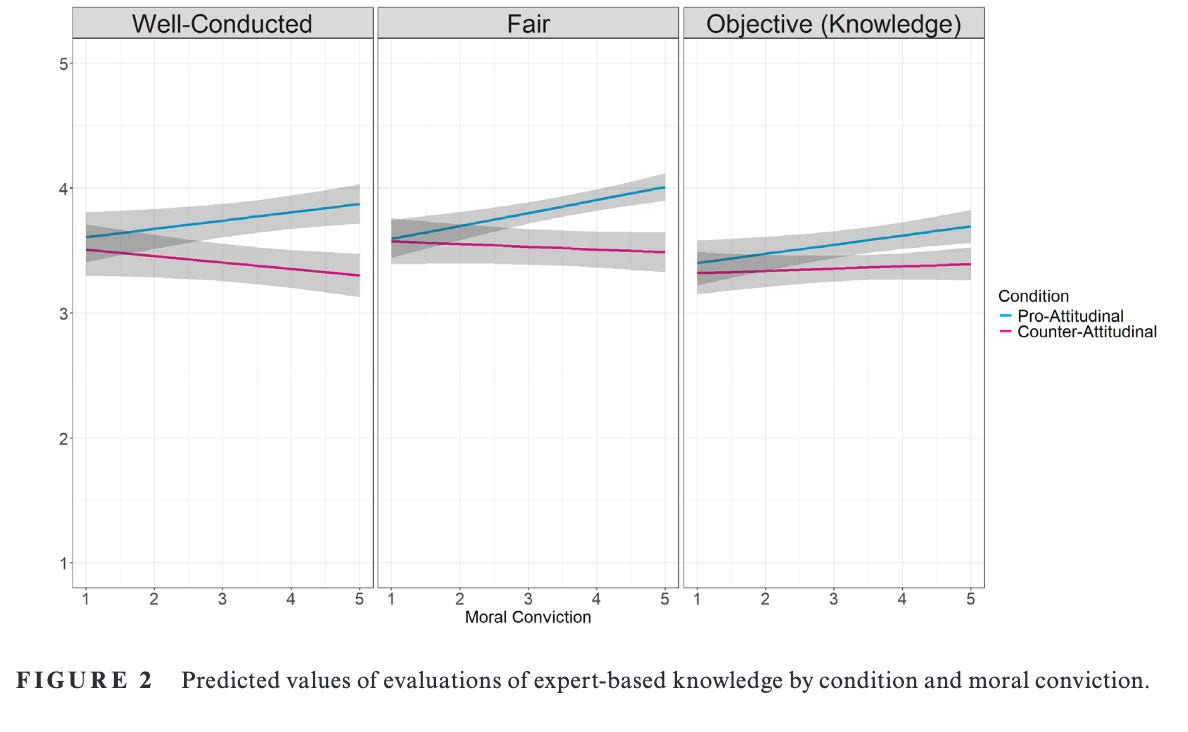
One might assume that the biggest risk to fair-minded evaluations of scientific findings comes from an unwillingness to accept results that challenge our beliefs. But this study suggests that it’s just as important to combat the uncritical acceptance of findings that support our beliefs.
That’s a wrap for this month’s Research Roundup. Got any hot tips about great research coming out in June? Drop us a line at research@heterodoxacademy.org.


