



New month, new research roundup! HxA HQ has been abuzz with activity from the recent HxA Mountain West Regional Conference, to HxA’s inaugural Leadership Summit, to planning for the 2027 HxA Conference. But the nerds in Research and Resource Development always find time to bring you the latest and greatest from the scholarly frontier.
Is there such a thing as legitimate politicization?
In a recent paper published in Theory and Society, HxA member and sociologist at University of Hawai’i Ashley Rubin attempts to draw the line between appropriate and inappropriate politicization in research, and offers thoughtful commentary on specific research norms that could revitalize the health of scholarship. Rubin posits that sometimes research findings will indeed support a specific political narrative or policy, and that researchers shouldn’t shy away from this. Scholars can also engage in political activism on their own time, outside of their regular research, teaching, and service duties. Rubin’s key demarcator is whether researcher behavior violates scientific protocols. Such violations include starting with a moral or political conclusion and then working backwards from there, hunting for evidence to support a preferred finding, cherry-picking data, making claims that go beyond what the data allow, or suppressing findings because they might be useful to political opponents. Rubin suggests that these varieties of inappropriate politicization are similar to p-hacking and citation nepotism, which researchers already recognize as clear ethical violations.
Rubin ends the paper by inviting more discussion about where the line falls between appropriate and inappropriate politicization. She also suggests some practices that might improve things, for instance, having researchers audit their own work for bias with volunteer peer-reviewers and AI checklists.
Anecdotes point to consequences for breaking ranks within gender and sex research.
Ceci, Williams, and Shulamit Kahn’s previous adversarial collaboration on gender bias in the academy found evidence of bias against women in teaching evaluations and salary, no bias in grant awards, journal reviews, or letters of recommendation, and a pro-woman bias in tenure-track hiring. In this recent piece, Ceci and Williams draw particular attention to that hiring advantage. According to the authors, recent CV-matching experiments have shown preferences for women candidates, and while it’s true that women are less likely to pursue tenure-track positions, when they do, they appear to have the edge.
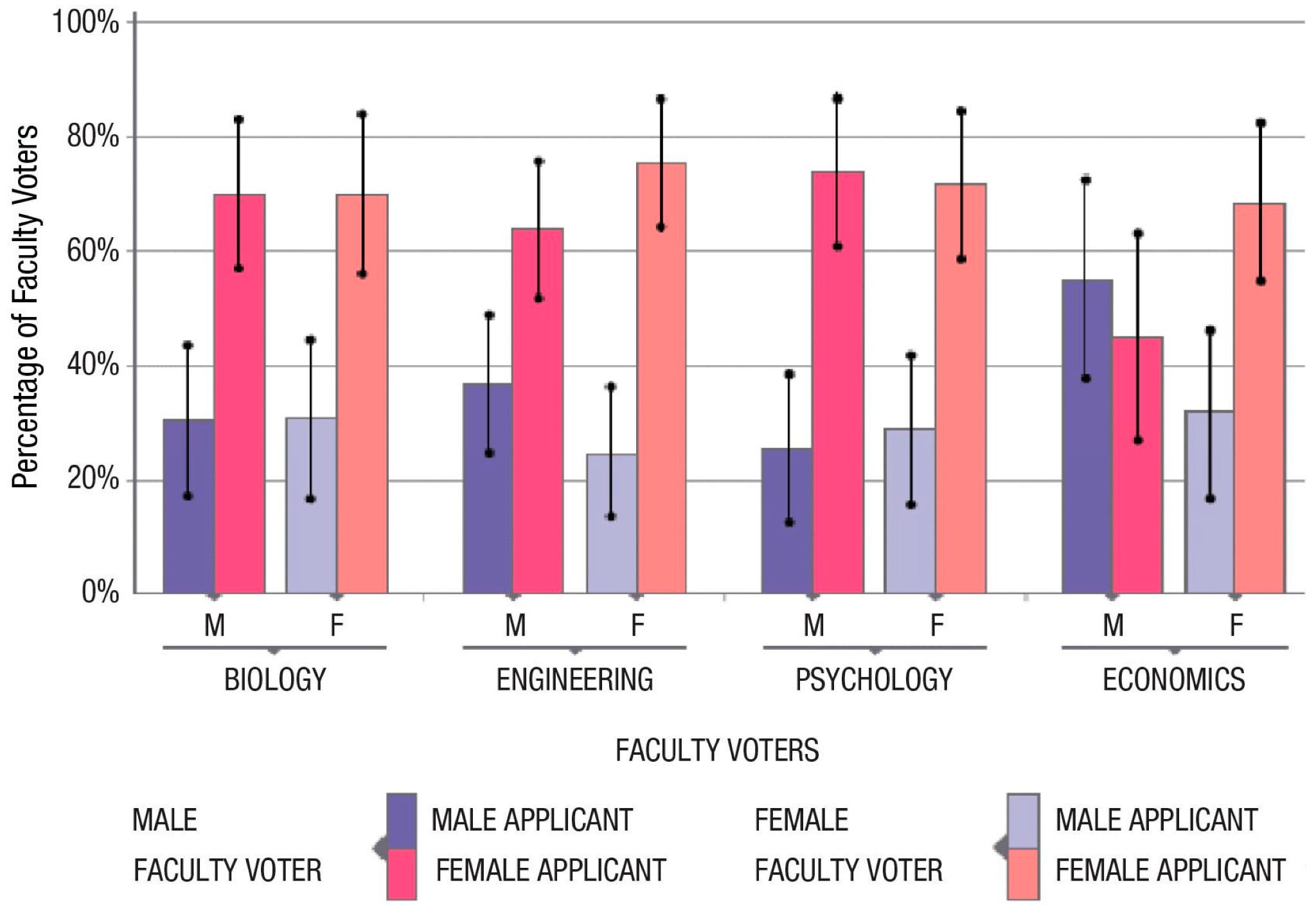
Next, the authors highlight findings from “an informal non-scientific” survey of gender and sex researchers. The vast majority of the 21 respondents described experiencing a range of consequences for engaging with research that insufficiently supports dominant narratives within the field. From formal complaints, cancelled courses, and even IRB audits, breaking out of the ideological mold has come with repercussions for many. Even when findings on a contentious topic are the result of years-long adversarial collaboration by researchers with competing views, as is the case with Ceci and Williams’ work, it is difficult to break the hardened dogmatism of certain beliefs.
(All the more reason to get the research method right! If you’re interested in learning more about pursuing research with your intellectual frenemies, check out the newly released Adversarial Collaboration Method for Research and Scholarship, hot off the HxA press!)
Disagreement is more constructive in speech than in writing, but people tend to think the opposite.
In a new paper out in advance publication in Nature Communications, Bevis, Schroeder, and Yeomans analyzed nearly 2,000 spoken and written disagreements. In an initial set of studies, pairs of participants who disagreed on a contentious political issue were asked to discuss the topic by either speaking or writing. Those who were speaking to their partners (vs. writing to them) reported more constructive conversations: less conflict, more understanding, and better impressions of their partners. But when the researchers asked a different group of participants what they expected would produce better disagreements, they found the opposite: people tended to predict that written disagreements would go better than spoken ones.
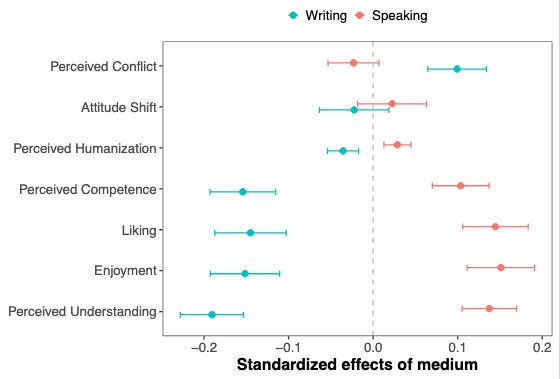
Why do spoken disagreements produce more constructive disagreements? When the researchers analyzed linguistic features of these conversations, they found that pairs who were speaking tended to incorporate more markers of conversational receptiveness, including the use of subjectivity phrases and agreement, and fewer markers of low receptiveness like negative emotion. The writing pairs not only exhibited lower overall receptiveness, but their perceived mutual understanding was more influenced by these cues of receptiveness than it was for the speaking pairs. As the authors put it, people seem to use less receptive language where it matters the most. But by the same token, the findings suggest that written disagreements could be more productive if partners make an extra effort to signal their receptiveness. (Might we recommend the HxA way or Sway?)
In the world of AI-assisted tools comes a new dataset on private grants to universities.
AEI’s Tao Tan has developed an interactive tool called SOURCE, or Searchable Open University Records of Charitable Expenditures, which provides visibility into more than one million grants from over 57,000 U.S. private foundations to nearly 5,300 colleges and universities. Joining a growing body of work following the money into universities, this push for deeper insights into university giving is a worthy undertaking that venturesome researchers will now be able to tap into, ultimately expanding the public’s understanding of “who gets what, when, how” on the modern campus.
Readers may recall Tan’s recent writing that examined several wealthy foundations’ funding for the humanities, arts, and social sciences (chart below). He found that private foundations are well-positioned to shape academic culture in these fields by providing nearly as much in grants as federal sources to these disciplines ($1.2 billion and $1.3 billion, respectively, in FY 2023) in a landscape of relatively scarce funding. And in so doing, this giving works to define fundworthy ideas, influence campus priorities, and establish shared norms aligned with donor interests.
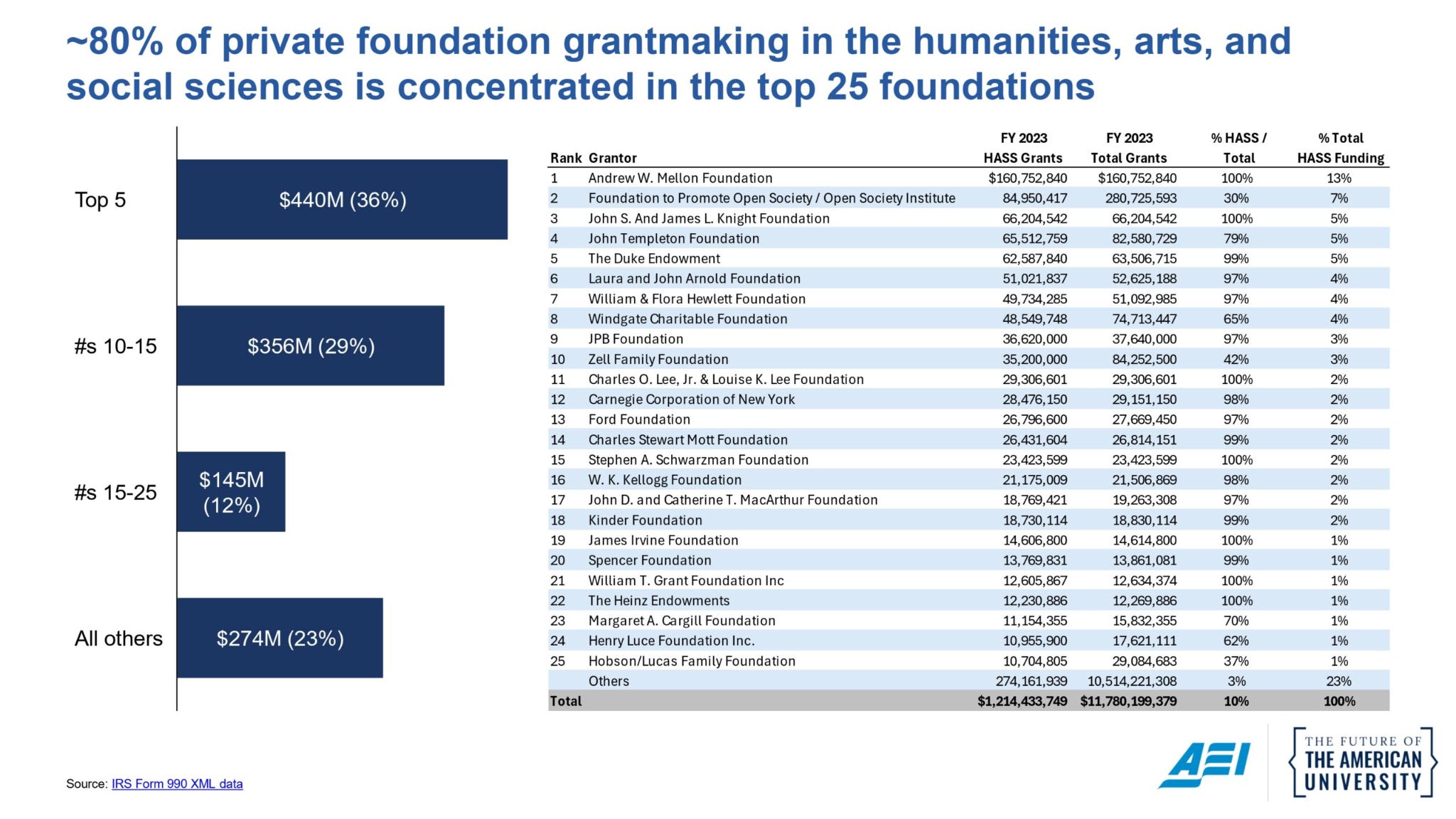
Tan’s motivations for building SOURCE stem from this earlier project. Having successfully leveraged artificial-intelligence techniques to extend the analysis from a single fiscal year to the full corpus of data available, Tan has given researchers a tool to investigate where many private grants are coming from, what they are funding, and what patterns can be found along such axes as institution type and student-life programming. Researchers can also filter by year, university, and grant purpose. “The tool itself makes no normative judgements whatsoever,” said Tan at the launch webinar. “It presents the data and encourages the user to draw your own conclusions.”
That’s a wrap for the Research Roundup for June. Got any interesting research coming down the pike that you’d like us to consider highlighting in the future? Give us a shout at research@heterodoxacademy.org!