



Busy prepping for the upcoming fall semester and don’t have time to follow the latest research? Team HxA has got you covered. Here are several things that caught our eye this month:
Faculty largely on board with diverse viewpoints for research and teaching
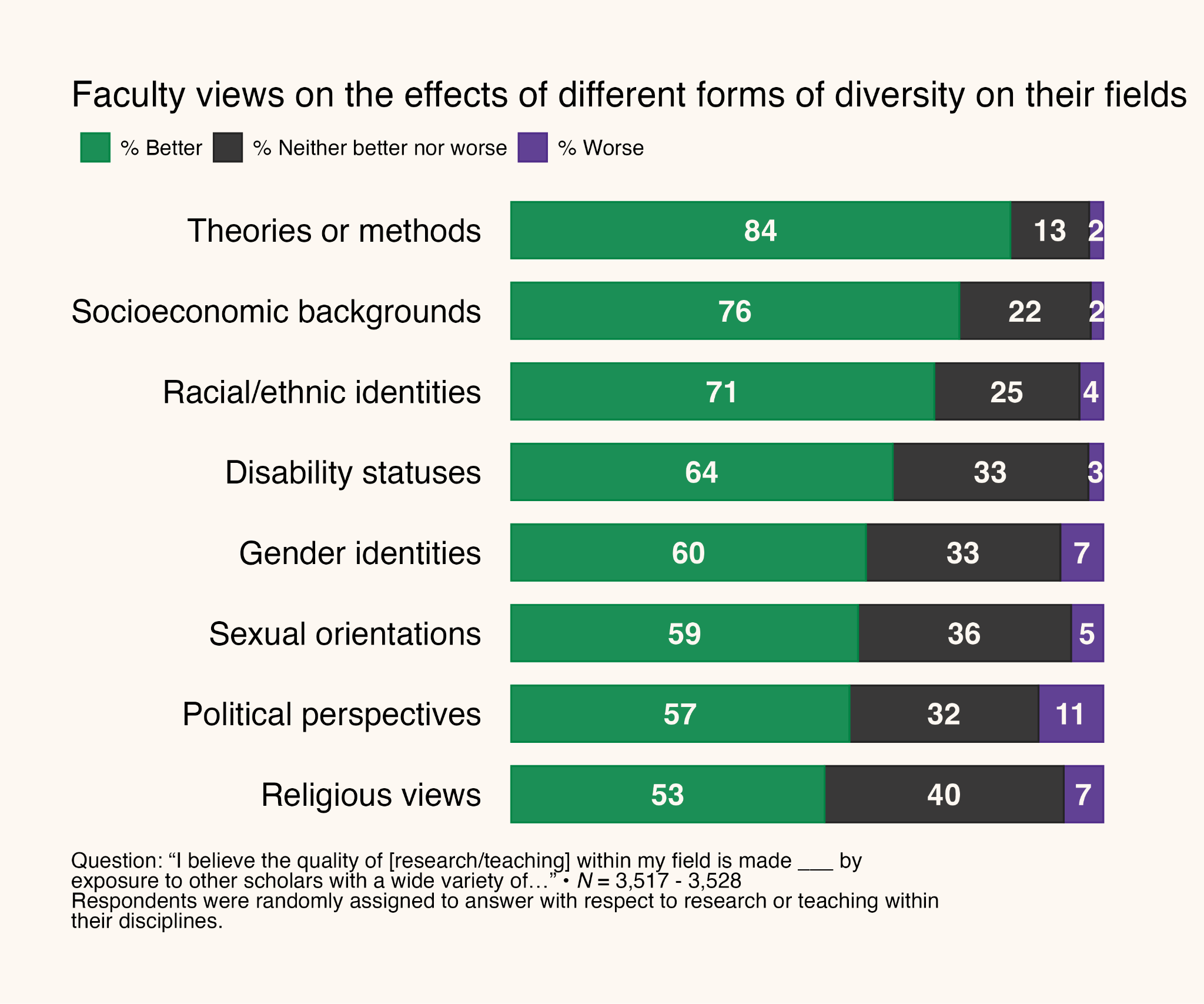
First, if we may be so bold: HxA’s latest research report, Faculty Attitudes Toward Diversity in Their Discipline: A National Survey, is out! We surveyed over 3,500 faculty at 80 institutions to understand the extent to which they think eight specific dimensions of diversity (including racial, religious, political, methodological, and more) either improve or undermine the quality of teaching and research in their discipline.
We found that overall, each of the eight sources of diversity on the survey won majority support from faculty. Even the least popular form of diversity, religious diversity, was believed by 53% of faculty to improve teaching and research within their discipline. Political diversity was viewed positively by 57% of faculty — and interestingly, liberal faculty were more likely than conservative faculty to report warm views toward political diversity.
Faculty also tend to underestimate their peers’ support for diversity of viewpoints in teaching and research, pointing to an important perception gap between how faculty actually feel about viewpoint diversity and how they think their peers feel. Read the full report to learn more about how faculty perceive the value of diversity in their disciplines.
Two cheers for regional public universities
Higher ed news often seems to be dominated by the goings-on of elite institutions, from library takeovers at Columbia to government settlements at Cornell to painful congressional testimonies at Harvard, MIT, and UPenn. While elite institutions wield strong influence over the culture and norms of higher education, they aren’t actually responsible for educating the majority of U.S. undergraduates — that job is proudly performed by regional public universities (RPUs). Since about 70% of U.S. undergraduates attend RPUs, the experiences and perspectives of RPU students have important implications for viewpoint diversity among the broader U.S. college student population. A recent survey from the think-tank Third Way of 500 RPU students paints a portrait of a student body that is less concerned with occupying libraries and more concerned with juggling their studies with other important life commitments, such as work and child-rearing.
The RPU students surveyed come from a range of backgrounds, with almost four out of 10 RPU students being first-generation college students, and over half of RPU students described as “non-white.” RPU students keep busy, by choice or otherwise: a little over 70% work at least part-time, 17% take care of children, and 16% take care of parents or other loved ones. And about 77% of students surveyed worry that a financial emergency will interrupt their education.
Forty-five percent of respondents identified as Democrat, 30% as Independent, and 19% as Republican — which is politically dissimilar from the general American population, with fewer Republicans than the broader population (but considerably more politically diverse than the faculty of many universities). About two-thirds reported having at least one friend with a political opinion different from their own, suggesting that cross-partisan friendships are not uncommon. Three-fourths said they had never attended a political protest on their campus.
In short, most undergraduate students are not cavorting around in the most exclusive of ivory towers. Most undergraduates are attending a regional public university, probably near where they grew up, probably while working, and maybe even while taking care of family. The attention given to highly selective institutions probably makes the state of viewpoint diversity among undergraduates seem worse than it is — the reality, thanks to RPU students, is likely more encouraging.
Majority of law faculty feel that they can’t express their opinions on campus
A new survey of U.S. law faculty by the Foundation for Individual Rights and Expression (FIRE) indicates an alarming climate for inquiry. First, 56% of law faculty report feeling at least occasionally that they can’t express their opinion for fear of repercussions from students, colleagues, or administrators, including 50% of liberal faculty and 72% of conservative faculty. Faculty detect threats from both inside and outside the university, with several reporting that they fear for their jobs should student complaints reach politicians.
Faculty also sense a hostile atmosphere toward conservatives that they themselves don’t endorse with any consensus: for instance, while 56% of faculty thought their colleagues would discriminate against a conservative job applicant, only 22% reported that they were personally willing to discriminate against a conservative (compared with 15% willing to discriminate against a liberal). This mirrors a pattern we found in our own survey on faculty attitudes toward different kinds of diversity: faculty feel more positively about diversity than they believe others in their field do, including dimensions of diversity typically stereotyped as conservative-coded, such as political and religious diversity.
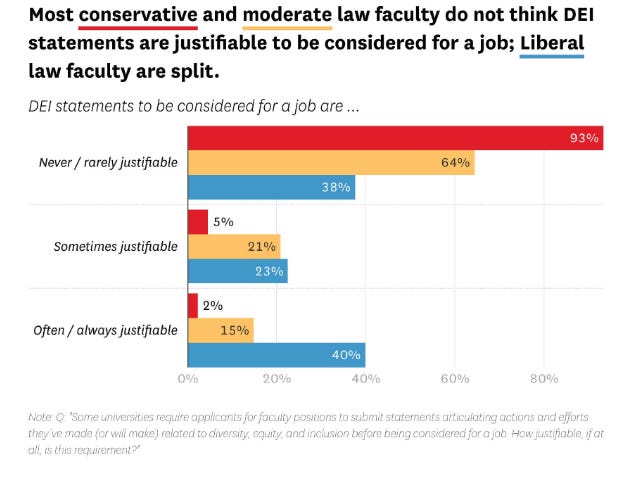
Finally, FIRE’s respondents held nuanced views about DEI: 61% simultaneously value equality/inclusion and free expression, and don’t see them as being in conflict. Over 50% of respondents thought that DEI statements are never or rarely justifiable in hiring or promotion and tenure, and 54% preferred the Supreme Court’s narrower definition of discriminatory harassment to the broader Obama-era standard set by the 2011 “Dear Colleague” letter.
All in all, the data show that law faculty are on the alert for threats to inquiry from all directions (even within their own ranks), while they themselves largely reject censorship and political bias.
New framework proposed to understand political bias in AI chatbots
A new paper by HxA researcher David Rozado and Penn professor Phil Tetlock examines political bias in large language models (LLM). But what does it really mean to say that AI applications are politically “biased”? Rozado and Tetlock offer the Viewpoint Preferences-Epistemic Integrity framework, which conceptualizes political bias along two dimensions. First, the authors suggest that AI systems can systematically lean left or right in terms of their preferences (what they refer to as “viewpoint preferences”). In other words, LLMs can communicate ideas that are more in line with liberal or conservative ideologies, like being pro-choice or pro-free trade. In response to this, some vocal users might cry foul and argue for AI to be politically neutral.
But the authors caution that we shouldn’t assume that neutrality of political viewpoints is ideal with regard to truth, arguing that a “model that is neutral between flat-Earth and round-Earth claims is not more objective; it is epistemically deficient.” They argue instead that LLMs should be designed to maximize accuracy, not neutrality. It may be the case that a liberal viewpoint has more supporting evidence than a conservative one, or vice versa. Being able to weigh evidence and come to the correct conclusion without being inappropriately motivated by political ideology is another, arguably more important way to think about bias. The authors refer to this as “epistemic integrity,” in contrast to viewpoint preferences.
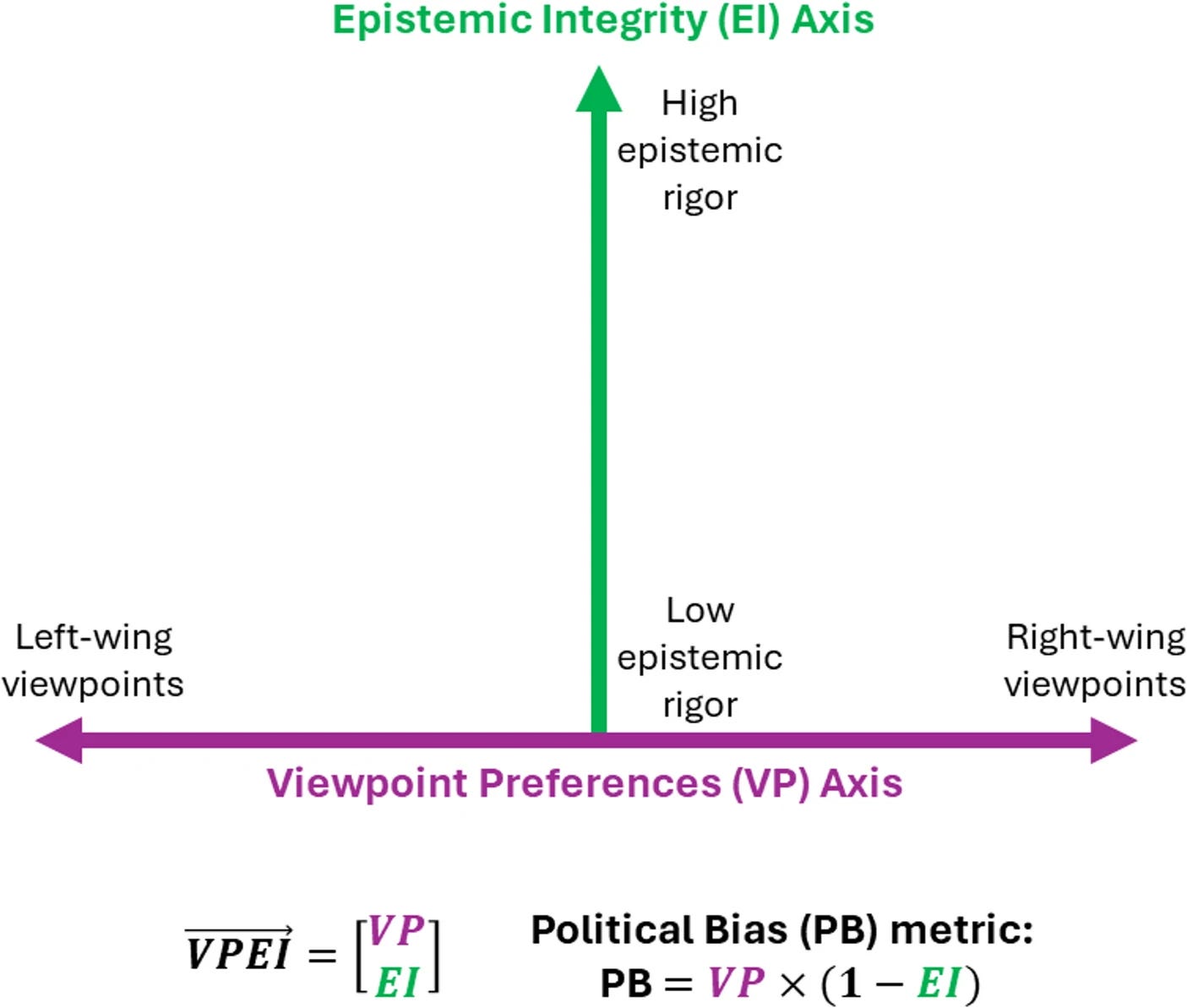
As the authors state, “An AI system may arrive at a left-leaning, centrist, or right-leaning conclusion through an epistemically rigorous process if the conclusion is supported by empirical evidence or rational priors” (our emphasis added). Epistemic integrity relates to how well an AI system upholds the standards of open inquiry when dealing with politically divisive content. This includes whether it weighs evidence evenhandedly, whether it accurately represents competing perspectives, and whether it reasons toward accurate rather than predetermined conclusions. In the authors’ framework, political bias is mainly a problem when epistemic reasoning is compromised, which would happen if LLMs weigh evidence differently depending on whether it supports a liberal or conservative value, or if it fails to accurately summarize information because that information conflicts with such values.
While reading this article, we were struck by how the authors’ framework for evaluating political bias in LLMs could just as easily apply to understanding human biases. HxA, like Rozado and Tetlock, does not argue for political symmetry. Instead, what we argue for is good epistemic processes (i.e., not letting our biases overwhelm our ability to reason carefully about evidence). Sometimes the evidence does support a liberal or a conservative conclusion, and that’s okay for both humans and our robot counterparts!
Federal science funding’s three-body problem
Last month we featured HxA member Ashley Rubin’s paper on where “legitimate” politicization of research ends and where “illegitimate” politicization begins. A new preprint by USC chemist and HxA member Anna Krylov and colleagues (including additional HxA members) asks the same question of federal research funding, and of the university-government compact that has sustained American economic and scientific leadership since World War II. That compact, the authors warn, may be incurring lasting damage from cycles of politicization and counter-politicization.
This tug-of-war over purse strings produces what they call a “whiplash” effect. One administration embeds DEI requirements or other ideological criteria in grant mechanisms; the next reverses them through abrupt cancellations and keyword-based screens. Each phase is justified as a correction of the last and so on, destabilizing vast swathes of the research community. How dizzying!
The toll shows up in how researchers adapt to the uncertainty of delays, freezes, and stop-work orders. Avoiding flagged or contentious topics rather than pursuing ideas wherever they lead. Pursuing technically safe but scientifically marginal questions, what the authors call “inner exile.” Indeed, one of the paper’s coauthors changed 86 instances of the word “gender” in an application on biological sex differences in smoking addiction “in the hope of foiling the language police.” The paper also describes a nearly completed brain science and addiction study that stalled when a routine “no-cost extension” sat unapproved for months. By consequence, results that don’t reach the wider scholarly community (this study and many others like it) break faith with the human volunteers who accepted real risk to make the work possible.
That’s not to suggest new administrations should not have the prerogative to pursue some corrective action, the authors point out. But how that’s done matters. What risks being lost in today’s politicization-counterpoliticization moment is the postwar settlement that made the American scientific enterprise the world’s most productive: government sets budgets and broad priorities, while merit-based review, in a culture of transparency and open inquiry, decides which ideas get funded. Rather than just lament, the authors offer tests for spotting illegitimate politicization, whichever direction it comes from. Are funds closed to qualified investigators for ideological reasons? Is research language limited and monitored? Do political appointees, rather than scientists, pick winning proposals? As sweeping revisions from the U.S. Office of Management and Budget — requiring grant priorities to align with administration policies and directing senior political appointees to conduct further pre-issuance reviews — are scheduled to take effect on October 1, 2026, these questions are all the more timely.
That’s all for this month, folks! Got any hot tips about juicy research cresting the horizon? Drop us a line at research@heterodoxacademy.org with the details!


Your roundup seems to misinterpret the bar graph. Religious diversity is not "least popular" (only 7% say it makes things worse, exceeded by political diversity). Rather, the largest plurality says it does not make research either better or worse, which is to say, it doesn't make much difference one way or the other. Or am I missing something?