



The fall semester is upon us! Syllabi? Refreshed. Freshmen? A little bit lost on campus, probably. HxA’s Research Roundup? Delivered.
Political segregation in the workforce starts early and is stratified by class
Many occupations in the United States are politically segregated, but is that because certain occupations shape workers’ political attitudes in systematic ways, or because people self-select into occupations they believe fit their worldviews? Using data on over 10 million college freshmen collected by the Higher Education Research Institute between 1976 and 2015, a new working paper by Turgut Keskintürk finds strong evidence that students select into careers that fit their political views.
Some professional domains, such as the military or the clergy, disproportionately draw self-identified conservatives, while others, such as the arts, higher education, and scientific research, disproportionately draw liberals. The data suggest that this ideological sorting between liberals and conservatives has increased over the four decades covered by the data. What’s more, it is either catching up with other prominent dimensions of sorting, like gender, or has already exceeded them in magnitude, as with race.
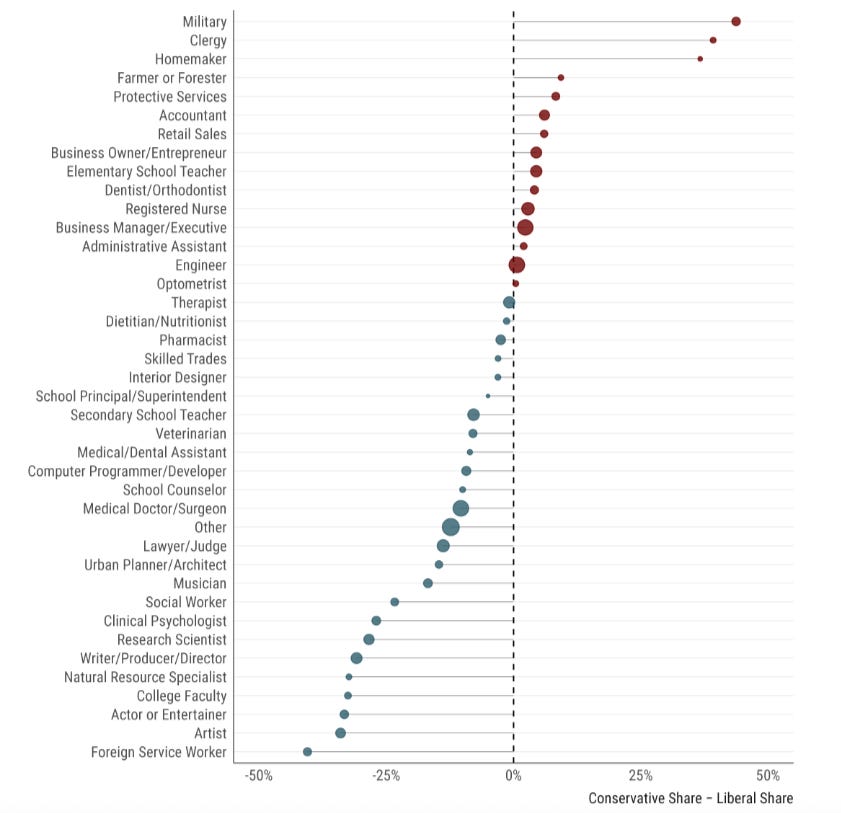
Notably, this ideological sorting wasn’t distributed equally across parental income brackets; instead, the association between ideology and professional aspirations became stronger with income. For students from lower income families, the connection between their political ideology and their career aspirations was relatively weak while students of greater means showed the strongest sorting tendencies.
When it comes to higher education occupations, although “college faculty” had a strong liberal lean across the income distribution, that lean was more pronounced among students in the top quartile compared to those in the bottom quartile. This, along with the more general pattern, supports the idea that symbolic considerations, such as an occupation’s cultural or political coding, play more of a role in the career choices of the wealthy than they do among lower income groups. Because students from affluent families are less constrained by financial or material considerations, they can afford to give relatively more weight to the fit between different occupations and their personal values — hence, ideology as a “luxury” good.
These findings suggest that people care about entering careers that are consistent with their values and political goals. Notably, even before beginning college, students seem to understand that continuing in higher education is something mostly liberals do, and they set career goals accordingly. But as we’ve argued before, this intellectual narrowing is a recipe for disaster for rigorous inquiry in higher education, made all the worse because the mechanism is self-sustaining — and it’ll be up to universities to disrupt this trend.
Class matters for career progression
More news on the role of class in professional and occupational trends: in a new paper, Anna Stansbury and Kyra Rodriguez explore the relationship between socioeconomic background and career progression of U.S. tenure-track faculty, spotlighting class as an attribute worthy of rigorous examination.
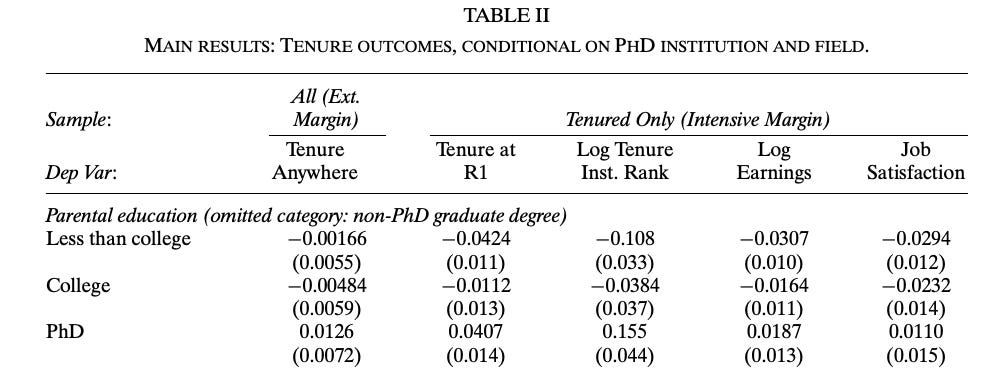
Using parental education status as a proxy for socioeconomic background, they find that first-generation college graduates with a PhD are 4.2 percentage points (10%) less likely than more advantaged peers to be tenured at an R1 university, even when accounting for their PhD-granting institution and field. Importantly, the authors do not find that first-gen college grads with PhDs are less likely to get tenure anywhere at all when compared to similar peers, but rather, they are less likely to end up at R1 or highly ranked institutions.
When constructing the comparison group, the authors compared first-gen college grads with PhDs to PhD grads whose parents had a graduate degree, but not a PhD. The children of MDs, JDs, MBA holders and so on were included in the comparison group, but children of PhD holders were not. The rationale: the authors wanted to isolate the role of socioeconomic class rather than that of inherited academic know-how.
The socioeconomic gap in career trajectory doesn’t appear to be explained by lower research productivity. The authors find that first-gen college grads with PhDs tend to be placed at less competitive institutions relative to peers, even at the same level of productivity (though the authors acknowledge that research quality is considerably more difficult to capture than research output). Considering personal preferences, such as distance from home state, financial constraints, and family obligations between the two groups doesn’t offer obvious explanations for the difference in career progression, either. The authors conclude that social capital may play a role, given that first gen college grads with PhDs had less well-published co-authors and were less likely to receive an NSF award compared to similar peers with non-PhD graduate degree holding parents.
Socioeconomic class is an often overlooked source of viewpoint diversity, yet is conspicuously under-explored in the “diversity” landscape, often positioned as an afterthought to race and gender. But as Richard Kahlenberg has argued, greater socioeconomic diversity can broaden viewpoint diversity and increase the representation of rural students, conservative students, and working class students. Team HxA is glad to see socioeconomic class get some overdue attention.
Students say they’re warm to opposing views, but the packaging matters.
A new report from More in Common surveyed 2,004 undergraduates and 209 faculty and staff at four-year institutions to find out how they perceive campus dialogue programming.
The good news: 81% of students reported being “very” or “somewhat” willing to listen to political views very different from their own, whereas only 5% said they were “not at all” willing. Faculty and staff looked nearly identical, with 83% being “very” or “somewhat” willing to listen to political views.
However, some particularly striking findings emerged with regard to student trust in such programming. Holding true across liberal, moderate, and conservative students, only about 6% of students said they trusted their institution “a great deal” to run a dialogue program that is “genuinely open” and “not politically motivated.” Fifty-five percent reported low trust or uncertainty. Asked about dialogue initiatives at colleges generally, 10% called them “meaningful” and “genuine,” 34% called them a “minor” or “add-on” effort, and 27% called them “mostly symbolic” or “performative.”
A framing experiment — whether the stated purpose for campus dialogue programming impacted student trust — reveals more still: Respondents were randomly assigned one of five stated purposes for a hypothetical program and asked about both favorability and likelihood of participating. Among low-trust students, favorability stayed clearly positive for all five frames (see table), ranging from +44% to +69% net. Engagement did not stay positive, however. It fell below net zero for three of the five, dropping 22 percentage points to -30% for the personal framing. Only the workplace (+15%) and community (+12%) frames garnered positive engagement with the low-trust group.
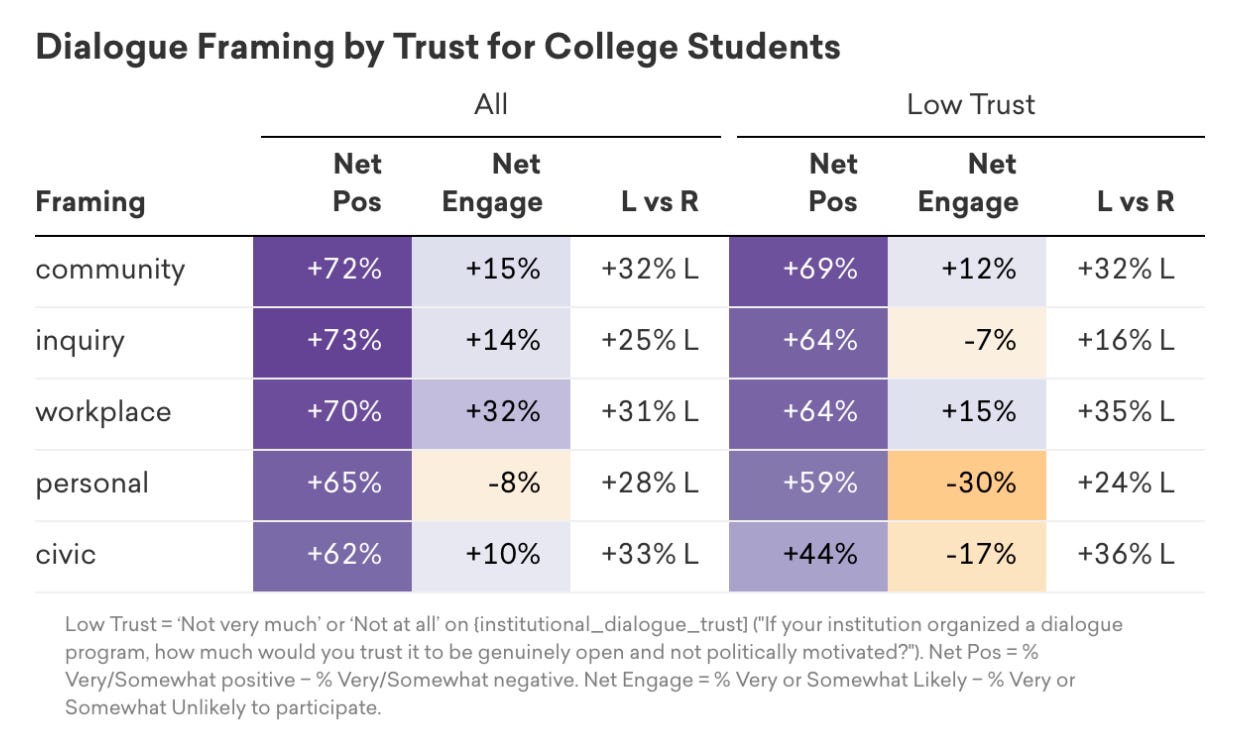
A not too far-fetched reading — an optimistic one, perhaps — is that low-trust students are not far out of reach. Dialogue programs may appeal to broad swaths of students if undertaken strategically, and with a sharp eye towards what students perceive as authentic.
Study suggests faculty have no “liberalizing” effect on students
We know that liberal faculty are overrepresented on university campuses. Much has been proclaimed, especially from the political right, about the alleged indoctrination of college students at the hands of their leftist professors. According to the “brainwashing” hypothesis championed by some commentators, students become more left-leaning as a result of taking classes with left-leaning professors enacting a political agenda in the classroom. This is not mere rhetoric. Faculty in Florida and Texas are now forced to tip-toe around burdensome curriculum and class content restrictions enacted by legislators who may have put stock in the brainwashing hypothesis.
But a recent working paper challenges this assumption. Researchers Baum, Endara, and Paulson examined political leanings for faculty members at an elite state flagship university, as measured by public voting records, linked faculty to students using transcripts, and then recorded student political leanings through self-reported ideology and voter registration records.
The results did not show evidence of instructors having a “liberalizing” effect on students. Overall, college students in this sample were indeed more liberal at the end of college than the beginning, but there was no significant difference in this trend when comparing students who took more courses with liberal professors versus conservative professors in terms of their resulting party affiliation and political identity.
Instead, the authors suggest a few other mechanisms and variables that carry more weight. For instance, students often enter college already having solidified political views. Not only do liberal students seek out courses, majors, and instructors who teach topics which are consistent with their views (echoing the political segregation in career aspirations from above), but when liberal students enroll in classes or majors, the demand for liberal topics increases. Here’s a key finding from the paper: “Compared to conservatives, liberal students take 36 percent more courses about race/racism, 55 percent more courses whose descriptions contain Woke Words, and nearly three times as many courses about feminism.” This suggests something similar to confirmation bias, where people seek out information that comports with their prior beliefs.
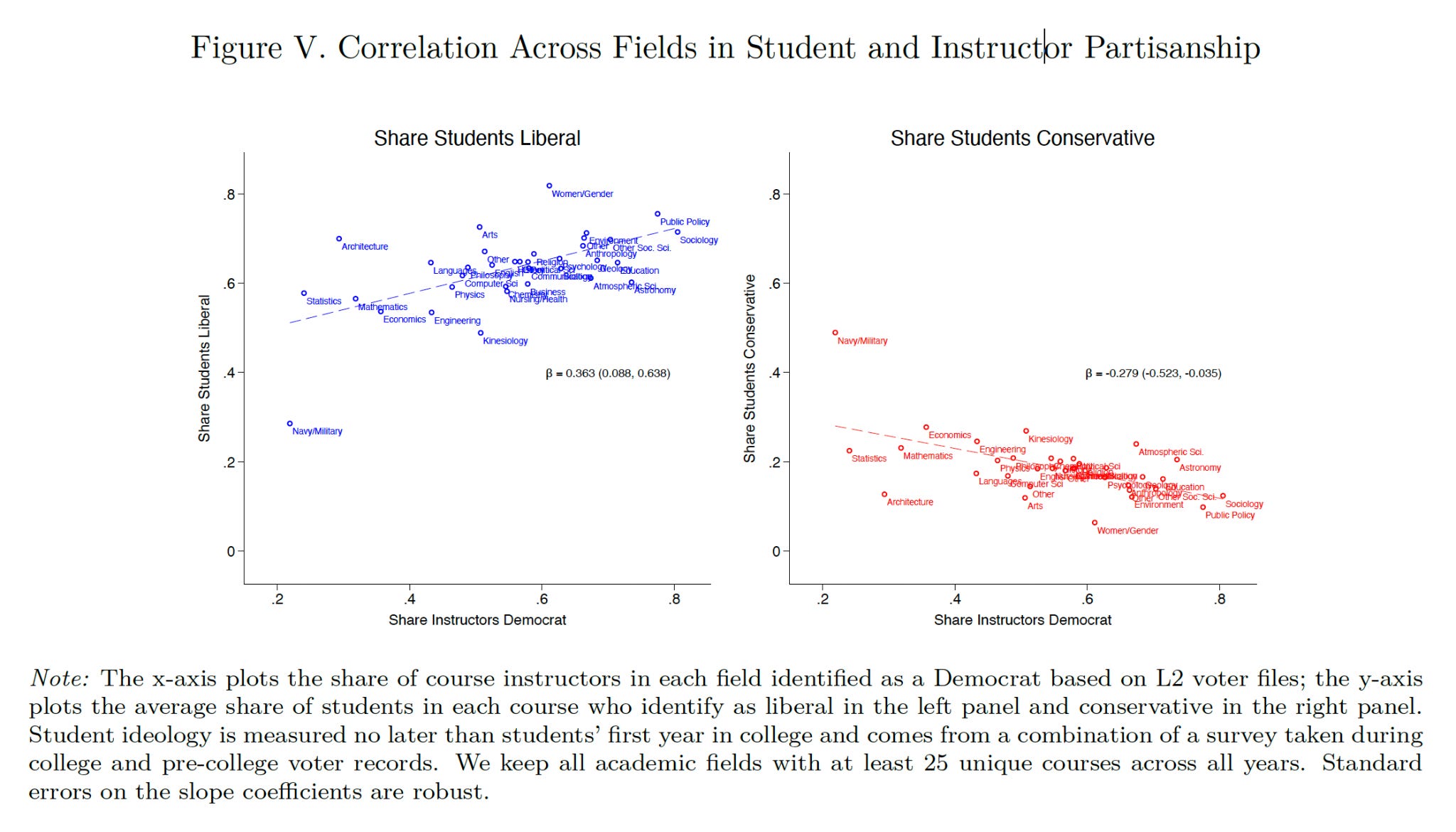
In addition, the effect of peer influence is stronger than professors’ teachings. Since liberal students tend to share classroom spaces with each other, this can have a social self-reinforcing effect, making students more likely to identify as liberal over time as a function of interactions within their peer groups, regardless of what courses they enroll in.
By contrast, when conservative students enroll in humanities and social science courses taught by left-leaning professors, there’s evidence of a small backlash effect, such that these students wind up more likely to identify as Republicans, rather than less likely. Again, this is evidence against the indoctrination hypothesis. Although this is just one study, the conclusions are broadly consistent with another analysis showing that students tend to select academic majors and concentrations that align with their preexisting political viewpoints, although that study also found that students moved further left as a result of majoring in a social science or humanities field. There remains much disagreement among scholars about the extent to which academic fields influence students’ political views.
One caveat: the authors refer to their findings as providing “causal evidence,” but in strict scientific language, this would not be fully accurate. The study is more of a quasi-experiment, in which the authors only measured the variables of interest; they did not manipulate any variables. A true experiment would be needed to establish causality, which would require randomly assigning some students to enroll in courses taught by more/less liberal faculty. That is unlikely to happen anytime soon for logistical reasons, so for now, we can only be confident in concluding that there’s a correlation between these variables, rather than a causal relationship.
Those are just a few of the findings that piqued our interest this month. We’re eager to see what the month of September has in store for research. If you’ve got any good tips, send them our way.


