



Welcome to the second installment of our new Research Roundup series, in which we take a quick look at some of the latest research findings on all things heterodox social science!
In a sweeping meta-science undertaking, about half of social and behavioral science findings didn’t replicate.
The replication crisis continues to muddy the waters of social science research. Several new papers in Nature have captured headlines as journalists reported the results of a massive effort to reproduce hundreds of behavioral and social science findings.
The outcomes of this meta-science project were… sobering, to say the least. Researchers were unable to replicate or reproduce many of the previously established key findings that were re-examined as a part of the study, raising questions about the original findings. For example, one team of researchers attempted to replicate 274 findings published in 164 papers by repeating the studies and analyzing the new data according to the original methods. But researchers were only able to replicate about half of the claims.
A different team exploring reproducibility used the same datasets and methods as the original studies and found more reassuring results, with over 70% of findings at least “somewhat reproducible,” but there was a great deal of variation in reproducibility across disciplines. The fields of education and sociology fared particularly poorly, while economics and political science came out stronger.
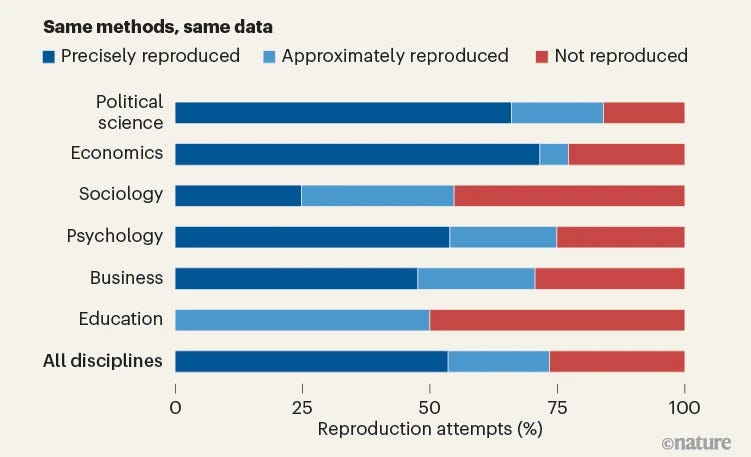
What can we take away from this huge undertaking? As we have emphasized before: scientists are people too. Clearly, different scientists addressing the same research questions (sometimes analyzing the exact same datasets) can come to different conclusions. Part of what drives divergence in findings is that research decisions can be influenced by underlying ideological attitudes. The findings reported in academic papers are the result of many consequential choices, such as which variables are most important, which statistical analyses to run, how to handle missing data, and so on. These researcher degrees of freedom mean that the same data can be bent (unintentionally or otherwise) toward scholars’ preferred conclusions.
Given this flexibility and the risk that even experienced researchers can be driven by their biases, this meta-science project underscores the need for viewpoint diversity and adversarial collaborations, especially in the social and behavioral sciences. Scholars with different worldviews may approach research questions from different angles, and that’s a good thing! This dynamic creates a “check and balance” against each other’s biases. To err is human. Scientists are human. Ergo, scientists err. So let’s err together, in opposite directions, and produce better science as a result!
Over 80% of Britons have “some” trust in science, but the share who have “a lot” has drastically fallen in the wake of COVID-19.
Quipped the British monarch to a joint session of Congress marking the 250th anniversary of America’s independence: “We have really everything in common with America nowadays, except, of course, language.” The five-times great-grandson of King George III, quoting Oscar Wilde’s The Canterville Ghost in a nod to the US-UK special relationship, could have also added a second difference: public trust in science.
Released this month, the More in Common-Wellcome Trust report Britain Talks Trust in Science makes the case for not becoming too much like America in this respect. The report finds that scientists remain a rare bright spot in an otherwise bleak landscape of British institutional confidence — outpolling politicians, journalists, big businesses, and judges by wide margins — but “[a]mber warning lights are now flashing.” Over 80% of Britons say they have at least some trust in science; however, the share saying they trust science “a lot” has severely declined from 63% in 2020 to 34% as of November 2025 polling by More in Common. Moreover, among those whose trust has slipped, 38% attribute it to science becoming “too closely associated with politics.”
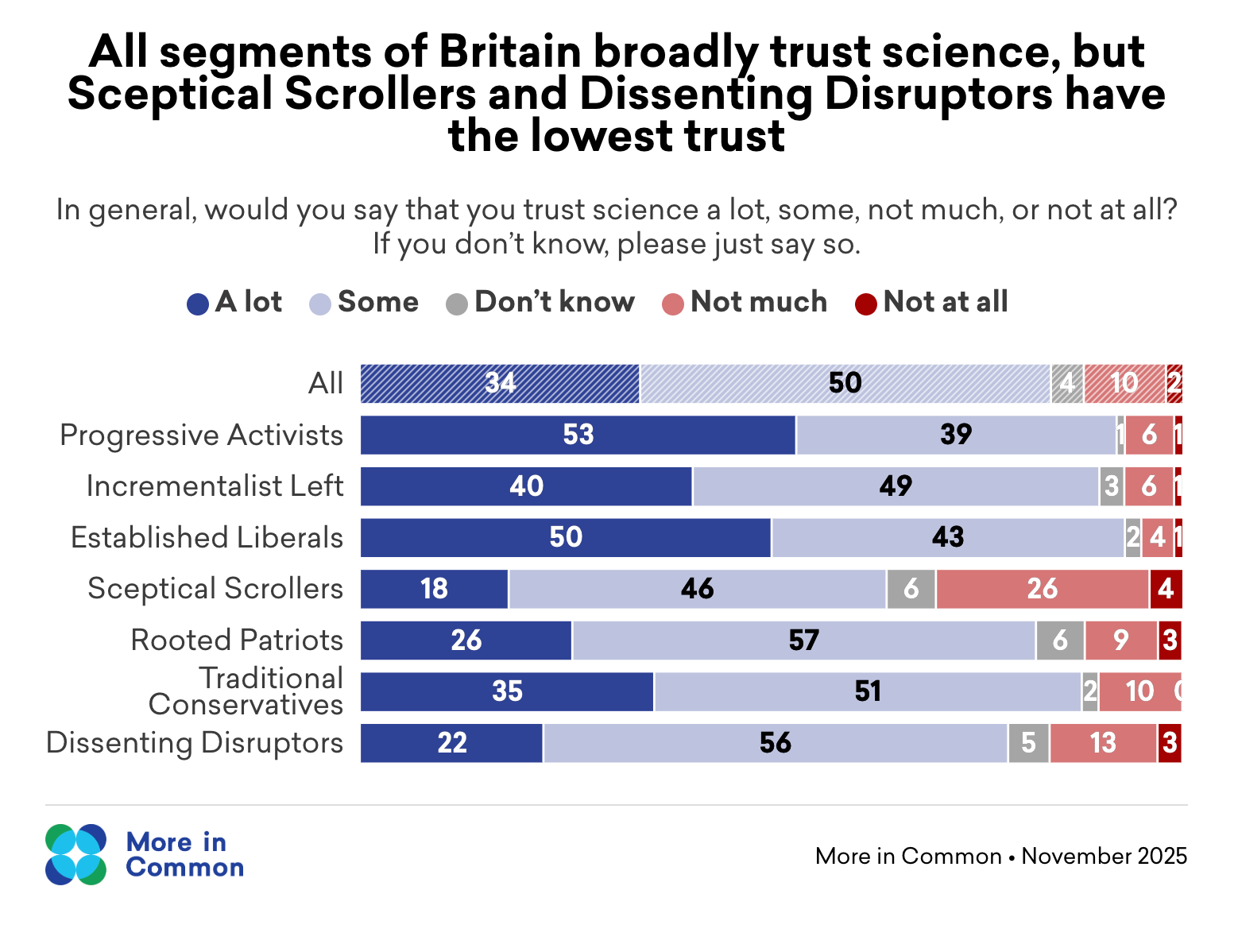
The consequences appear to be not merely attitudinal. Of the seven clusters of respondents (defined by core beliefs and values rather than demographics), the two least-trusting segments, “Sceptical Scrollers” and “Dissenting Disruptors,” were also the least likely to receive the COVID-19 vaccine (17% and 20% unvaccinated, respectively, compared to 5% of Traditional Conservatives).
Among the report’s key messages is: “Those who want to preserve science’s privileged position in the UK should heed the example of the United States,” where confidence in scientists to act in the public’s best interests is polarized along party lines, and concerns over ideological bias in the academy have reached a watershed.
Students’ views on free speech depend on who is being talked about.
Free speech advocates will find a lot to chew on with this one. Abramitzky et al. (2026) examined attitudes toward free speech on campus and found that feelings about free speech can shift based on the target of the speech. In two experiments, students judged whether professors and students, respectively, should be disciplined for offensive speech of varying levels of severity that targeted one of these groups, selected at random: black people, Jewish people, Muslim people, transgender people, or white people. A third experiment asked students whether they supported or opposed campus policies that prohibit offensive speech targeting one of the same five groups, again selected at random.
Students’ judgments were strongly influenced by the severity of the speech, with respondents indicating that more offensive statements (such as that the target group was the “root of all evil”) were considerably more deserving of discipline than less offensive statements (such as that the target group “plays the victim to get special treatment”). The target of the speech also mattered: compared to white people, offensive speech directed at minority groups was more likely to be punished or prohibited by participants.
But perhaps the most interesting finding from this study is that students’ judgments sometimes conflicted with their stated principles around free speech. Around a third of the students in the sample identified as free speech universalists (endorsing the same free speech rules for all speech regardless of who it was about), and the remaining two-thirds identified as particularistic (considering identity when weighing free speech boundaries). But even students who stated a universalistic view of free speech were influenced by the target of the speech, deviating from their principles in a direction consistent with their political leanings. Compared to speech targeting white people, left-wing universalists were more punitive toward speech targeting any minority group. Meanwhile, right-wing universalists were less punitive toward speech targeting Muslims and transgender people.
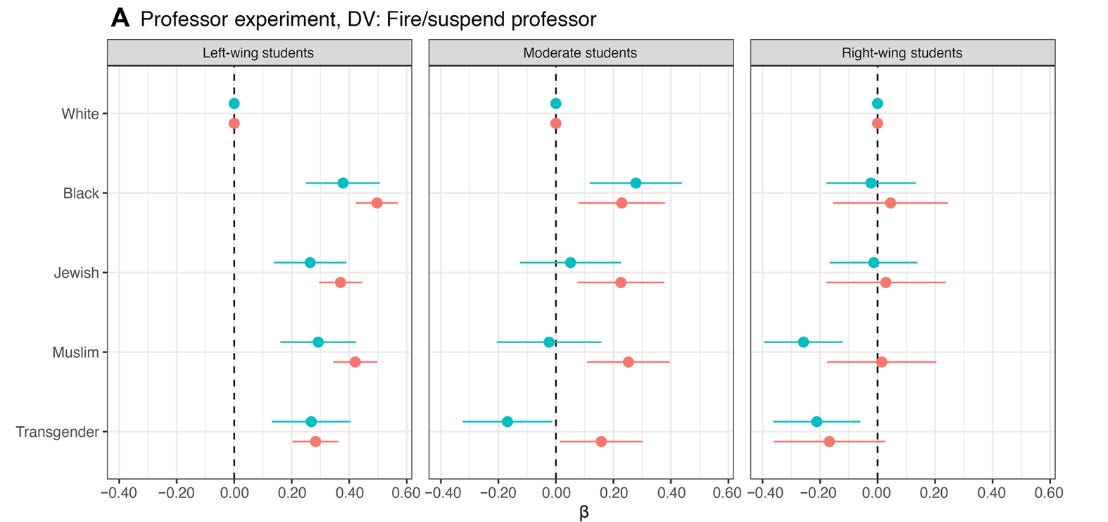
Students only made one judgment per experiment, so it’s not like they were being consciously inconsistent. They were just being human. But the results suggest that feelings toward certain groups and social issues can still influence our judgment about what kind of speech is appropriate, even while we subjectively feel neutral and principled.
Perspective-taking practices halt declines in open-mindedness.
In a quasi-experimental study, Jauernig et al. (2026) found that perspective-taking practices can halt declines in open-mindedness, but aren’t so great at actually increasing open-mindedness. In this study, which was supported in part by an HxA member grant, participating classes at two different universities were assigned to a treatment or control condition. Students in the treatment group participated in perspective-taking practices, such as engaging with the “pro” and “con” sides of three select controversial topics (genetically modified organisms, price gouging, and social media) through curated readings defending both positions, and creating “fuzzy cognitive maps” (example below) to visually depict the arguments and beliefs of each position. Students in the control group experienced no changes to their regular classroom instruction.
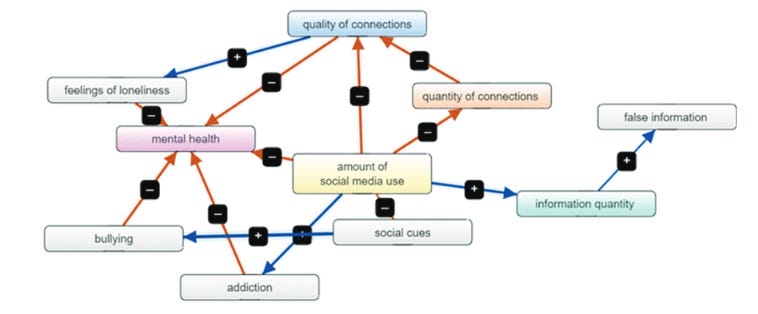
All students were surveyed at the beginning and the end of the semester to assess three components of an open-minded mindset: perspective-taking, open-minded cognition, and intellectual humility. But contrary to their pre-registered predictions, Jauernig et al. found that at the end of the intervention, participants in the treatment group exhibited no increase in open-mindedness as measured by perspective-taking, open-minded cognition, and intellectual humility (although they were more likely to perceive ideological opponents as rational rather than irrational). And, at least, participants in the treatment group didn’t experience any broad decreases in open-mindedness. The same can’t be said for the control group, which ended the semester scoring lower in open-mindedness than when they started.
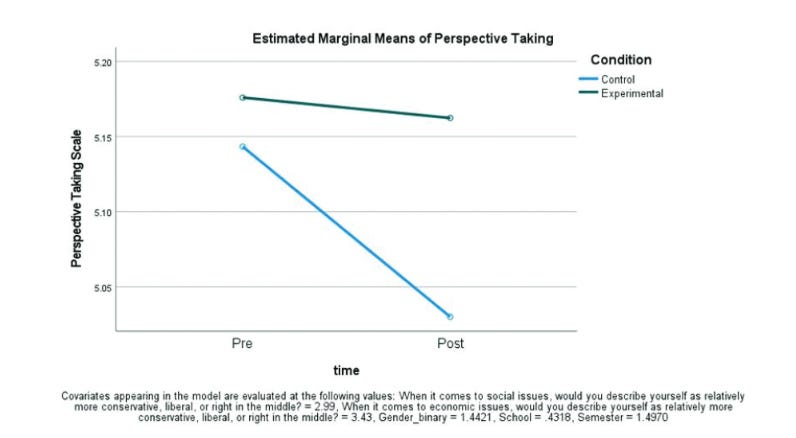
The results suggest that although we can’t easily shift the trend of increasing polarization into reverse, at the very least, trying to understand the perspectives of opposing sides might prevent polarization from accelerating.
DEI statements in faculty hiring sharply decline in 2025-26 hiring cycle
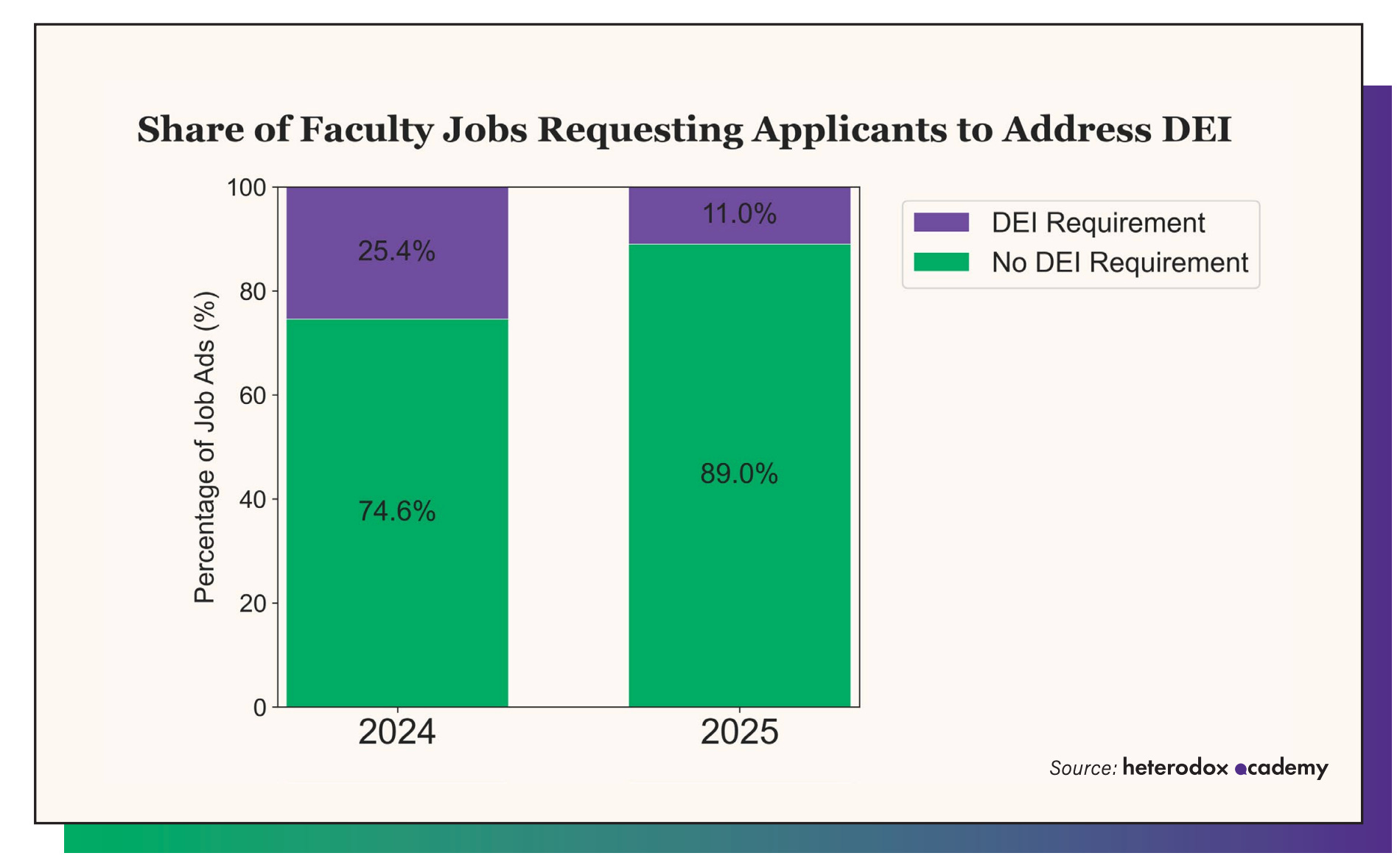
And, finally, we’d be remiss not to mention Team HxA’s latest research report, Changing DEI Requirements in Faculty Hiring: A Comparative Analysis Between 2024 and 2025 Hiring Cycles. Requests for DEI-related materials in faculty job applications have declined considerably, from 25% during the 2024-2025 cycle down to 11% in the most recent hiring cycle. However, nearly 40% of job ads still signal that commitments to DEI will be valued. Read the full report to learn more about how trends in DEI statement requests in faculty hiring have changed since last year.
Think we missed a juicy research finding from this month? Drop us a line at research@heterodoxacademy.org so we can nerd out with you.


