



At HxA, we like to keep our finger on the pulse of the latest research on topics like viewpoint diversity, polarization, and academic culture. To help keep you informed of the latest research on these issues, we’re launching a new monthly Heterodox Research Roundup series showcasing recent studies that may interest HxA members, the heterodox-curious, and the general public.
We’re starting off the series strong with highlights from March 2026, including a new study on the “diploma divide”, an analysis of ideological trends in social science research since the 1960s, a new “Words Can Harm” survey scale, and a working paper from HxA Segal Center Postdoctoral Fellow Eric Torres on political messaging in K-12 schools (spoiler: some people want neutrality… until they don’t).
College grads have shifted more liberal, non-grads hold steady in political identity.
Prinzing & Vazquez (2026) find that the relationship between education and political self-identification has shifted over the last 15 years. Using large-scale survey data, the authors found that although college grads have held more liberal positions than non-grads for the last 50 years, the gap between how grads and non-grads actually identify themselves politically (e.g., liberal or conservative) only emerged during the 2000s. That gap has been widening since 2012, reflecting what commentators are now calling a “diploma divide.” Interestingly, the gap is driven by college grads increasingly identifying as liberal; meanwhile, the average non-grad’s political identity has remained steadily “moderate.”

In a second study, Prinzing & Vazquez explored changes in students’ political orientation during college. Using survey data tracking over 360,000 undergraduates from freshman to senior year between 1994 and 2019, their analysis revealed that the average college grad has left college more liberal than when they entered. This trend began around 1997, and the size of the within-person shift toward more liberal views increased substantially between 2012 and 2017 and remained high through 2019. Women, Black and Hispanic students, social science and humanities majors, and those with high SAT scores tended to move more to the left, while business and engineering majors tended to shift right.
Of course, these studies are subject to the usual caveats about causation: without a randomized experiment, we can’t conclude definitively that experiences in college (as opposed to other experiences correlated with college attendance) are driving these shifts. Still, the results suggest that educational attainment is becoming increasingly entangled with people’s political identities, widening the cultural rift between those with diplomas and those without.
Social science research skews left.
An abundance of research points to a largely left-leaning professoriate, which raises concerns about ideological homogeneity, especially given the possibility that ideological positions influence research approaches. But until recently, there was limited information about the political and ideological leanings of research itself. Manzi (2026) used an LLM to evaluate the political leanings of nearly 600,000 scholarly works from 11 social science disciplines published between 1960-2024. About 180,000 of the abstracts were determined to be “politically relevant” abstracts, 90% of which lean left. Manzi also found that all disciplines moved leftward between 1990 and 2024, though not always steadily. Gender studies, ethnic studies, and anthropology had the most left-leaning research. Economics, while still mostly left-leaning, had the greatest share of right-leaning research.
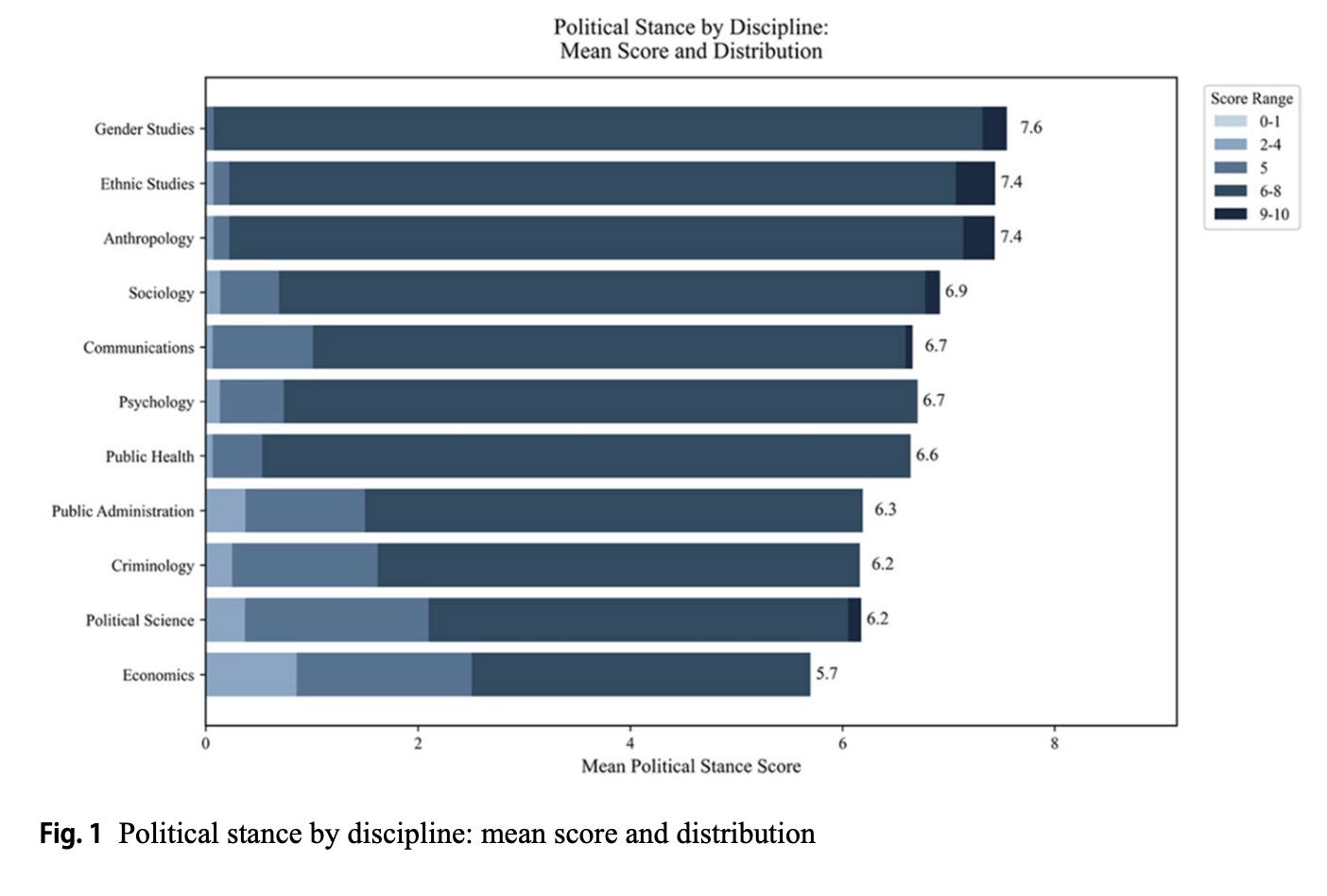
Manzi takes care to emphasize that the assigned political scores of the abstracts are anchored to the modern-day political landscape, not the political landscape at the time of publishing. The scores may not reflect how authors situated their research within the political context of the day. But even with that important limitation in mind, Manzi’s work points to worrying trends in the political valence of research.
New survey to measure the belief that words can harm.
Great news for the survey nerds out there: a new survey scale just dropped. Pratt et al. (2026) developed the ten-item “Words Can Harm Scale” (WCHS), which measures the belief that speech can cause lasting psychological damage. A sample of 956 American adults recruited online reported the extent to which they agreed or disagreed with statements like “Exposing someone to a triggering idea can seriously damage their mental health,” and “Even a simple phrase can be emotionally traumatizing for someone vulnerable.” Pratt et al. found that those more likely to believe that words cause harm tend to be younger, female, non-White, and politically liberal.
Unsurprisingly, higher scores were associated with a preference for safeguards against potentially harmful speech (e.g., trigger warnings and safe spaces). Higher scores were also linked with greater self-perceived empathy, a tendency towards interpersonal victimhood (i.e., as perceiving oneself as a victim in social situations) and moral grandstanding (i.e., proclaiming one’s moral attitudes as a way to gain status and popularity).
Clinically, higher scores mapped onto worse outcomes across every well-being variable examined: more depression, anxiety, emotion dysregulation, and lower resilience. But the largest correlations were found with censorship, particularly top-down censorship, one of three components of left-wing authoritarianism (e.g., “University authorities are right to ban hateful speech from campus”). The WCHS gives researchers a precision tool for understanding who supports speech restriction, and why.
Neutrality for thee, if you don’t agree with me.
Should 10th grade government teachers be revealing their political candidate preferences to their students? According to one survey experiment, the answer is no — unless those preferences align with the respondent’s own political views.
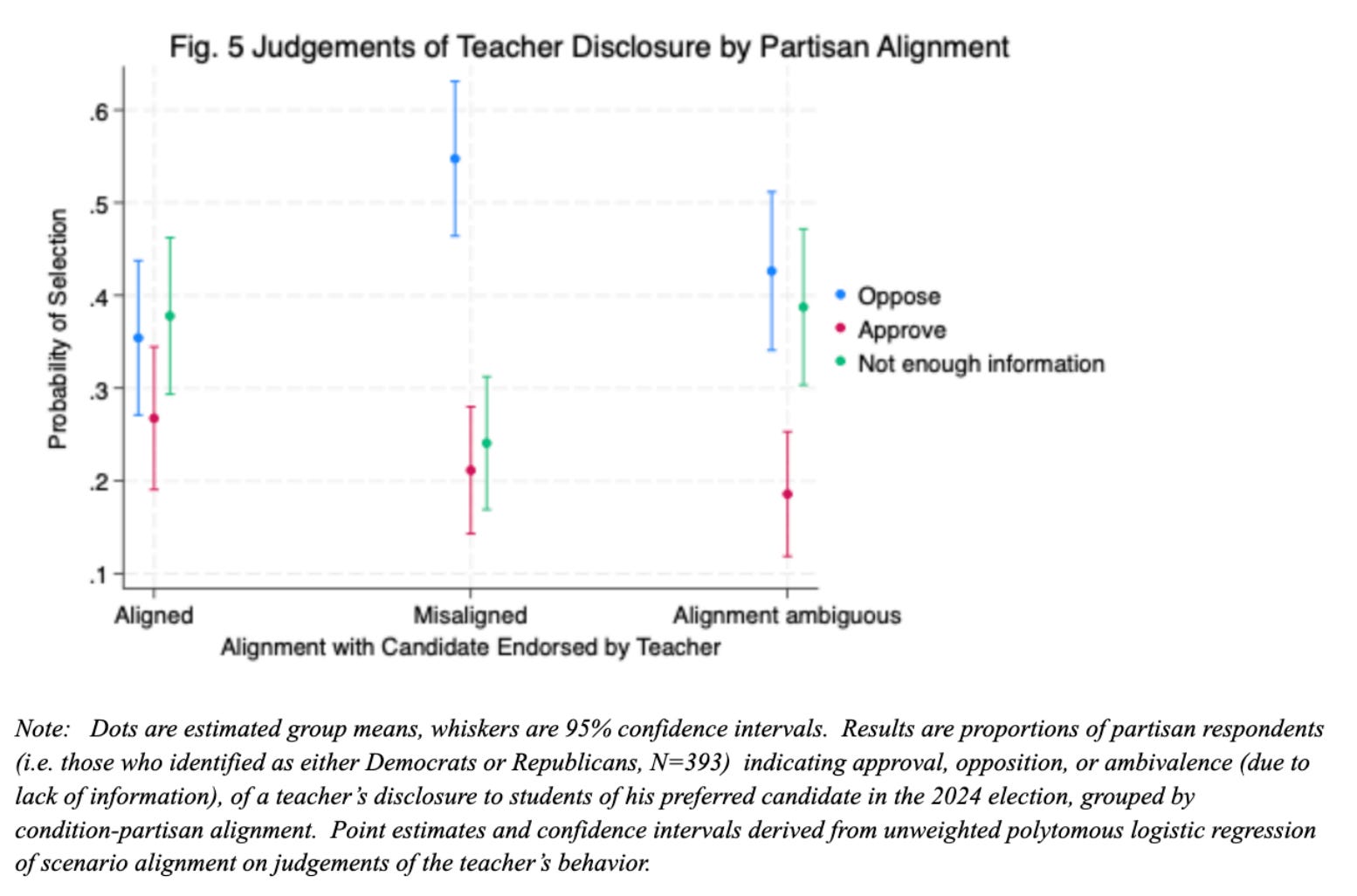
This standout working paper by Eric Torres, HxA member and postdoctoral fellow at the Segal Center for Academic Pluralism, offers new empirical research on Americans’ attitudes toward political neutrality in public schools. Torres (2026) analyzed responses from the March 2025 Harvard CAPS-Harris Poll, a nationally representative survey of American adults, which included a vignette experiment. He focused in particular on a random subsample of 537 respondents (out of 1,080) who were given, among other items, one of three classroom scenarios featuring a 10th grade teacher who revealed his political preferences to his government class, either for Trump, Harris, or an unnamed candidate.
The findings are striking. First, Americans across party lines generally endorsed ideological impartiality in their local public schools, at least in principle: 57% opposed schools promoting either liberal or conservative viewpoints, with support for impartiality outpacing the promotion of ingroup views by at least 2-to-1 among both Democrats and Republicans.
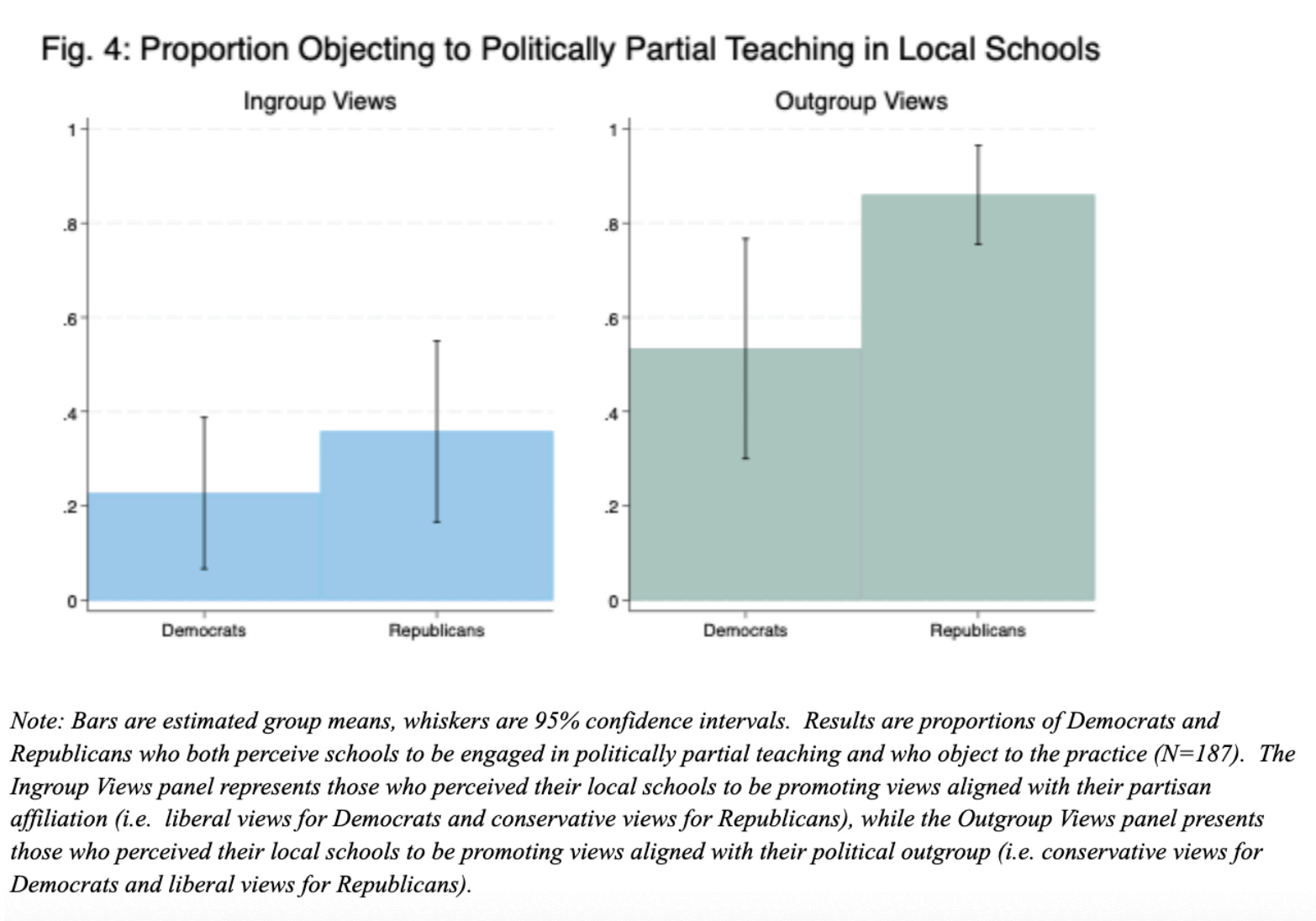
But (... and it’s a big but) stated principles appear to bend significantly when ingroup interests are at stake. Among a small number of people who identified with a party and perceived that their local schools were promoting their own side’s views (n=66), 71% rated this favorably. And in the vignette experiment, partisans in general were 1.5 times more likely to object to a teacher’s political disclosure when it favored the opposing party.
What do these findings mean? For those of us interested in affective polarization in the United States, Torres’ study highlights that further work is needed on the “permission structure[s]” and “mechanism[s] by which teaching in politically conservative and politically liberal districts might systematically drift apart.” For those interested in viewpoint diversity in the academy, Torres points the way for a research agenda that takes seriously the uniquely influential role of educational institutions as sites where political identities are shaped and contested.
Have a recommendation?
Have you heard of interesting new research that we should include next month? Drop us a line at research@heterodoxacademy.org. We welcome suggestions for recent articles on HxA-relevant issues, ranging from hot-button topics to evergreen methodological research across all disciplines.


Always great to read your summaries! With reference to the first two, I feel there there are a couple of major missing pieces in your discussion - and, more generally, in a lot of conversations I hear around HxA:
1) When I asked Google for a 'definition of "conservative"', here is the response:
"A conservative is someone or something that favors tradition, opposes rapid change, and prefers cautious, moderate approaches over risky or extreme ones. It implies a desire to preserve existing institutions and values, often appearing as traditional in style, or cautious in estimating amounts."
It would seem to me that the very nature of academia is somewhat at odds with the definition of "conservative." People seek an education so that they can grow, improve, gain socio-economic mobility... in other words, to change. Conservatives generally do not like change. So, right off the bat, why is it in any way surprising that academia skews liberal?
2) Regarding the research on social studies, again, let's think for a moment about what most social studies are about: society. Most conservatives tend to favor individualism, it would seem more shocking to find that a significant number of social science research studies were NOT left-leaning.
3) More generally, I find that your conclusions in both summaries show a concerning bias. Specifically, let me point out two points:
* Both studies in the first summary show a widening gap in recent decades. This widening gap has been seen across many parts of society, and is reflection of the increasing polarization that we are seeing across society. It would be weird to see that the gap has stayed the same or shrunk in academia.
* In your second summary, you conclude "the results suggest that educational attainment is becoming increasingly entangled with people’s political identities". Again, there is an underlying societal trend that can explain at least part of the growing gap, but also it seems entirely natural that people who go into education with a certain leaning, will likely grow more convinced as they gain additional knowledge that supports their belief system to being with. The fact that "business and engineering majors tended to shift right" shows that this is not an issue unique to liberals.
Why do I say this is a "concerning bias"? A lot of the writing I see in HxA seems to suggest (sometimes very openly) that ideological positions are a bad thing. Your own article states that some of the findings you summarize "raises concerns about ideological homogeneity". It is a bit insulting to the academic community to assume that being aligned with an ideological or political framework means that the research or teaching will somehow be tainted and will lead to homogeneity. If anything, we have overwhelming evidence that it is those with conservative views that frequently try to impose their ideology on others, by banning books, by scrutinizing syllabi, by eliminating programs.