

Even Free Speech Proponents Violate Their Principles. We Need Institutions That Can’t.
New research shows that stated support for free speech often breaks when the speech triggers political biases.

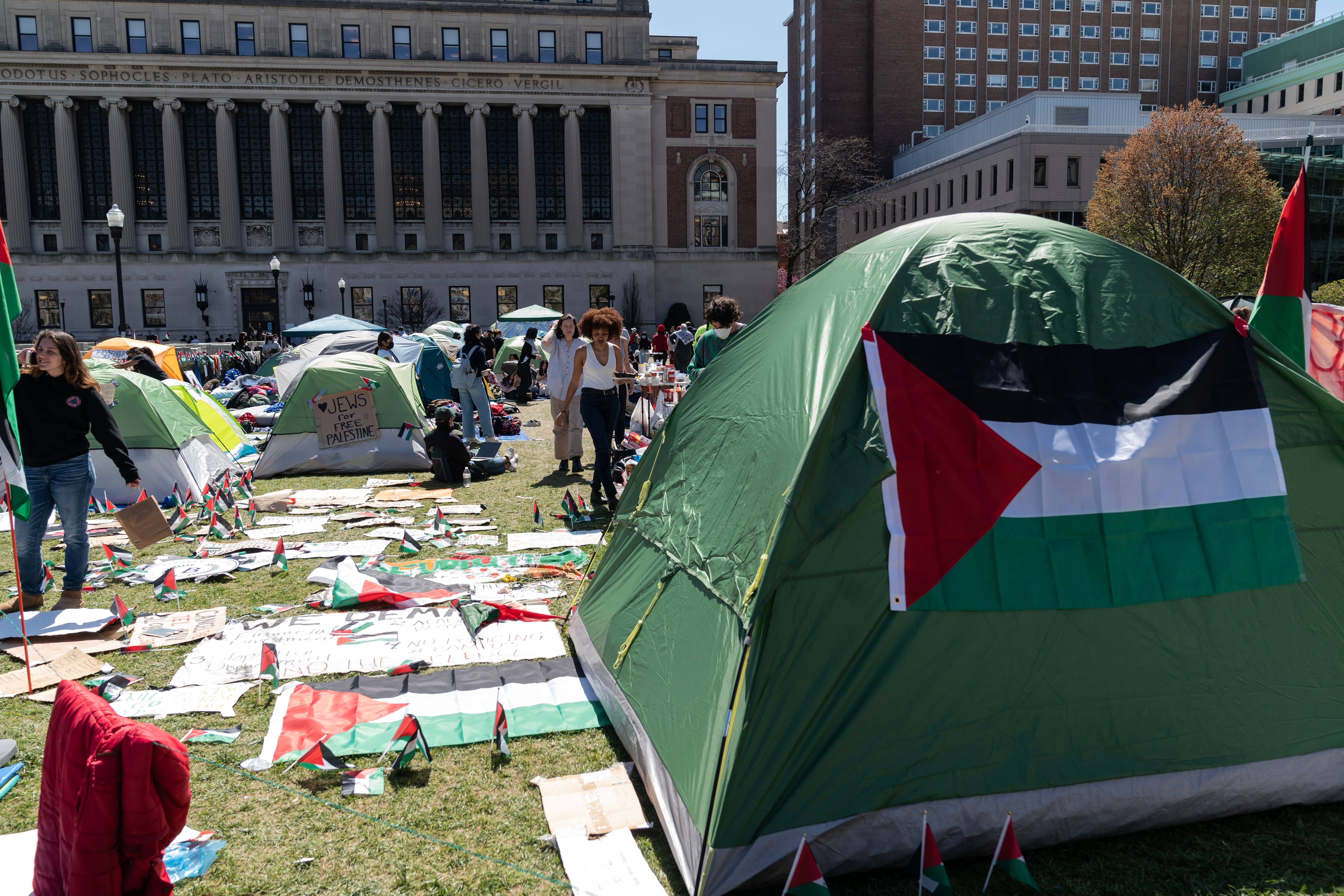
The debate over free speech on campus is usually framed as a persuasion problem: if only more students believed in free expression, the culture would protect it. A new study in Science Advances, by researchers at Stanford, Penn, Columbia, and the University of Colorado, suggests the problem runs deeper. The study found that many students already believe in the principle of free speech, but they abandon it when their group loyalties are engaged. For those of us who see free expression as the precondition for the truth-seeking work universities exist to do, this insight is key: persuasion is necessary, but not sufficient.
The researchers surveyed a nationally representative sample of 3,065 US college students in the summer of 2024, at the height of the campus Gaza protests, and found that nearly 75% reported believing that protecting campus free speech is “very important.” Yet when the researchers asked whether speech aimed at a marginalized group should be policed more strictly than the same words aimed at anyone else, 64% said yes. They claimed to value free speech but did not apply it consistently across views. The authors labeled this group “particularists.” In contrast, 36% of respondents said the rules should be applied neutrally and consistently no matter the target of speech. This group was labeled “universalists.”
The particularist position deserves scrutiny: a right that is applied inconsistently is not a right, but a revocable permission. Even if the “particularists” self-identify as free speech proponents, they cannot accurately be viewed as such. The authors conducted a similar survey among US adults and found that the split between particularists and universalists is nearly even, 52% particularist to 48% universalist. It appears that universalism does better off campus than on it.
However, what the study shows about the universalists is even more concerning.
The researchers had students read a scenario in which a professor made a derogatory statement about white, Black, Jewish, Muslim, or transgender people, and asked whether the university should suspend or fire the professor. Particularists behaved in line with their stated position: support for punishment jumped when the target was a minority rather than white. Universalists mostly held the line, albeit inconsistently, barely moving when the target was Muslim or transgender, and their support for punishment rising far less than that of particularists when the target was Black or Jewish.
However, splitting the universalists up by their politics — left versus right, and sympathy toward Israel or the Palestinians — revealed that much of this consistency was an illusion created by averaging them out. Students who were ambivalent in these divides better maintained consistency. But right-leaning and pro-Israel “universalists” were less supportive of suspending or firing a professor when their target was a Muslim or a transgender student than they were if the target was of a different group; conversely, pro-Palestine “universalists” tilted the opposite way and were more likely to support suspending or firing professors who expressed hate toward Black or Muslim students.
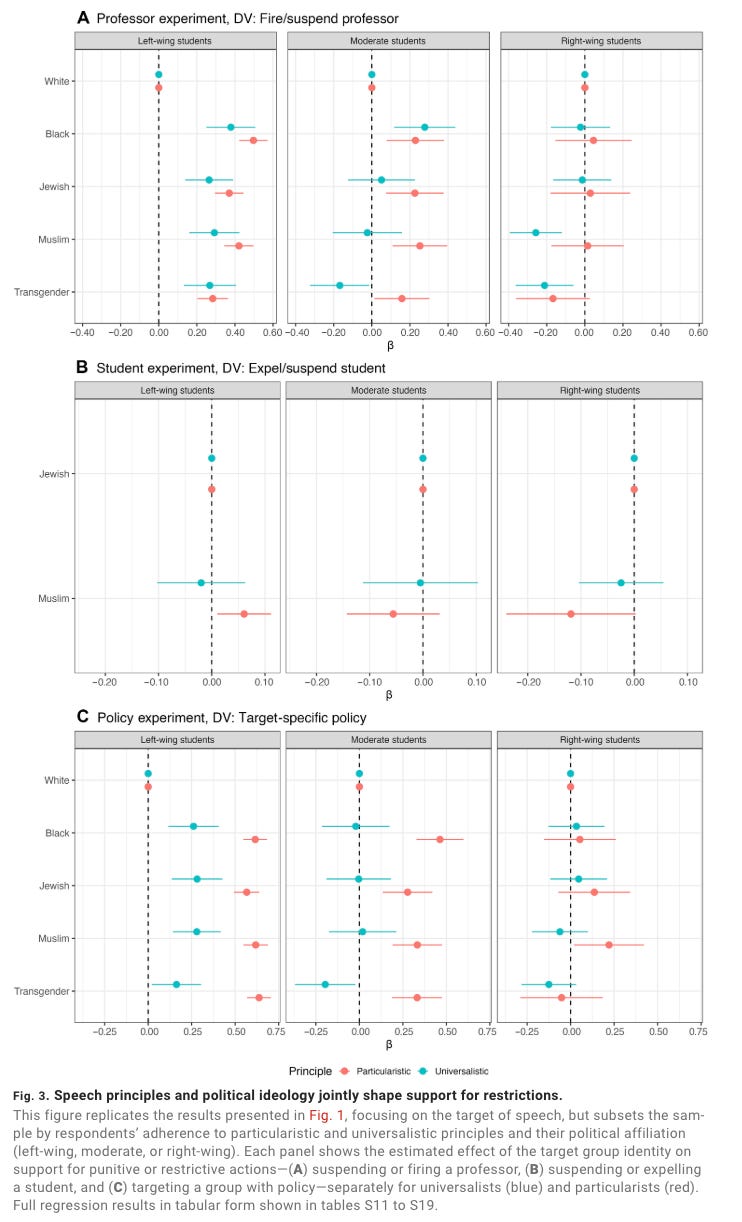
Economists distinguish stated preferences from revealed preferences: what people say they value versus what their choices show they actually value. By their stated preferences, these students viewed themselves as universalists who believed in universal application of free speech rights, regardless of the target of the potentially offensive language. Yet their revealed preferences when faced with a concrete issue showed they were in fact particularists who struggled to apply free speech principles consistently when the target group in question held political salience to them. Their abstract principles didn’t survive contact with genuine stakes.
Why do people struggle to uphold their stated principles? Dan M. Kahan’s work on identity-protective cognition explains the incentive structure: for the individual, bias is rational. Your lone opinion rarely changes an outcome, but visibly breaking with your tribe on a charged issue much more often costs you standing, trust, and friends, so the mind protects group membership over accuracy. Tellingly, a survey conducted by Kahan and colleagues on climate change risk-perception found that the best reasoners (those who score highest on tests of numeracy, science-literacy, and cognitive-reflection) show more of this bias, not less, being better at building the justifications their identity needs. The impulse is bipartisan: a meta-analysis of 51 experiments found liberals and conservatives show partisan bias at statistically indistinguishable rates.
In the decade before October 7, 2023, the loudest complaints about campus censorship came from the right. FIRE’s data show students were mostly targeted from the left between 2020 and 2022. After October 7, the pattern reversed: students were mostly targeted from the right, and many incidents involved pro-Palestinian speech. Some prominent critics of cancel culture cheered efforts to ban Students for Justice in Palestine chapters engaging in protected speech or pressure universities to investigate, discipline, or deport pro-Palestinian students and faculty. On the other side, pro-Palestinian students and faculty who invoked free speech and academic freedom to protect their own expression have themselves shouted down speakers and disrupted events. As FIRE’s Greg Lukianoff put it, “Again and again, political actors preach the importance of free speech, only to reach for the censor’s muzzle when it helps their side.”
Where does this leave advocacy for free speech and open inquiry? Although a third of students endorse a universalist perspective on free speech, and more still need to be persuaded to do so, endorsement alone isn’t enough. Fighting natural human tendencies of protecting group loyalties is an uphill battle. Campus free expression, then, cannot rest on the in-the-moment consistency of individuals; it has to rest on institutions.
Students ambivalent to either side of the Israeli-Palestinian conflict applied their principles consistently across nearly every scenario the researchers proposed. Distance from the fight preserved judgment. This insight into procedural justice is ancient. Roman law codified it in 376 AD; later named nemo iudex in causa sua, the principle states that no one may be a judge in a case in which he has an interest. James Madison wrote Federalist No. 10 around this: “No man is allowed to be a judge in his own cause, because his interest would certainly bias his judgment, and, not improbably, corrupt his integrity.” Courts ameliorated the issue of bias structurally; judges are to recuse themselves when their impartiality could reasonably be questioned, and jurors with a stake are struck.
Free expression needs the same strategy. A university whose disciplinary outcomes depend on biased individuals will produce biased enforcement, even if they claim to be principled free speech universalists. Instead, content and identity-neutral rules must be in place before any controversy strikes, and ideally the administrators judging complaints should be as free as possible from any overt biases.
The time to build such rules and policies into academic institutions is now. Every new controversy converts more professed universalists into practicing particularists. The next Gaza — and there will be a next controversy just as divisive — will not be the moment to start drafting neutral speech policies. It will be the moment when well-formulated policies withstand pressure and protect speech equally, and weak and ineffective policies fail under pressure from individual biases.
"Instead, content and identity-neutral rules must be in place before any controversy strikes, and ideally the administrators judging complaints should be as free as possible from any overt biases."
Those rules are highly desirable. The good administrators are essential.
This is a valuable account, but the analysis is premised on a highly contestable proposition. It takes for granted that "free speech" is a stand-alone principle, rather than one embedded in a cluster of inter-related principles (e.g., human dignity, equality). In historical and comparative perspective, the latter view is the norm, and the former -- the identification of free speech with viewpoint neutrality -- the exception. International human rights law expressly rejects viewpoint neutrality, as do many liberal-democratic constitutional orders (including Canada). U.S. constitutional doctrine's embrace of viewpoint neutrality dates, not from the founding, but more or less from a 1969 Supreme Court decision (Brandenburg v. Ohio), which subsequently became identified with the maxim that "constitutionally speaking, there is no such thing as a false idea." Viewpoint neutrality has much to be said in its favor, but to characterize rejection of that doctrine as unprincipled, as this post appears to do, is misconceived and unfair.