


Thirty-eight percent of Americans currently report having “a great deal” or “quite a lot” of confidence in higher education, according to this year’s Gallup poll, down from 42% last year and just two points above the record lows of 36% recorded in 2023 and 2024. Last year’s uptick, it turns out, was not the start of a recovery so much as a blip.
The more interesting finding, though, is who drove this year’s decline. Confidence among Democrats fell from 61% to 50%, an 11-point drop that is both the largest single-year decline Gallup has recorded for Democrats since tracking began in 2015 and a new record low for the group. Republicans and independents barely moved by comparison, down 3 points (26% to 23%) and 2 points (41% to 39%), respectively. Democrats, however, remain the most confident group of the three overall.
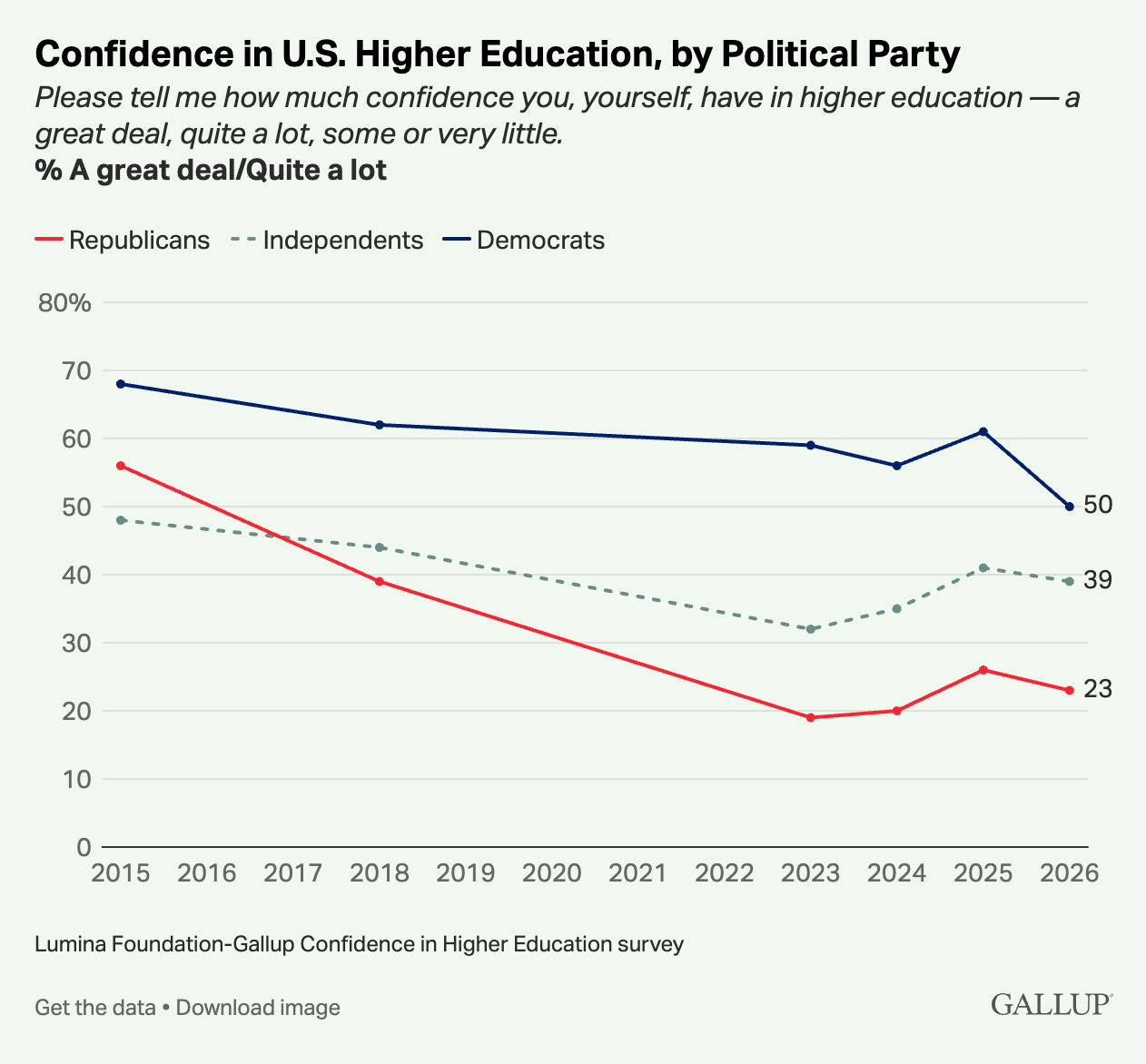
Gallup did not look into respondents’ reasons as thoroughly this year as it did last, this year, as in prior years, Americans pointed to political agendas on campus (31%) as the top reason they lack confidence in higher education, even more than cost (30%) and inadequate preparation for the workforce (25%).
Given the lack of Democrat-specific data, the cause of their record-breaking decline is open to interpretation. Mine is that last year’s confidence rebound arrived just after Trump returned to office and began funding cuts, lawsuits, and executive actions that have defined his second-term approach to higher education; a good deal of that uptick in Democratic confidence looks, in retrospect, like a rally behind institutions under fire more than a sustained reassessment of the sector. A year later, with the standoff between Washington and university leadership still unresolved, that solidarity appears to be waning: any concession, any negotiated settlement, and any acknowledgment by a university that something needed fixing, may appear to some Democrats as capitulation.
Part of that waning is downstream of a deeper disconnect between what the public sees and what the (left-wing) faculty at large thinks, caused in part because faculty are unrepresentative of the American public. Especially when it comes to politics, left-leaning faculty vastly outnumber right-leaning faculty. When you have this kind of ideological homogeneity among the country’s knowledge producers, the knowledge they produce is distorted, even if from the inside they view that knowledge as obviously correct.

A startling example of this — and it’s just one — is the recent viral interview with the American Anthropological Association’s president, Carolyn Rouse, wherein she is pressed on the claim in the Vanderbilt-Wash U State of Scholarship Report that anthropology is “the most extreme case” of scholarly deterioration from politicization. Washington Post reporter Megan McArdle puts in plain language how this ideological defense looks to the public:
When the interviewer pushes back on that last point, she tries to dodge and weave, but has no idea what an effective dodge would be. So we end up watching an unintentional comedian take repeated pratfalls, such as suggesting that people who believe sex is binary maybe “want to kill babies that aren’t just XX presenting XX or XY presenting XY,” and that teaching that sex is binary is as inappropriate in a classroom as debating the pros and cons of interning Japanese people. Perhaps this sounds more coherent if you are fluent in Anthropologese, but to those outside the tribe? Woof.
Woof, indeed.
The good news is that some university leaders and a growing mass of faculty are seeing truth in external critiques: it’s what produced Yale’s Trust Report, the Harvard Medical School Open Inquiry Report, and the Vanderbilt-Wash U State of Scholarship Report this year. There remains, however, a non-trivial segment of the Left that treats any admission of ideological homogeneity or DEI overreach as tantamount to handing the academy over to political actors who want to dismantle it. I don’t think that premise holds, and I suspect it explains at least part of this year’s drop in Democratic confidence. Both things can be true: the federal assault on universities can be real, aggressive, and worth resisting, and the underlying problems with politicization on campus can also be real and worth addressing. Admitting the second does not require surrendering on the first.
As I’ve argued before, federal overreach does not negate the fact that things have gone ideologically awry on campus and need reform. And that reform has to come from inside the house. Rebuilding public trust requires admitting what needs fixing and doing the work of fixing it, regardless of which political party happens to claim parts of whatever issue as its own in any given moment. When principles supersede politics, this isn’t a difficult position to hold.
As an analytics guy, I am quite certain that the recent swings up/down of the past few years are due to data quality issues, not real changes in people's opinions. Things like different kinds of people choosing to respond one year to the next, slight changes in the wording or layout of the survey, timing of when the survey is made available, etc. However minor these things seem to be, in reality, they have massive impact on results. Issues like this are extremely common and can be very expensive or difficult to correct, so misleading data is everywhere, even at organizations with PhDs, scientists, etc.
A strange drop considering that Democrats and their ilk are in charge of the ideology in so many university departments and administrations.
Possibly it's because of the capture of Dems by the DSA and communists, who want to tear down most everything. I doubt that they have any regard for universities.