



A couple of months ago, we spoke with the Chronicle of Higher Education about what they are calling “the conservative hiring boom.” At the time, it seemed clear to us that there was a “vibe shift” of sorts in terms of academic norms. Standalone DEI statements were on the decline, and there were anecdotal reports of heterodox scholars being recruited for faculty positions with a goal of increasing viewpoint diversity. On the other hand, given all of the cuts we’ve seen to universities, and their effects on hiring, it’s tough to call this a friendly job market for anyone right now.
In light of this, we ran a poll asking folks about their perceptions of academic job market vibes, using an informal member email survey. We collected responses from 244 people working in higher education (77% of whom are HxA members). Here’s what we found.
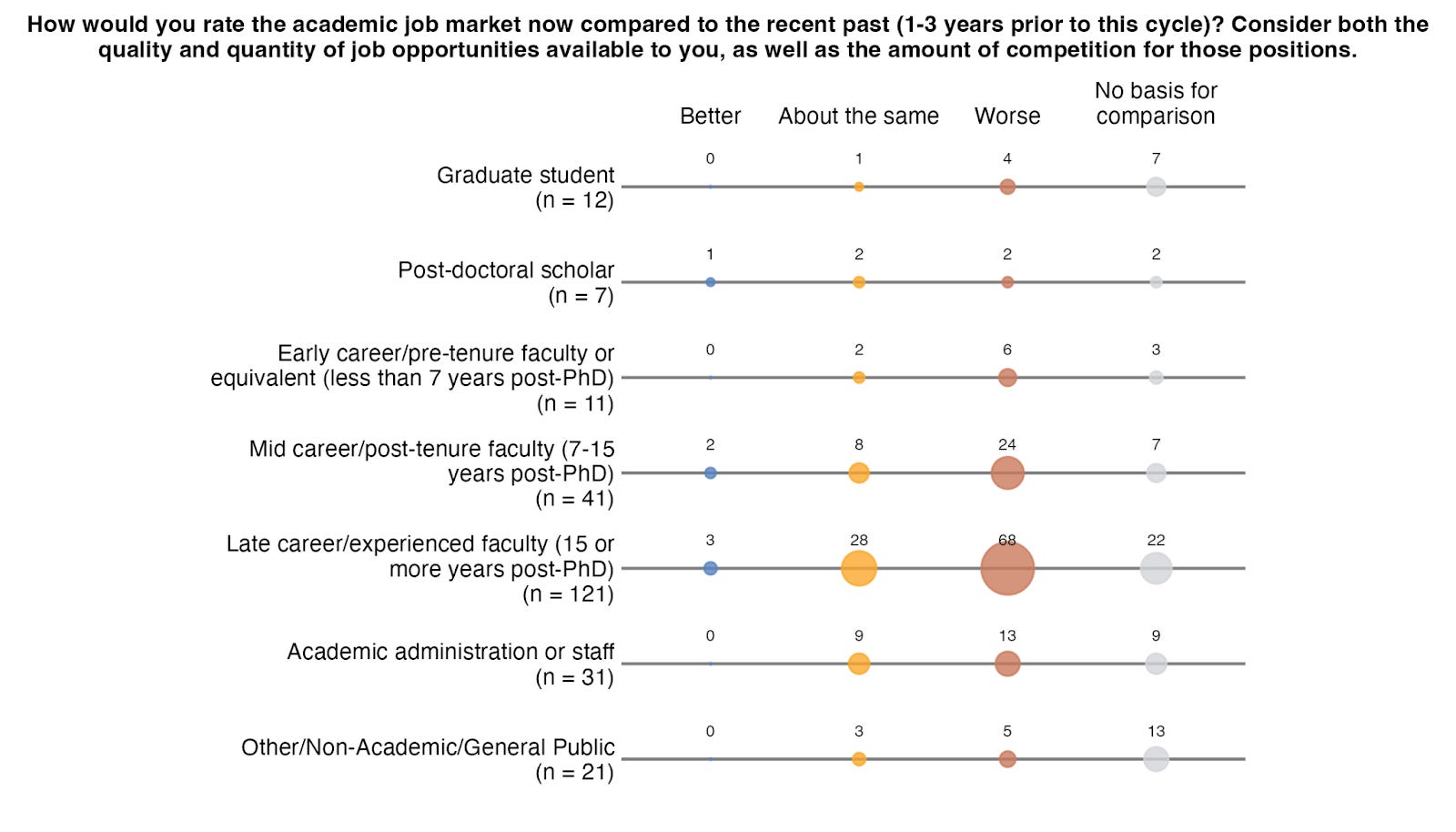
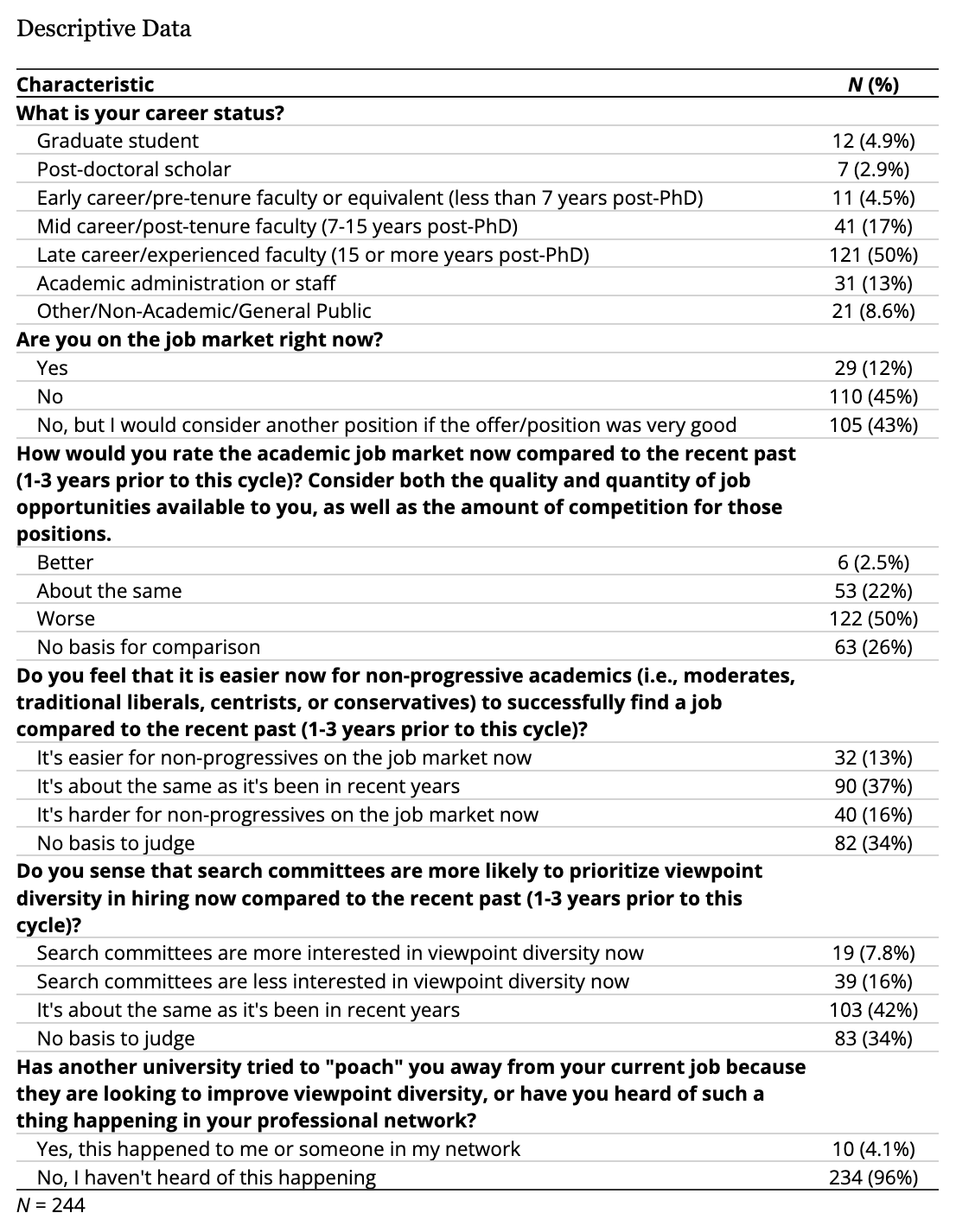
First we asked respondents about the job market in general compared to recent years. Exactly half (50%) rated the market as worse than prior cycles, while 22% rated it as about the same, and only 2.5% rated it as better. So overall, the “vibes” aren’t great as far as hiring in general. This makes sense when considering that universities are tightening their belts given some drastic federal cuts.
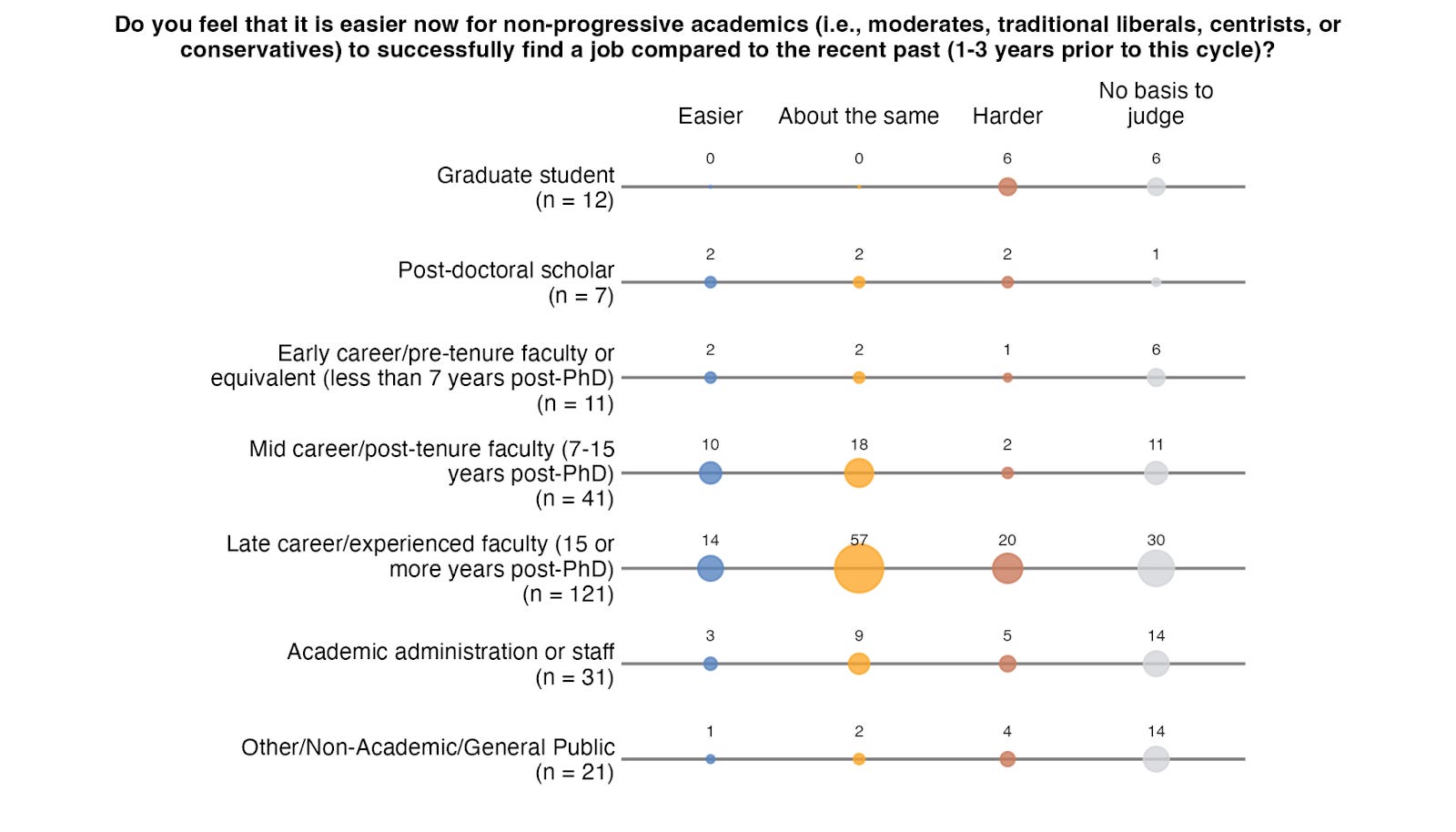
Then we asked respondents to consider whether the academic job market was friendlier towards non-progressive academics (center-left, moderate, conservative). Thinking about the climate for those folks, the largest share (37%) reported thinking it’s about the same as it has been in recent years. Others were roughly split between those who think it’s easier for non-progressives (13%) and those who think it’s harder (16%).
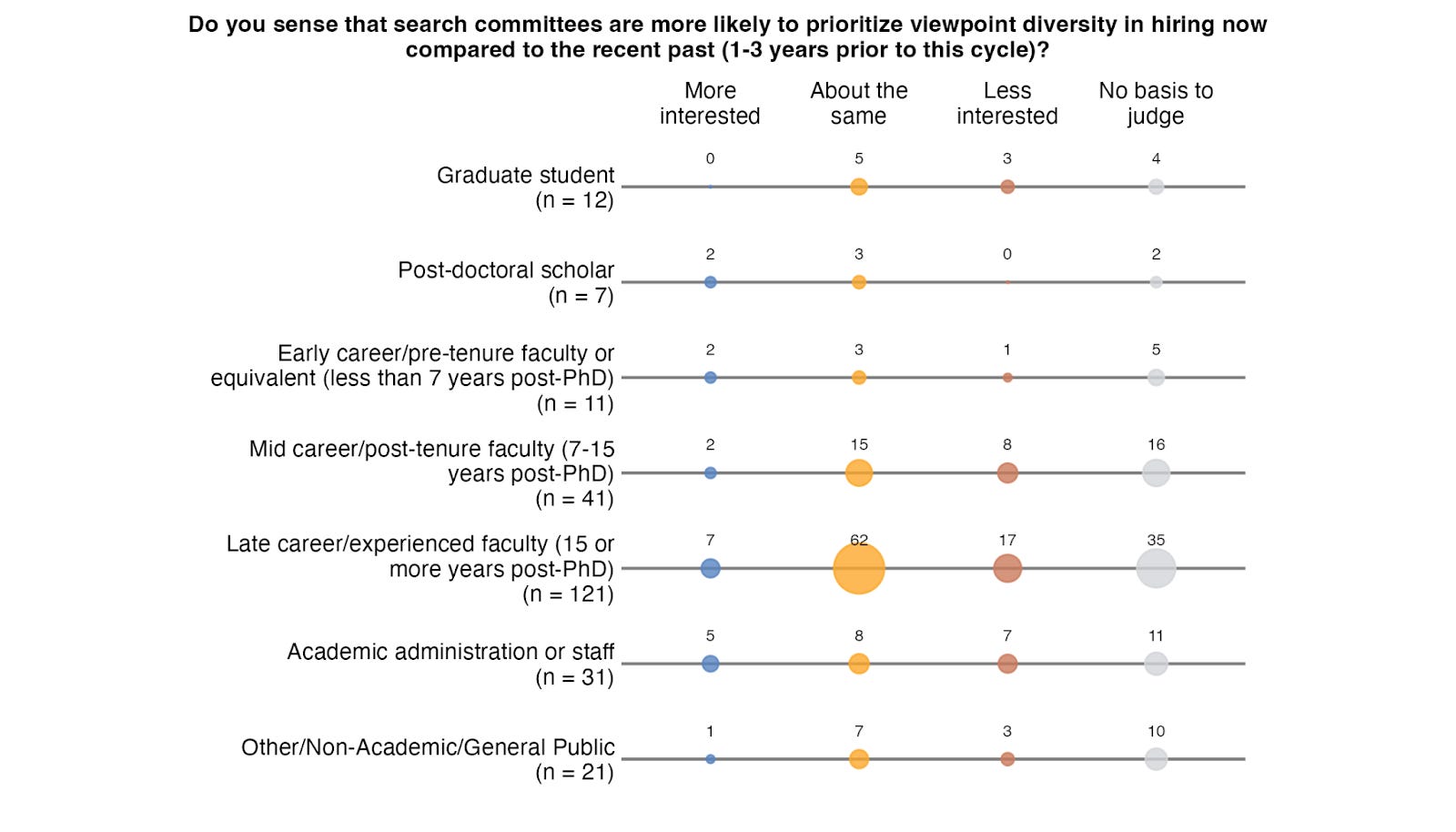
We next asked respondents for their impressions of search committees’ interest in viewpoint diversity. The largest share (42%) thought that interest in viewpoint diversity is about the same as it has been. The next largest group was respondents who thought committees are less interested in viewpoint diversity (16%), followed by 7.8% who thought committees are more interested. (It’s worth noting that 26-34% of respondents reported having no basis to judge each of these things about the market; when excluding them, the share of respondents answering “worse” for each of the preceding questions increases to over half.)
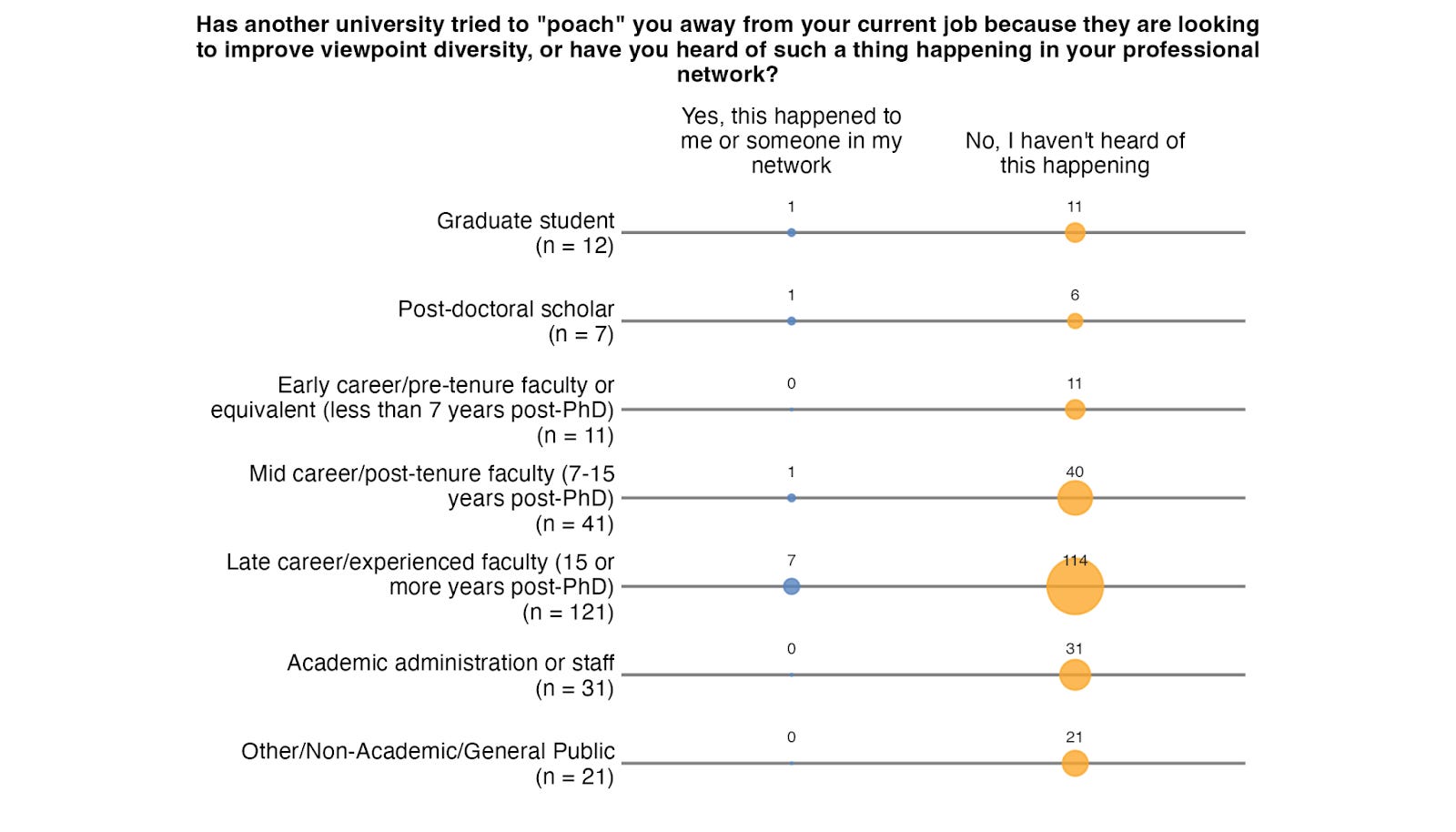
Finally, poaching scholars in an effort to increase viewpoint diversity doesn’t seem to be widespread. Only 4% of respondents reported it happening to them or someone in their professional network. Still, this would be considered anecdotal evidence, even if it’s occurring rarely. Perhaps it will catch on and become more of a thing in future years, assuming a healthier budgetary environment.
So what can we take away from these numbers? Overall, the job market vibes aren’t that great, so it wouldn’t make sense to call the period we’re currently in a hiring “boom” for anyone, conservatives least of which. For the most part, respondents indicated that it’s business as usual in terms of prioritizing viewpoint diversity and in terms of the ease for non-progressives to land faculty positions. Of those who detect any kind of change, they appear divided between those who perceive negative change (harder for non-progressives and less interest in viewpoint diversity) versus those who perceive positive change (easier for non-progressives and more interest in viewpoint diversity).
Since this is an informal member email survey, we can’t extrapolate to the whole population of academics. But at the very least, the survey responses suggest we don’t have good evidence that academic hiring priorities have changed in a systemic way. That said, there may be a different set of priorities (pro-viewpoint diversity and pro-conservative) happening within civic centers, which sometimes operate in a different way than traditional academic departments. It remains to be seen how civic center hiring priorities will evolve alongside potential changes in hiring within traditional academic departments.
That doesn’t mean that there isn’t anecdotal evidence of some departments here and there getting creative and trying new things, but overall, they are the exceptions that prove the rule. Our data pour some cold water on the idea of a “conservative hiring boom.”


Where is the search for truth in all of this? Isn’t this fundamental to scholarship and life itself?